
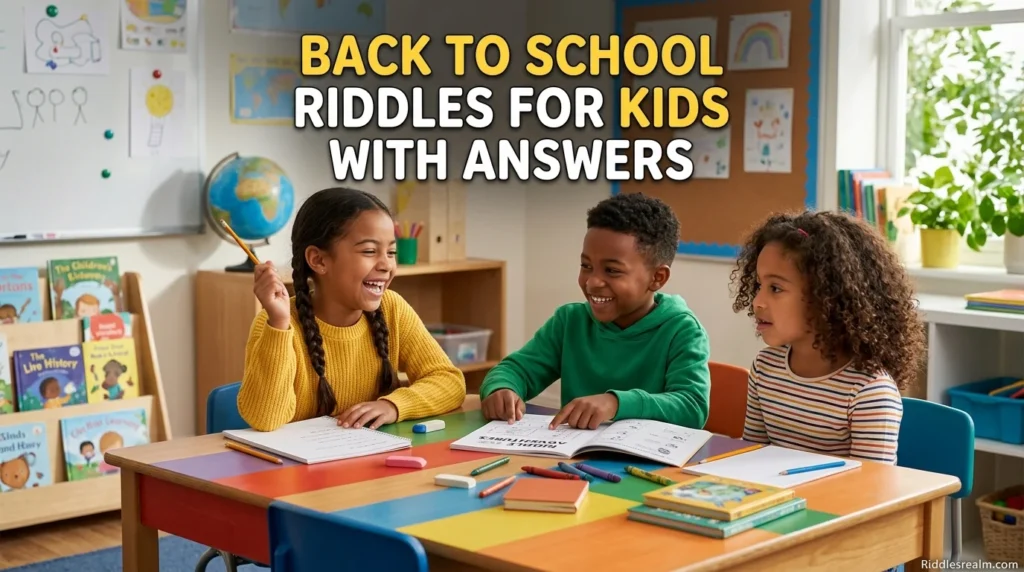
The start of a new school year brings fresh notebooks, sharpened pencils, new teachers, and exciting learning adventures. However, it can also bring a few first-day jitters. One of the best ways to help children feel excited about returning to class is through back to school riddles for kids with answers.
Riddles combine fun and learning in a way that captures children’s attention. They encourage critical thinking, improve problem-solving skills, and create memorable classroom moments. Whether you are a teacher looking for engaging icebreakers, a parent planning educational activities, or a student who loves brain teasers, these school-themed riddles can make the back-to-school season much more enjoyable.
Moreover, educational riddles help children practice reasoning while having fun. As a result, they strengthen memory, boost creativity, and encourage teamwork. Throughout this guide, you will discover a wide variety of school riddles, funny puzzle questions, logic puzzles, and classroom brain teasers suitable for different age groups.
Why Back to School Riddles Are Great for Kids
School riddles are more than simple entertainment. They provide valuable learning opportunities while keeping children engaged.
Benefits of School-Themed Riddles
- Improve critical thinking skills
- Encourage creative problem-solving
- Build vocabulary and language skills
- Strengthen memory retention
- Promote classroom participation
- Create positive learning experiences
- Help reduce first-day school anxiety
- Encourage teamwork and communication
Additionally, teachers often use guessing games and word puzzles as classroom warm-up activities. These activities help students focus and prepare for learning.
How Riddles Support Learning
Riddles require children to analyze clues, think creatively, and connect ideas. Consequently, they develop important cognitive skills that support academic success.
When students solve tricky riddles, they learn to:
- Examine information carefully
- Consider multiple possibilities
- Draw logical conclusions
- Think outside the box
- Improve reading comprehension
Therefore, back-to-school riddles serve as both educational tools and entertainment activities.
Easy Back to School Riddles for Kids
These beginner-friendly riddles are perfect for younger children and elementary students.
1. What has pages but isn’t a tree?
Answer: A book
2. I am full of words but never speak. What am I?
Answer: A dictionary
3. What school item gets shorter every day?
Answer: A pencil
4. I carry books but cannot read. What am I?
Answer: A backpack
5. What has numbers and helps with math?
Answer: A calculator
6. What room has no doors or windows in a school?
Answer: A classroom mushroom (wordplay)
7. What writes but never talks?
Answer: A pen
8. What has an eraser on one end and helps you write?
Answer: A pencil
9. I ring loudly but have no mouth. What am I?
Answer: A school bell
10. What can be opened but is not a door?
Answer: A book
Funny Back to School Riddles
Children love funny riddles because they combine humor with clever thinking.
11. Why did the pencil visit the principal?
Answer: Because it needed sharpening up.
12. Why was the math book sad?
Answer: Because it had too many problems.
13. Why did the student eat his homework?
Answer: Because the teacher said it was a piece of cake.
14. Why was the ruler always calm?
Answer: Because it knew how to keep things straight.
15. Why did the notebook go to school?
Answer: To improve its writing skills.
16. Why did the computer wear glasses?
Answer: Because it lost its website.
17. Why was the teacher carrying a ladder?
Answer: To reach higher education.
18. Why did the chalk feel important?
Answer: Because it always made a point.
19. Why did the backpack blush?
Answer: Because it carried all the student’s secrets.
20. Why did the desk get an award?
Answer: Because it always supported students.
Classroom Brain Teasers
These educational riddles challenge students to think a little deeper.
21. What gets wetter the more it dries?
Answer: A towel
22. What has keys but cannot open locks?
Answer: A keyboard
23. What comes once in a minute, twice in a moment, and never in a thousand years?
Answer: The letter M
24. What belongs to you but others use more than you do?
Answer: Your name
25. What can travel around the world while staying in one corner?
Answer: A stamp
26. What has many teeth but cannot bite?
Answer: A comb
27. What begins with T, ends with T, and has tea inside?
Answer: A teapot
28. What has one eye but cannot see?
Answer: A needle
29. What gets bigger the more you take away?
Answer: A hole
30. What can you catch but never throw?
Answer: A cold
School Supply Riddles
School supplies make excellent subjects for puzzle questions and guessing games.
31. I erase mistakes but am not a teacher. What am I?
Answer: An eraser
32. I hold papers together but am not glue. What am I?
Answer: A paperclip
33. I help you color but am not paint. What am I?
Answer: A crayon
34. I measure lines but never draw them. What am I?
Answer: A ruler
35. I keep papers organized but am not a shelf. What am I?
Answer: A folder
36. I am used for cutting but am not a knife. What am I?
Answer: Scissors
37. I stick things together but am not tape. What am I?
Answer: Glue
38. I sharpen pencils but never write. What am I?
Answer: A sharpener
39. I store notes but am not a computer. What am I?
Answer: A notebook
40. I protect your papers but am not a box. What am I?
Answer: A binder
Math Riddles for Back to School Fun
Math riddles encourage logical thinking and make numbers more exciting.
41. What number becomes smaller when you turn it upside down?
Answer: 9 becomes 6
42. If there are five apples and you take away three, how many do you have?
Answer: Three
43. What has many numbers but isn’t a math book?
Answer: A clock
44. What is half of two plus two?
Answer: Three
45. What odd number becomes even when you remove one letter?
Answer: Seven (remove “s” to get even)
46. What comes after 99 but before 101?
Answer: 100
47. I am a number. Double me and I stay the same. What am I?
Answer: Zero
48. What number has the same number of letters as its value?
Answer: Four
49. How many months have 28 days?
Answer: All of them
50. What can add numbers but never do homework?
Answer: A calculator
Tricky School Riddles for Older Kids
Older students often enjoy more challenging riddles and logic puzzles.
51. What question can you never answer yes to?
Answer: Are you asleep?
52. What has hands but cannot clap?
Answer: A clock
53. What goes up but never comes down?
Answer: Your age
54. What can fill a room but takes up no space?
Answer: Light
55. What breaks when you say its name?
Answer: Silence
56. What has a neck but no head?
Answer: A bottle
57. What runs but never walks?
Answer: Water
58. What is always in front of you but cannot be seen?
Answer: The future
59. What has words but never speaks?
Answer: A book
60. What comes down but never goes up?
Answer: Rain
First Day of School Icebreaker Riddles
Icebreaker riddles help students feel comfortable and encourage interaction.
61. What is a student’s favorite place to swim?
Answer: The school of fish
62. Why did the student bring a ladder to class?
Answer: To reach higher grades
63. Why did the pencil win an award?
Answer: Because it drew attention
64. What kind of school do surfers attend?
Answer: Boarding school
65. Why did the teacher wear sunglasses?
Answer: Because the students were bright
66. Why did the backpack join the club?
Answer: To make new friends
67. Why was the classroom so noisy?
Answer: Because the lessons were buzzing with excitement
68. What subject does a snake enjoy most?
Answer: Hiss-tory
69. Why was the student excited about school?
Answer: Because every day brought a new lesson
70. What did the notebook say on the first day?
Answer: Time to start a new chapter
Read more https://riddlesrealm.com/trick-questions-with-answers/
Back to School Riddles by Difficulty
The table below helps teachers and parents choose appropriate riddles.
Difficulty LevelAge GroupBest UseEasy5–8 YearsClassroom warmupsMedium8–11 YearsGroup activitiesChallenging11–14 YearsCritical thinking exercisesAdvancedTeens & AdultsLogic competitionsMixedAll AgesFamily game nights
How Teachers Can Use School Riddles
Teachers often use educational riddles to create engaging lessons.
Morning Warm-Up Activities
Start each day with a quick riddle. This approach helps students transition into learning mode.
Classroom Competitions
Divide students into teams and reward correct answers. Consequently, participation increases.
Brain Break Sessions
Use short puzzle questions between lessons to refresh students’ minds.
Critical Thinking Exercises
Discuss how students arrived at their answers. This process helps strengthen reasoning skills.
Bulletin Board Challenges
Post a new riddle every week and invite students to submit answers.
How Parents Can Use Back to School Riddles
Parents can make learning enjoyable outside the classroom as well.
During Car Rides
Riddles keep children entertained while encouraging active thinking.
At Dinner Time
Family-friendly riddles spark conversations and laughter.
During Homework Breaks
A quick brain teaser can help children recharge mentally.
Before Bedtime
Fun puzzles create positive learning habits while ending the day on a cheerful note.
Tips for Creating Your Own School Riddles
Making original riddles can be just as fun as solving them.
Choose a School Object
Start with common classroom items like pencils, books, desks, or backpacks.
Focus on Unique Features
Think about what makes the object special.
Add Clever Clues
Use wordplay, hints, or comparisons.
Keep the Language Simple
Children should understand the clues without difficulty.
Test the Riddle
Ask a child to solve it and see if the clues make sense.
For example:
“I carry your books every day, but I never read a page. What am I?”
Answer: A backpack
Key Takeaways
- Back to school riddles make learning fun and interactive.
- Riddles improve critical thinking and problem-solving skills.
- School-themed brain teasers help students feel comfortable in class.
- Teachers can use riddles as warm-ups, icebreakers, and educational activities.
- Parents can incorporate riddles into daily routines.
- Different difficulty levels allow children of all ages to participate.
- Educational guessing games combine entertainment with learning.
Frequently Asked Questions
What are back to school riddles for kids?
Back to school riddles are school-themed puzzle questions designed to entertain children while encouraging critical thinking and learning.
Why are riddles good for students?
Riddles help students improve reasoning, creativity, vocabulary, memory, and problem-solving skills. They also make learning more engaging.
What age group enjoys school riddles?
Children of almost every age enjoy riddles. Younger kids prefer simple guessing games, while older students often enjoy challenging logic puzzles and brain teasers.
How can teachers use riddles in the classroom?
Teachers can use riddles as icebreakers, warm-up activities, brain breaks, team competitions, and critical thinking exercises.
Are riddles educational?
Yes. Educational riddles encourage analysis, reasoning, reading comprehension, and creative thinking while keeping learning enjoyable.
What makes a good school riddle?
A good school riddle uses clear clues, simple language, and a clever answer. It should challenge children without causing frustration.
Can riddles improve problem-solving skills?
Absolutely. Solving riddles teaches children how to analyze information, identify patterns, and think logically.
Where can I use back to school riddles?
You can use them in classrooms, homeschool lessons, family game nights, school assemblies, birthday parties, road trips, and educational activities.
Conclusion
These back to school riddles for kids with answers offer an exciting way to combine learning and fun at the beginning of the school year. Whether you use them as classroom icebreakers, educational brain teasers, family-friendly guessing games, or entertaining party activities, riddles help children develop valuable thinking skills while enjoying themselves.
Furthermore, school-themed puzzle questions encourage creativity, strengthen problem-solving abilities, and make learning feel like an adventure. As students return to class, these fun puzzles can help create a positive atmosphere filled with curiosity, laughter, and discovery.
The next time you need an engaging classroom activity or a fun educational challenge, try sharing a few of these school riddles. You may be surprised by how quickly they spark excitement, conversation, and a love of learning.

Joseph Morgan is an enigmatist known for creating clever and mysterious riddles. Born in Scotland, he spent his life challenging people to think deeply through puzzles and brainteasers. He became famous for his creative mind and love of mystery.