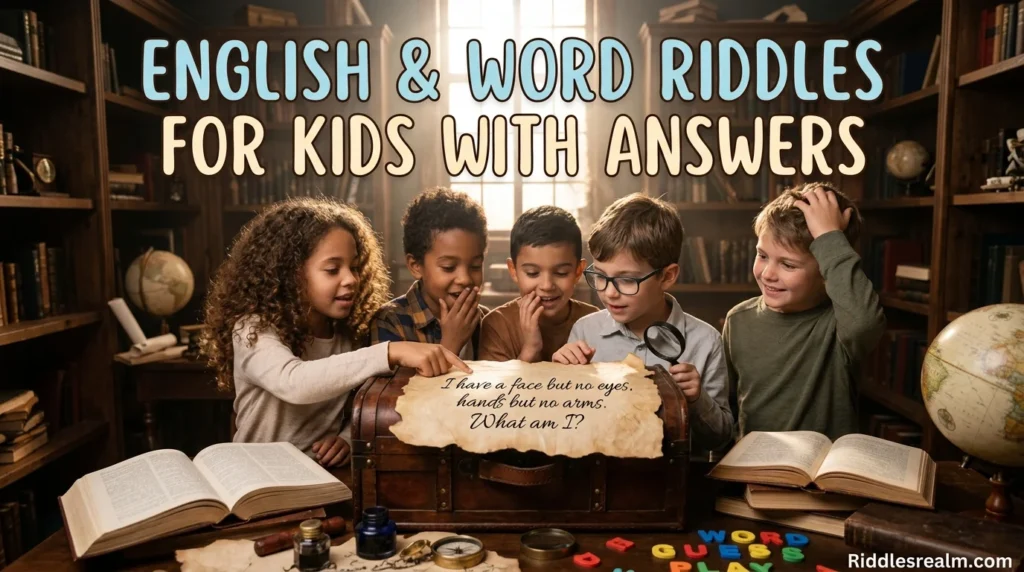
Riddles have entertained children for generations. They make learning fun, encourage curiosity, and help young minds develop critical thinking skills. Whether you are a parent, teacher, or caregiver, English and word riddles offer an enjoyable way to improve vocabulary, spelling, reading comprehension, and problem-solving abilities.
Moreover, kids love the challenge of guessing answers before their friends do. As a result, riddles become powerful educational tools that feel more like games than lessons. From simple word puzzles to clever brain teasers, these activities keep children engaged while helping them learn new language skills.
In this guide, you will find a large collection of English & Word Riddles for Kids with Answers, along with tips, benefits, and ideas for using them at home, in the classroom, during family gatherings, and at parties.
Why English and Word Riddles Are Great for Kids
Word riddles do much more than provide entertainment. They encourage children to think creatively and analyze information from different angles.
Benefits of Word Riddles for Children
- Improve vocabulary and language skills
- Strengthen critical thinking abilities
- Enhance reading comprehension
- Develop logical reasoning
- Encourage creative thinking
- Increase concentration and focus
- Build confidence through problem-solving
- Create fun learning experiences
Furthermore, educational riddles help children recognize patterns in language. They also teach kids how words can have multiple meanings, which improves communication skills over time.
Easy English Riddles for Beginners
These simple riddles are perfect for younger children who are just starting to explore word games.
1. What has many letters but never sends a message?
Answer: A post office.
2. What has a head and a tail but no body?
Answer: A coin.
3. What gets wetter the more it dries?
Answer: A towel.
4. What has four wheels and flies?
Answer: A garbage truck.
5. What has one eye but cannot see?
Answer: A needle.
6. What comes down but never goes up?
Answer: Rain.
7. What has hands but cannot clap?
Answer: A clock.
8. What can run but never walks?
Answer: Water.
9. What goes around the world while staying in one corner?
Answer: A stamp.
10. What can you catch but not throw?
Answer: A cold.
These beginner-friendly puzzle questions help children gain confidence while learning how riddles work.
Read more https://riddlesrealm.com/printable-riddles-for-kids-activities/
Fun Word Riddles for Kids
Word riddles focus on language, spelling, and vocabulary. Therefore, they are excellent tools for language development.
11. What word becomes shorter when you add two letters to it?
Answer: Short.
12. What word starts with E, ends with E, and contains one letter?
Answer: Envelope.
13. What five-letter word becomes shorter when you add two letters?
Answer: Short.
14. What word is always spelled incorrectly in the dictionary?
Answer: Incorrectly.
15. What English word has three consecutive double letters?
Answer: Bookkeeper.
16. What word begins and ends with an E but contains only one letter?
Answer: Envelope.
17. Remove one letter from me and I sound the same. Remove another and I still sound the same. What am I?
Answer: Postman.
18. What word contains all five vowels in order?
Answer: Abstemious.
19. What word can you read the same upside down?
Answer: SWIMS.
20. What starts with T, ends with T, and has T inside?
Answer: Teapot.
Word puzzles like these make language learning enjoyable and memorable.
Funny English Riddles for Kids
Children often enjoy riddles that make them laugh. Consequently, funny riddles keep kids engaged longer.
21. Why did the student eat his homework?
Answer: Because the teacher said it was a piece of cake.
22. Why can’t a nose be twelve inches long?
Answer: Because then it would be a foot.
23. What kind of tree fits in your hand?
Answer: A palm tree.
24. Why was the math book sad?
Answer: Because it had too many problems.
25. What has ears but cannot hear?
Answer: A cornfield.
26. Why did the bicycle fall over?
Answer: Because it was two-tired.
27. What kind of room has no doors or windows?
Answer: A mushroom.
28. Why did the scarecrow win an award?
Answer: Because he was outstanding in his field.
29. What has a face and two hands but no arms or legs?
Answer: A clock.
30. Why did the cookie go to the doctor?
Answer: Because it felt crummy.
Funny riddles combine humor and learning, making them ideal family-friendly riddles.
Tricky Word Riddles That Make Kids Think
These challenging riddles encourage lateral thinking and deeper reasoning.
31. What comes once in a minute, twice in a moment, but never in a thousand years?
Answer: The letter M.
32. What has keys but cannot open locks?
Answer: A piano.
33. What belongs to you but is used more by others?
Answer: Your name.
34. What can fill a room but takes up no space?
Answer: Light.
35. What gets bigger the more you take away?
Answer: A hole.
36. What can travel around the world while staying in the same place?
Answer: A stamp.
37. What breaks without falling?
Answer: Daybreak.
38. What has many teeth but cannot bite?
Answer: A comb.
39. What can be cracked, made, told, and played?
Answer: A joke.
40. What has a neck but no head?
Answer: A bottle.
These logic puzzles improve reasoning and encourage children to think beyond obvious answers.
Vocabulary-Building Riddles for Kids
Vocabulary riddles help children learn new words while having fun.
41. I am a word that means happy. I start with J. What am I?
Answer: Joyful.
42. I am the opposite of dark. What am I?
Answer: Light.
43. I mean very large and start with G.
Answer: Giant.
44. I rhyme with cat and sit on your head.
Answer: Hat.
45. I start with B and carry books to school.
Answer: Backpack.
46. I begin with S and shine in the sky.
Answer: Sun.
47. I begin with F and swim in water.
Answer: Fish.
48. I start with T and tell time.
Answer: Timer or clock.
49. I begin with C and help you communicate.
Answer: Cell phone.
50. I start with P and write on paper.
Answer: Pencil.
Challenging Riddles for Older Kids
Older children often enjoy tougher brain teasers and mystery puzzles.
51. The more you have of me, the less you see. What am I?
Answer: Darkness.
52. What has cities but no houses, rivers but no water, and forests but no trees?
Answer: A map.
53. What can you hold without touching it?
Answer: Your breath.
54. What begins with an E but only contains one letter?
Answer: Envelope.
55. What is so fragile that saying its name breaks it?
Answer: Silence.
56. What goes up but never comes down?
Answer: Your age.
57. What has an end but no beginning?
Answer: The letter E.
58. What can you keep after giving it away?
Answer: Your word.
59. What question can you never answer yes to?
Answer: Are you asleep?
60. What comes at the end of everything?
Answer: The letter G.
These IQ challenges help older children sharpen analytical thinking.
English Riddles Based on Letters and Sounds
Language-based riddles are excellent for teaching phonics and spelling.
61. What letter comes after A but before C?
Answer: B.
62. What begins with P, ends with E, and contains thousands of letters?
Answer: Post office.
63. What letter is found in every day of the week?
Answer: D.
64. What letter is always tired?
Answer: Z.
65. What starts with a P, ends with an E, and is full of people?
Answer: Police station.
66. Which letter can drink water?
Answer: C.
67. Which letter is a vegetable?
Answer: P (pea).
68. Which letter is a body of water?
Answer: C (sea).
69. Which letter is a question?
Answer: Y.
70. Which letter is an insect?
Answer: B (bee).
Family-Friendly Riddles for Group Activities
Families can enjoy these riddles during game nights, road trips, and gatherings.
71. What has many rings but no fingers?
Answer: A telephone.
72. What has legs but cannot walk?
Answer: A table.
73. What kind of band never plays music?
Answer: A rubber band.
74. What has words but never speaks?
Answer: A book.
75. What can you hear but never see?
Answer: Your voice.
76. What has a bottom at the top?
Answer: Your legs.
77. What can be full of holes and still hold water?
Answer: A sponge.
78. What goes through cities and fields but never moves?
Answer: A road.
79. What is easy to lift but hard to throw?
Answer: A feather.
80. What has a bark but no bite?
Answer: A tree.
Educational Word Games and Riddle Activities
Riddles become even more valuable when combined with educational activities.
Classroom Activities
Teachers can use riddles to:
- Start morning lessons
- Introduce vocabulary words
- Encourage class participation
- Improve reading skills
- Support language arts instruction
Home Learning Activities
Parents can use riddles to:
- Reduce screen time
- Encourage family interaction
- Improve communication skills
- Build confidence
- Make learning enjoyable
Party Game Ideas
Word riddles work perfectly for:
- Birthday parties
- Family reunions
- School events
- Sleepovers
- Holiday gatherings
Comparison of Riddle Types for Kids
Riddle TypeMain BenefitDifficulty LevelWord RiddlesVocabulary growthEasy to MediumLogic PuzzlesCritical thinkingMediumBrain TeasersProblem-solvingMedium to HardFunny RiddlesEntertainmentEasyMystery PuzzlesCreative thinkingMediumLetter RiddlesSpelling skillsEasyLateral Thinking PuzzlesAnalytical reasoningHard
Tips for Solving Word Riddles
Children can improve their riddle-solving skills by following a few simple strategies.
Read Carefully
Many riddles contain clues hidden within the wording. Therefore, reading slowly often helps.
Think About Multiple Meanings
Words sometimes have more than one meaning. As a result, the answer may not be as obvious as it first appears.
Look for Wordplay
Many word puzzles rely on puns, sound-alike words, and clever language tricks.
Eliminate Impossible Answers
If one possibility does not fit all clues, cross it off and continue exploring.
Practice Regularly
The more riddles kids solve, the better they become at recognizing patterns and solving problems.
Why Riddles Improve Critical Thinking Skills
Riddles challenge children to process information differently than traditional schoolwork. Instead of memorizing facts, they must analyze clues, identify patterns, and make logical connections.
Furthermore, brain teasers encourage flexible thinking. Children learn that some problems have unexpected solutions. Consequently, they become more adaptable thinkers both inside and outside the classroom.
Research also suggests that puzzle-solving activities strengthen memory, concentration, and reasoning abilities. Therefore, riddles can play an important role in cognitive development.
Key Takeaways
- English and word riddles help children develop language skills.
- Riddles improve vocabulary, reading, and comprehension.
- Brain teasers strengthen critical thinking and logic.
- Funny riddles keep learning entertaining.
- Family-friendly riddles encourage social interaction.
- Educational riddles support classroom and home learning.
- Regular puzzle-solving builds confidence and creativity.
Frequently Asked Questions
What are English and word riddles for kids?
English and word riddles are puzzle questions that use language, vocabulary, spelling, or wordplay to challenge children and encourage problem-solving.
Why are riddles good for children?
Riddles improve critical thinking, reading comprehension, vocabulary, creativity, concentration, and logical reasoning skills.
What age is best for word riddles?
Children as young as five can enjoy simple riddles. However, older kids often prefer more challenging brain teasers and logic puzzles.
How do riddles help with vocabulary?
Riddles expose children to new words, multiple meanings, and creative language use. As a result, vocabulary grows naturally through play.
Are riddles educational?
Yes. Educational riddles support literacy, critical thinking, communication, and problem-solving skills while keeping learning enjoyable.
Can riddles be used in classrooms?
Absolutely. Teachers often use riddles as warm-up activities, vocabulary exercises, reading comprehension tasks, and team-building games.
What are the easiest riddles for young children?
Simple riddles with familiar objects, animals, and everyday experiences work best for younger children because they are easier to understand and solve.
How often should kids practice riddles?
A few riddles each day can provide consistent mental exercise while keeping the activity fun and engaging.
Conclusion
English & Word Riddles for Kids with Answers offer the perfect combination of education and entertainment. They help children strengthen vocabulary, improve problem-solving skills, and develop critical thinking in a fun and interactive way. Whether you choose funny riddles, word puzzles, logic puzzles, brain teasers, or guessing games, these activities encourage creativity and lifelong learning.
Moreover, riddles create opportunities for families, teachers, and children to learn together. By making riddles a regular part of daily activities, kids can build confidence, sharpen their minds, and discover that learning can be exciting. The next time you want a fun educational activity, challenge your children with a few clever riddles and watch their imaginations come to life.

A playful wordsmith with a knack for misdirection, I craft riddles that tease the brain. My puzzles blend clever clues, clean logic, and a dash of humor—built to challenge beginners and stump seasoned solvers alike. From short, punchy brainteasers to layered mysteries with hidden meanings, I love turning everyday ideas into mind-bending questions that invite curiosity and conversation. When I’m not twisting words into puzzles, I’m collecting strange facts, testing new clue styles, and fine-tuning the art of fair—but fiendish—fun.