
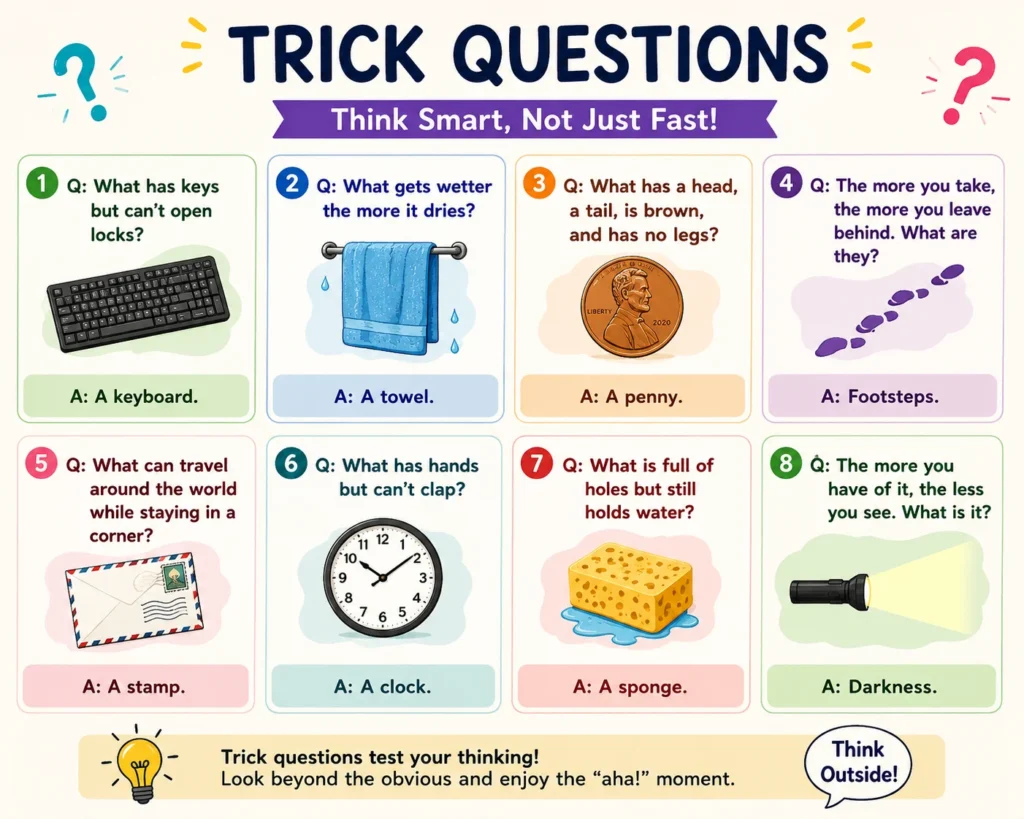
Trick questions are more than simple entertainment. They challenge assumptions, sharpen thinking skills, and encourage people to look beyond the obvious. Whether you’re playing party games, improving critical thinking, entertaining friends, or testing your problem-solving abilities, clever questions can create memorable moments and spark interesting conversations.
Unlike traditional quiz questions, trick questions often rely on wordplay, hidden meanings, misleading details, or unexpected logic. As a result, they push people to think differently and develop stronger reasoning skills.
In this comprehensive guide, you’ll discover a wide variety of brain teasers, puzzle questions, funny examples, challenging mind games, and practical tips for solving them. By the end, you’ll have a collection of questions suitable for kids, adults, classrooms, family gatherings, and social events.
What Are Trick Questions?
Trick questions are questions designed to encourage unconventional thinking. Instead of testing factual knowledge alone, they often test observation, reasoning, and attention to detail.
Many people answer too quickly because they focus on what they expect the question to mean rather than what it actually says.
These questions frequently appear in:
- Brain teasers
- Logic puzzles
- Educational activities
- Family game nights
- Party games
- Classroom exercises
- IQ challenges
- Team-building events
Because they combine fun with learning, they remain one of the most popular forms of mental entertainment.
Why People Love Trick Questions
Several factors explain their popularity.
They Challenge Assumptions
Most people rely on patterns and habits when solving problems. However, these questions force participants to slow down and analyze information carefully.
They Improve Critical Thinking
When someone solves a tricky question, they often practice:
- Logical reasoning
- Observation skills
- Creative thinking
- Decision-making
- Problem-solving skills
They Create Entertainment
Additionally, the surprising answers often produce laughter and friendly competition.
They Work for All Ages
Whether you’re looking for educational riddles for children or challenging puzzles for adults, there are options for every age group.
Benefits of Solving Clever Questions
Improved Mental Agility
Regular exposure to puzzles and riddles helps keep the mind active.
Better Problem-Solving Skills
People learn to examine situations from multiple perspectives.
Enhanced Creativity
Many puzzle questions reward unconventional thinking.
Stronger Memory
Repeated mental exercises can strengthen recall and concentration.
Social Engagement
Furthermore, these questions are excellent conversation starters.
Types of Trick Questions
Understanding different categories helps people solve them more effectively.
Wordplay Questions
These rely on language and multiple meanings.
Example:
Question: What has four wheels and flies?
Answer: A garbage truck.
The word “flies” refers to insects rather than flying through the air.
Logic-Based Questions
These require reasoning instead of factual knowledge.
Example:
Question: How many months have 28 days?
Answer: All twelve months.
Observation Questions
These test attention to detail.
Example:
Question: If there are three apples and you take away two, how many do you have?
Answer: Two. You took them.
Mathematical Trick Questions
These often exploit assumptions about numbers.
Example:
Question: A farmer has 17 sheep. All but 9 die. How many remain?
Answer: 9.
Lateral Thinking Questions
These encourage creative reasoning.
Example:
Question: What can travel around the world while staying in one corner?
Answer: A stamp.
Easy Trick Questions for Beginners
These family-friendly riddles are great for warming up.
Question Collection
QuestionAnswerWhat gets wetter as it dries?A towelWhat has hands but cannot clap?A clockWhat has a neck but no head?A bottleWhat comes down but never goes up?RainWhat has one eye but cannot see?A needleWhat can you catch but not throw?A coldWhat has keys but can’t open locks?A pianoWhat has many teeth but cannot bite?A combWhat belongs to you but others use more?Your nameWhat runs but never walks?Water
These examples demonstrate how simple wording can create confusion.
Funny Trick Questions That Make Everyone Laugh
Humor makes guessing games even more enjoyable.
Hilarious Questions
Why can’t a bicycle stand by itself?
Because it is two-tired.
What kind of room has no doors or windows?
A mushroom.
What goes up and down but never moves?
A staircase.
What starts with T, ends with T, and has T in it?
A teapot.
Why did the math book look sad?
Because it had too many problems.
What building has the most stories?
The library.
What has an endless supply of letters?
The post office.
Why do ducks have feathers?
To cover their quacks.
What has a face and two hands but no arms or legs?
A clock.
Why don’t skeletons fight each other?
They don’t have the guts.
Challenging Questions for Adults
Adults often enjoy more complex brain teasers and logic puzzles.
Difficult Questions
Which weighs more: a pound of feathers or a pound of bricks?
Neither. Both weigh one pound.
How far can a fox run into the woods?
Halfway. After that, it is running out.
What can fill a room but takes up no space?
Light.
What is always in front of you but cannot be seen?
The future.
If an electric train travels south, which way does the smoke go?
Electric trains don’t produce smoke.
What comes once in a minute, twice in a moment, but never in a thousand years?
The letter M.
What breaks without being touched?
A promise.
What can you hold without ever touching it?
A conversation.
What can be cracked, made, told, and played?
A joke.
What gets bigger the more you take away?
A hole.
Hard Logic Questions and Answers
These questions test reasoning skills more than knowledge.
Logic Challenge Collection
A man was born in 1990 and died in 1985. How is this possible?
1985 was a room number.
What occurs once every second, twice every week, and never in a year?
The letter E.
If two’s company and three’s a crowd, what are four and five?
Nine.
What five-letter word becomes shorter when you add two letters?
Short.
What can you keep after giving it away?
Your word.
What question can you never answer yes to?
Are you asleep?
What is so fragile that saying its name breaks it?
Silence.
What goes through cities and fields but never moves?
A road.
What can be seen once in a year and twice in a week?
The letter E.
What has branches but no fruit, leaves, or trunk?
A bank.
Trick Questions for Kids
Children enjoy simple but surprising puzzle questions.
Kid-Friendly Collection
What has ears but cannot hear?
A cornfield.
What kind of tree can you carry in your hand?
A palm.
What has four legs but cannot walk?
A table.
What begins with an E but contains only one letter?
An envelope.
What is full of holes but still holds water?
A sponge.
What has a thumb and four fingers but is not alive?
A glove.
What goes up when rain comes down?
An umbrella.
What has words but never speaks?
A book.
What kind of band never plays music?
A rubber band.
What gets sharper the more you use it?
Your brain.
Family-Friendly Questions for Game Night
These questions work well for groups.
Popular Family Favorites
What has cities but no houses?
A map.
What can travel around the world while staying in one spot?
A stamp.
What comes before thunder and after lightning?
The letter N.
What is easy to lift but difficult to throw?
A feather.
What has an eye but cannot see?
A needle.
What kind of coat is always wet?
A coat of paint.
What gets broken without being held?
A promise.
What can run but never walks?
Water.
What has a head and a tail but no body?
A coin.
What goes around the world but stays in a corner?
A stamp.
How to Solve Tricky Questions Faster
Many people struggle because they rush to answer. Fortunately, several strategies can help.
Listen Carefully
Pay attention to every word.
Avoid Assumptions
Many questions are designed to exploit assumptions.
Look for Double Meanings
Words often have multiple definitions.
Focus on Exact Wording
Small details frequently contain clues.
Think Creatively
Lateral thinking puzzles reward unconventional approaches.
Slow Down
The obvious answer is often incorrect.
Common Mistakes People Make
Understanding these mistakes can improve performance.
Answering Too Quickly
Fast answers often miss hidden details.
Ignoring Keywords
Words such as “all,” “only,” and “exactly” can change the meaning completely.
Overthinking Simple Questions
Sometimes the simplest interpretation is correct.
Assuming Facts Not Given
Stick only to the information presented.
Using Trick Questions in Education
Teachers increasingly use educational riddles and puzzle activities because they offer numerous benefits.
Classroom Advantages
- Encourages participation
- Improves attention
- Builds reasoning skills
- Promotes teamwork
- Makes learning enjoyable
Subjects That Benefit
- Mathematics
- Language Arts
- Science
- Social Studies
- Critical Thinking Programs
Students often retain information better when learning feels like a game.
Using Trick Questions at Parties and Events
Party games become more engaging when brain teasers are included.
Best Ways to Use Them
Icebreakers
Help guests interact naturally.
Team Competitions
Create friendly rivalry.
Family Gatherings
Keep all age groups entertained.
Virtual Meetings
Boost engagement during online events.
Corporate Team Building
Strengthen communication and collaboration.
The Psychology Behind Trick Questions
The popularity of mind games is rooted in cognitive science.
Pattern Recognition
Human brains naturally seek patterns.
Mental Shortcuts
People use assumptions to save mental effort.
Surprise and Reward
Unexpected answers trigger satisfaction when discovered.
Cognitive Flexibility
Regular exposure improves adaptability and creative thinking.
As a result, solving puzzles becomes both entertaining and educational.
Key Takeaways
- Trick questions challenge assumptions and encourage deeper thinking.
- They improve critical thinking and problem-solving skills.
- Different categories include wordplay, logic puzzles, observation puzzles, and lateral thinking challenges.
- They work well for classrooms, family gatherings, and party games.
- Careful reading often matters more than intelligence.
- Regular puzzle solving can strengthen cognitive abilities and creativity.
Frequently Asked Questions
What are trick questions?
They are questions designed to mislead assumptions and encourage creative or logical thinking rather than straightforward answers.
Are trick questions good for the brain?
Yes. They promote critical thinking, problem-solving skills, memory, and mental flexibility.
What is the difference between a riddle and a trick question?
A riddle typically uses clues to lead to an answer, while a trick question often relies on misleading wording or assumptions.
Why are trick questions so popular?
They combine entertainment, learning, surprise, and social interaction, making them enjoyable for people of all ages.
What are the best trick questions for adults?
Logic-based questions, lateral thinking puzzles, and challenging brain teasers are often the most popular among adults.
Can children benefit from trick questions?
Absolutely. They help develop observation skills, vocabulary, creativity, and reasoning abilities.
How do you answer tricky questions correctly?
Read carefully, avoid assumptions, focus on wording, and consider alternative interpretations.
Are trick questions used in education?
Yes. Many teachers use them to improve engagement, critical thinking, and classroom participation.
What makes a good trick question?
A good one has a simple answer hidden behind clever wording, unexpected logic, or a misleading assumption.
Can trick questions improve problem-solving skills?
Yes. Regular practice trains the brain to analyze information more carefully and think from different perspectives.
Conclusion
Trick questions remain one of the most enjoyable forms of mental entertainment because they challenge how we think rather than what we know. Whether you’re exploring brain teasers, solving logic puzzles, enjoying funny riddles, or participating in family-friendly guessing games, these clever challenges encourage creativity, observation, and critical thinking.
From simple questions for kids to difficult IQ challenges for adults, the best puzzles reward curiosity and careful reasoning. Moreover, they provide a fun way to improve cognitive skills while creating memorable experiences with friends, family, classmates, and coworkers.
The next time someone asks what appears to be a simple question, pause for a moment. The answer may be hiding in plain sight.

A modern riddle-maker who builds clever, pocket-sized puzzles with sharp wordplay and elegant misdirection. Her clues are clean, surprising, and designed to make you think twice—then smile when it clicks.