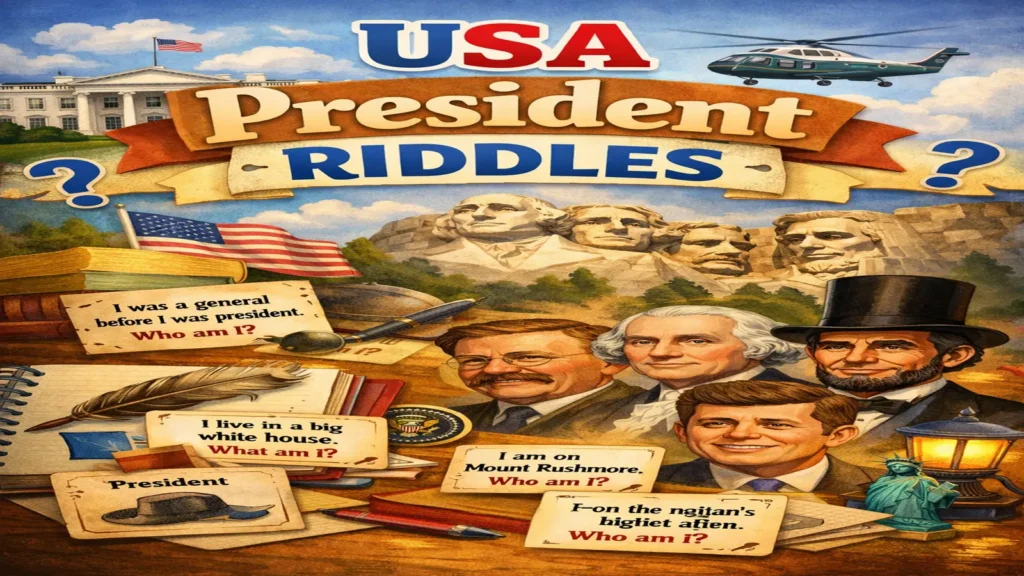
History can feel heavy when it is only names and dates. However, a clever riddle can make the same topic feel fun. This guide is for parents, teachers, students, and trivia fans who want a lighter way to explore American history. Along the way, it shows how to use riddles at home, in class, and during game night. If you want USA president riddles, this version gives you examples, tips, and simple ways to keep readers engaged.
Quick Answer
USA president riddles are short clue-based puzzles about American presidents, the White House, and famous national symbols. Usually, they work best when the answer feels fair, familiar, and fun. Good USA president riddles can teach history while still feeling playful.
TL;DR
• Presidential riddles blend history with guessing fun
• Easy clues work well for wide audiences
• Harder clues fit adults and trivia fans
• Holiday versions suit schools and families
• Modern topics need careful, neutral wording
• Fair answers keep readers coming back
What Makes a Good USA President Riddle
A strong presidential riddle points to one answer without sounding like a history test. Instead, it hints, nudges, and then surprises. As a result, the reader feels smart when the answer appears.
Trivia works in a different way. It asks directly for a fact, while a riddle hides the answer behind wordplay or images. Because of that, riddles often feel more social and memorable.
• One clear answer keeps the clue focused
• Familiar details help readers guess faster
• Short wording makes each line stronger
• Playful hints add charm and surprise
• Fair twists create better final reveals
• Real symbols make clues easier to picture
• Simple wording reaches more people
• Strong images improve memory and guessing
• Clear themes make collections feel organized
• Smart clues beat random facts
• Good rhythm helps lines sound natural
• Quick payoff makes the puzzle satisfying
Why Americans Enjoy Presidential Riddles
Many Americans already know the White House, George Washington, and Abraham Lincoln. Because of that, presidential riddles feel easy to enter. Even casual readers can join in quickly.
Also, riddles turn history into something people can share out loud. Families can guess together, and classrooms can join the fun without much setup. So the format feels useful as well as entertaining.
• They turn civics into playful challenge
• Shared history makes clues easier to follow
• Famous leaders bring instant recognition
• National landmarks create vivid mental pictures
• Family groups can solve together
• Teachers can use them as warmups
• History feels lighter through short puzzles
• Group guessing adds friendly energy
• Familiar symbols make answers feel fair
• Quick clues fit busy routines
• Readers enjoy testing what they know
• The format works across many ages
Easy USA President Riddles
Easy riddles should feel welcoming from the start. For that reason, they work best with famous names, well-known places, and clear symbols. New readers can solve a few fast and build confidence.
Below are simple examples for a broad U.S. audience. Each one aims for a quick and satisfying answer.
• First to lead the nation, I never lived in the White House. George Washington
• Wearing a stovepipe hat, I helped free slaves. Abraham Lincoln
• I stand in Washington, yet I am a house. The White House
• I am the president’s round workroom. Oval Office
• I fly the president, though I am no bird. Air Force One
• I guard presidents every day. Secret Service
• Presidents were carved into me. Mount Rushmore
• I begin each term with a promise. Oath of office
• Voters take part in me every four years. Presidential election
• I am the nation’s highest office. President
• I advise the president. Cabinet
• I stand ready to replace the president. Vice president
Hard USA President Riddles
Harder riddles should still feel fair. However, they can hide the answer with layered clues or careful wording. When done well, they slow readers down without losing them.
Older readers often enjoy this level more. Meanwhile, history fans like clues that reward patience and memory.
Serving two nonconsecutive terms, I returned to office again. Grover Cleveland
• With a big stick and soft speech, I led strongly. Theodore Roosevelt
• Before one month ended, my presidency was over. Answer: William Henry Harrison
• A huge land deal came before I saw it myself. Answer: Thomas Jefferson
• In my farewell, I warned against political parties. George Washington
• During the nation’s deepest split, I held the Union together. Abraham Lincoln
• Rather than face defeat, I chose resignation. Answer: Richard Nixon
• Through Depression and world war, I guided America. Answer: Franklin D. Roosevelt
• Moon missions became a national goal in my time. Answer: John F. Kennedy
• “The buck stops here” became my famous line. Harry Truman
• From Hollywood to the White House, my path surprised many. Answer: Ronald Reagan
• After serving once, I won the office again. Answer: Donald Trump
Funny President Riddles
Funny riddles ease the mood right away. Even when someone misses the answer, the reveal can still get a smile. Because of that, they work well in groups.
Presidential humor works best when it stays light. So a little wordplay is often enough.
• Which president loves change most? The one on coins
• Which president never loses papers? One with a strong cabinet
• Which leader likes circles at work? The Oval Office boss
• Which president travels best by pun? Air Heir One
• Which leader keeps secrets safest? One with top protection
• Which president has the busiest lawn? The White House host
• Which leader dislikes square desks? The oval-minded one
• Which president loves mountain portraits? A Rushmore favorite
• Which leader enjoys swearing in? The newly elected one
• Which president likes long speeches most? State of the Union speaker
• Which leader values backup plans? The vice president’s boss
• Which president never needs home directions? The White House resident
Presidents Day Riddles
Presidents Day riddles work best when they feel festive and easy to share. For example, they fit family tables, classrooms, and school handouts. Because of this, familiar figures often work better than obscure ones.
Although the holiday falls in February, the topic can stay useful year-round. Still, the holiday angle adds extra charm.
• Which holiday honors many commanders in chief? Presidents Day
• Which first president leads many holiday worksheets? George Washington
• Which tall president appears in February puzzles often? Abraham Lincoln
• Which house gets extra attention on patriotic posters? White House
• Which mountain becomes a holiday clue favorite? Mount Rushmore
• Which office sounds round instead of boxy? Oval Office
• Which job carries the nuclear football? President
• Which event begins with a hand on scripture? Inauguration
• Which symbol waves by many classroom doors? American flag
• Which leader signs papers from a famous desk? President
• Which day sparks history games in school? Presidents Day
• Which title sounds ordinary, yet leads the nation? President
Classroom-Friendly President Riddles
Classroom riddles should be short, clear, and easy to discuss. That way, students stay engaged instead of overwhelmed. Also, teachers can turn each answer into a quick lesson.
Because they are flexible, these riddles fit many moments. For example, they work as warmups, review games, or exit tasks.
• Use famous names students already know
• Match clues to lessons in progress
• Keep each answer easy to explain
• Read clues aloud before showing text
• Let partners guess before full-class reveals
• Follow every answer with one fact
• Mix people, places, and symbols
• Avoid clues needing advanced political knowledge
• Use short rounds to hold attention
• Add picture support for younger students
• Rotate easy and medium challenge levels
• Finish with one student-written clue
Adult Game Night President Riddles
Adults often enjoy slightly sharper clues. In addition, they like history mixed with humor and a little tension. Still, the riddles should stay clean enough for mixed company.
Game night works best with variety. So it helps to mix famous presidents with places, objects, and traditions.
• Use deeper history without sounding lecture-like
• Add one twist per clue
• Pull from elections, speeches, and symbols
• Balance joke prompts with serious ones
• Read slowly to build suspense
• Give teams thirty seconds to debate
• Reward exact answers over vague guesses
• Include one final lightning round
• Mix founders with more modern leaders
• Use scorecards for extra energy
• Keep politics lighter than history
• Choose broad facts over niche scandals
Modern President Riddles for 2026
Modern presidential riddles need extra care. Readers know recent names well, so the clue should stay neutral and puzzle-focused. As a result, the riddle feels safer and more useful for a wide audience.
For recent decades, symbols and public roles work best. Meanwhile, hot arguments usually date quickly.
• Recent presidents bring instant audience recognition
• Neutral clues stay useful longer
• Public roles work better than hot takes
• Campaign language can age very fast
• White House imagery still feels evergreen
• Office-based clues keep the tone steady
• Famous speeches can inspire fair hints
• Well-known firsts offer strong material
• Recent elections raise natural reader curiosity
• Trump, Obama, and Biden invite recognition
• Modern clues need extra wording care
• Broad civic facts travel best
History-Based Riddle Topics That Always Work
Some topics stay useful year after year. For example, readers return to founding history, the Civil War, and famous national places. Because of that, these themes make strong evergreen material.
Visual topics also work well in riddles. When people can picture the answer, guessing feels easier and more fun.
• Founding era clues stay widely useful
• Civil War themes carry instant meaning
• Great Depression topics offer strong context
• World War links add natural drama
• Famous speeches inspire memorable wording
• Historic homes create vivid answers
• Mount Rushmore always sparks curiosity
• Presidential pets offer lighter material
• Elections provide built-in suspense
• First ladies can widen the topic
• Vice presidents add fresh angles
• National monuments strengthen visual clues
How to Write Your Own President Riddles
Writing your own presidential riddles gets easier with a simple process. First, choose the answer. Then list a few facts, images, or symbols tied to it.
Next, keep only the details most readers will know. That choice makes the final clue feel fair.
• Start with one answer only
• List three familiar traits first
• Hide the name behind clear images
• Cut textbook wording wherever possible
• Choose clues readers can picture quickly
• Test each line for fairness
• Avoid stacking too many facts
• Replace plain questions with playful hints
• Read the clue out loud
• Tighten weak verbs and vague nouns
• Add one surprise near the end
• Revise until the answer clicks clearly
Common Mistakes to Avoid
Weak riddles often fail for the same reasons. Sometimes the clue is too vague. Other times it depends on facts almost nobody knows.
A strong collection also needs variety. Otherwise, readers start to feel the same pattern over and over.
• Do not hide answers behind trivia alone
• Do not use three presidents in one clue
• Avoid weak reveals with many solutions
• Skip jargon younger readers may not know
• Do not overfill clues with dates
• Avoid repeating Lincoln and Washington too often
• Do not confuse jokes with riddles
• Skip partisan wording that narrows appeal
• Avoid recycled phrasing across the set
• Do not make every clue hard
• Skip dull answers lacking strong images
• Avoid endings that explain too much
FAQs
What is the difference between a presidential riddle and presidential trivia?
Trivia asks directly for a fact. By contrast, a riddle hides the answer behind clues, images, or wordplay. So riddles usually feel more playful.
Are USA president riddles good for kids?
Yes, especially when the clues use famous names, places, and symbols. For example, George Washington, Abraham Lincoln, and the White House are great starting points.
Can I use president riddles in a classroom?
Yes, they work well as warmups, transitions, and review games. In addition, they can spark quick discussions without taking much time.
Can adults enjoy presidential riddles too?
Absolutely. Harder versions can lean into history, famous speeches, elections, and major moments while still feeling fun.
Should modern presidents be included in riddles?
They can be included, but the wording should stay neutral and broad. Usually, public facts and well-known symbols work best.
What makes a presidential riddle feel fair?
A fair riddle gives enough detail to guide readers toward one answer. Even better, the reveal feels surprising without seeming random.
Conclusion
USA president riddles work because they blend history, symbols, and quick thinking in one simple format. As a result, they fit classrooms, family play, holidays, and adult game nights with very little setup. The strongest collections mix easy clues, harder challenges, and a few funny twists. So when you build USA president riddles with fair wording and familiar answers, readers stay curious from the first clue to the last.

Joseph Morgan is an enigmatist known for creating clever and mysterious riddles. Born in Scotland, he spent his life challenging people to think deeply through puzzles and brainteasers. He became famous for his creative mind and love of mystery.