
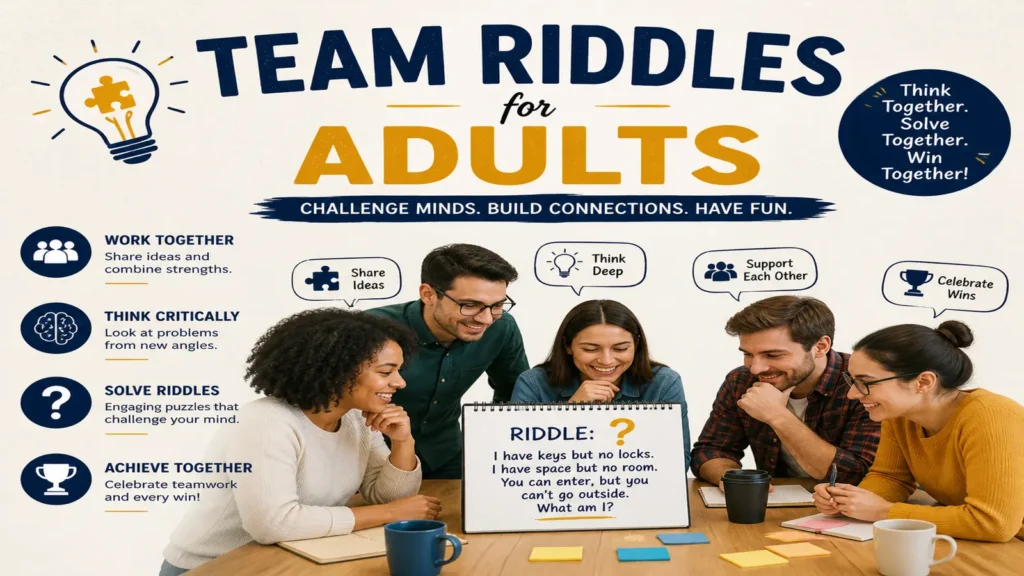
Team activities often feel repetitive, especially in workplaces or social groups. That is where team riddles for adults come in as a refreshing change. These games mix fun thinking with collaboration. They help people talk, laugh, and solve problems together in a simple way. As a result, groups feel more connected and engaged. This guide explores how to use riddles in teams, from icebreakers to harder challenges. It also shows practical ways to run them in real settings.
Quick Answer: What Are Team Riddles for Adults
Team riddles for adults are group puzzle games where people solve questions together. They encourage communication, teamwork, and shared thinking in a fun format.
These riddles work well in offices, parties, and virtual meetings. They turn simple questions into engaging group challenges.
TL;DR
• Team riddles boost group communication and teamwork
• Great for parties, offices, and online meetings
• Easy icebreakers help people relax quickly
• Hard riddles add fun competition between teams
• Works for both small and large groups
What Are Team Riddles for Adults
Team riddles are group-based puzzles solved through discussion. Instead of individual answers, teams collaborate to find solutions.
They are used in social events and professional settings. Because of this, they improve both fun and communication.
• Group-based puzzle solving activity
• Encourages shared problem discussions
• Used in workplaces and parties
• Builds communication between members
• Can be timed or untimed rounds
• Works with simple or complex riddles
• Often includes competitive scoring
• Encourages creative thinking in groups
• Helps break social awkwardness
• Can include visual or verbal clues
• Adaptable to different group sizes
• Suitable for mixed skill levels
Why Team Riddles Work for Adults
Adults benefit from structured yet fun activities. Team riddles create a balance of challenge and enjoyment.
They improve how people communicate and listen. As a result, teams often bond faster during activities.
• Encourages better workplace communication
• Builds trust between group members
• Reduces stress in social settings
• Promotes active listening skills
• Supports creative problem solving
• Strengthens group decision making
• Helps break routine office monotony
• Increases engagement in meetings
• Makes introverts more comfortable
• Encourages shared laughter and bonding
• Improves focus during group tasks
• Supports healthy team competition
Best Icebreaker Team Riddles
Icebreakers help people relax at the start of a session. These riddles are simple and quick to solve.
They are perfect for meetings, workshops, or social events. The goal is to make everyone feel included.
• Easy riddles for quick participation
• No complex logic required
• Helps new groups feel comfortable
• Works in first five minutes
• Encourages early group interaction
• Builds friendly atmosphere quickly
• Good for office morning meetings
• Ideal for training sessions
• Suitable for mixed experience levels
• Keeps pressure very low
• Encourages laughter and responses
• Helps break silence in groups
Funny Team Riddles to Break the Ice
Humor makes group activities more enjoyable. Funny riddles lighten the mood and reduce tension.
These riddles are best for casual environments. They help teams relax and enjoy the moment.
• Light-hearted puzzle questions
• Focus on humor and surprise
• Great for social gatherings
• Works well in parties
• Encourages group laughter
• Reduces formal workplace tension
• Easy to understand clues
• Good for mixed age groups
• Promotes positive energy
• Keeps engagement high
• Encourages playful thinking
• Ideal for informal events
Hard Team Riddles for Challenge Lovers
Hard riddles test logic and patience. They push teams to think deeply and collaborate closely.
These are best for competitive groups. They create excitement and mental challenge.
• Complex logic-based puzzles
• Requires team discussion and strategy
• Encourages deeper problem solving
• Great for competitive games
• Takes more time to solve
• Improves analytical thinking skills
• Suitable for experienced players
• Often includes trick questions
• Builds teamwork under pressure
• Encourages multiple solution attempts
• Strengthens reasoning abilities
• Adds excitement to group events
Workplace Team Riddles for Office Groups
Workplace riddles improve communication and morale. They are designed to stay professional and inclusive.
These games fit well in meetings or team breaks. They also help reduce work stress.
• Professional-friendly puzzle activities
• Improves team collaboration skills
• Works in office meetings
• Encourages friendly competition
• Boosts workplace engagement
• Helps reduce daily stress
• Suitable for HR activities
• Strengthens team relationships
• Easy to organize quickly
• Encourages group participation
• Builds positive office culture
• Supports creative thinking
Virtual Team Riddles for Remote Teams
Remote teams need interactive activities. Virtual riddles help bridge distance gaps.
They work well on video calls. As a result, teams stay connected online.
• Designed for video meetings
• Works on Zoom or Teams
• Encourages remote collaboration
• Keeps online meetings engaging
• Easy to share digitally
• Supports chat-based responses
• Builds remote team bonding
• Reduces virtual meeting boredom
• Encourages active participation
• Fits global teams easily
• Simple to organize online
• Improves remote communication
How to Run a Riddle Game in Teams
Running a riddle game requires structure. A clear setup keeps everyone engaged.
Timing, scoring, and rules matter. Because of this, preparation improves the experience.
• Choose clear and simple riddles
• Divide participants into teams
• Set a time limit per round
• Decide scoring system early
• Keep instructions easy to follow
• Use a host or moderator
• Encourage equal participation
• Avoid overly long riddles
• Mix easy and hard questions
• Keep energy levels high
• Use whiteboard or chat tools
• End with quick recap round
Team Riddle Rules and Fair Play Tips
Fair play keeps the game enjoyable. Rules ensure everyone participates equally.
Good structure avoids confusion. It also keeps competition friendly.
• No shouting over other teams
• Allow equal speaking time
• Avoid external search tools
• Keep answers within time limits
• Respect all participants equally
• Encourage teamwork over individual wins
• Clarify rules before starting
• Avoid overly complex scoring
• Rotate speaking responsibilities
• Prevent one-person dominance
• Keep disputes minimal and fair
• Focus on fun over winning
Creative Ways to Use Team Riddles
Riddles can be used in many settings. They are flexible and easy to adapt.
You can include them in events or breaks. This keeps engagement fresh.
• Use during meeting warm-ups
• Add to birthday party games
• Include in training workshops
• Combine with trivia sessions
• Use as coffee break activity
• Include in onboarding programs
• Add to virtual happy hours
• Mix with storytelling games
• Use in classroom group work
• Include in retreats or camps
• Combine with scavenger hunts
• Use for team rewards events
Team Riddles for Large Groups
Large groups need structured formats. Without structure, engagement can drop quickly.
Breaking into smaller teams helps. This keeps everyone involved.
• Divide crowd into small teams
• Use round-based competition format
• Assign team leaders for coordination
• Keep riddles short and clear
• Use loud or visible announcements
• Rotate speaking opportunities often
• Encourage team collaboration quickly
• Limit answer time strictly
• Track scores on board
• Keep energy levels high
• Use easy-to-follow instructions
• Celebrate group participation
Team Riddles for Small Groups
Small groups allow deeper interaction. Everyone can participate more actively.
These settings support complex riddles. Discussion becomes more detailed.
• Encourage full group participation
• Use more challenging riddles
• Allow longer discussion time
• Focus on detailed reasoning
• Promote open communication
• Avoid rushed answers
• Build stronger group bonding
• Support creative explanations
• Rotate who leads discussion
• Encourage multiple solution ideas
• Keep relaxed environment
• Focus on learning together
FAQs
Common questions help clarify how to use riddles in teams. These answers support beginners and organizers.
What makes team riddles fun for adults?
They mix challenge and humor in a social setting. Adults enjoy solving problems together in a relaxed way.
How long should a team riddle game last?
Most sessions work best between 15 and 45 minutes. This keeps attention strong without fatigue.
Can team riddles improve workplace communication?
Yes, they encourage discussion and listening. Teams often communicate better after regular practice.
Are team riddles good for virtual meetings?
They work very well online. Video calls and chat tools make participation easy.
What size group works best for riddles?
Both small and large groups can enjoy them. The format just needs slight adjustments.
Do team riddles need special materials?
No, most only need questions and a timer. Whiteboards or chat tools can help.
Conclusion
Team games work best when they are simple and engaging. That is why team riddles for adults are so effective. They bring people together through shared thinking and fun. With the right setup, any group can enjoy them easily. Whether in offices, parties, or online calls, these riddles create better connection and energy.

A modern riddle-maker who builds clever, pocket-sized puzzles with sharp wordplay and elegant misdirection. Her clues are clean, surprising, and designed to make you think twice—then smile when it clicks.