
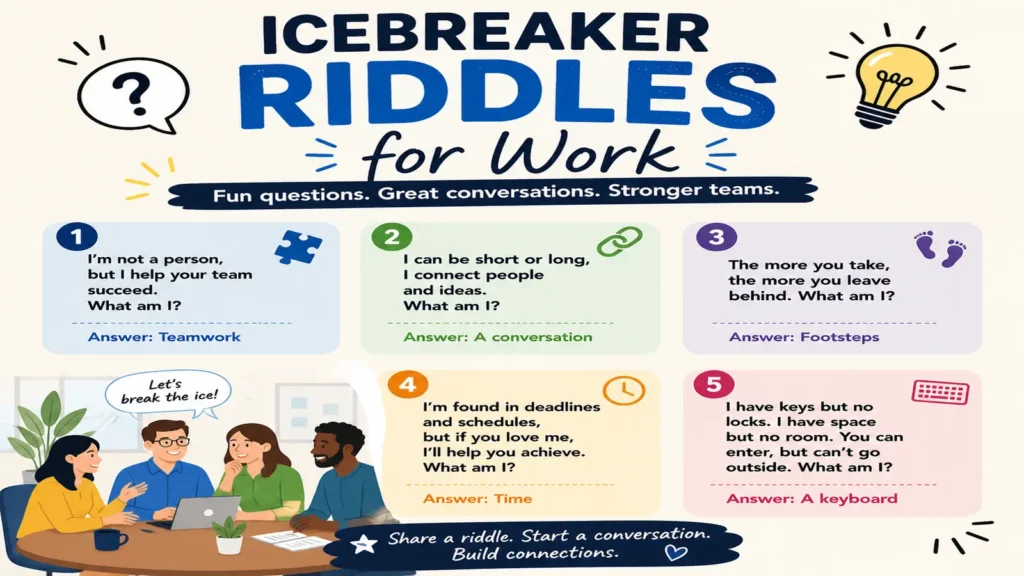
Work meetings can feel slow at the start. People join quietly, and energy stays low. That’s where icebreaker riddles for work come in. Riddles wake up the brain and spark conversation quickly. They also help coworkers relax and connect. Whether your team is remote or in-office, a good riddle can change the mood fast.
Quick Answer
Icebreaker riddles for work are short, fun puzzles used to start meetings. They help teams think, laugh, and engage right away.
TL;DR
• Riddles boost energy at the start of meetings
• Short puzzles work best for busy teams
• Funny riddles reduce workplace tension
• Tricky ones improve critical thinking
• Use them for both remote and in-person teams
Funny Icebreaker Riddles for Work
A little humor goes a long way at work. Funny riddles help people relax and open up fast.
• What has hands but cannot clap? A clock
• Why did the computer get cold? It left Windows open
• What has a face but no eyes? A clock
• Why don’t programmers like nature? Too many bugs
• What runs but never walks? Water
• Why was the math book sad? Too many problems
• What gets wetter while drying? A towel
• Why did coffee file a report? It got mugged
• What has keys but no locks? A keyboard
• Why did the scarecrow win? Outstanding in his field
• What has legs but doesn’t walk? A table
• Why did the calendar break? Too many dates
Short Icebreaker Riddles for Busy Meetings
Time is limited in most meetings. Short riddles keep things quick and effective.
• What has one eye but cannot see? A needle
• What goes up but never down? Your age
• What has a neck but no head? A bottle
• What gets bigger the more you take away? A hole
• What has a ring but no finger? A phone
• What can travel worldwide without moving? A stamp
• What has a heart that doesn’t beat? An artichoke
• What comes once in a minute twice in a moment? The letter M
• What has a thumb and fingers but isn’t alive? A glove
• What can you catch but not throw? A cold
• What has many teeth but cannot bite? A comb
• What begins with T ends with T has T in it? A teapot
Tricky Riddles to Challenge Your Team
Some teams enjoy a challenge. Tricky riddles push thinking and spark discussion.
• I speak without a mouth. What am I? An echo
• The more you take, the more you leave. Footsteps
• What has cities but no houses? A map
• What can fill a room but takes no space? Light
• What has keys but can’t open doors? Piano
• What disappears when named? Silence
• What has an eye but cannot see? A storm
• What can you break without touching? A promise
• What runs but never tires? A river
• What flies without wings? Time
• What has a spine but no bones? A book
• What comes down but never goes up? Rain
Easy Riddles for Quick Wins
Easy riddles help everyone feel included. They are perfect for mixed-skill teams.
• What is full of holes but holds water? A sponge
• What has four wheels and flies? A garbage truck
• What has one head one foot four legs? A bed
• What is always in front of you but unseen? The future
• What can you keep after giving? Your word
• What goes through cities and fields? A road
• What has a tail but no body? A coin
• What kind of tree fits your hand? A palm
• What is always running but never moves? A fridge
• What has ears but cannot hear? Corn
• What is orange and sounds like parrot? A carrot
• What has an end but no start? A stick
Brain Teaser Riddles for Office Fun
These riddles make people pause and think. They work well for team discussions.
• What comes before thunder? Lightning
• What has no beginning end or middle? A circle
• What gets sharper the more used? Your brain
• What has branches but no fruit? A bank
• What cannot be used until broken? An egg
• What grows but never shrinks? Age
• What can’t talk but replies? An echo
• What has no life but can die? A battery
• What can’t be seen but can be felt? Wind
• What is always coming but never arrives? Tomorrow
• What has no weight but slows you? Time
• What has many answers but one question? A test
Icebreaker Riddles for Virtual Meetings
Remote teams need simple engagement tools. Riddles work great in chat or video calls.
• What can you share but never touch? A secret
• What has a screen but no display? A window
• What connects people worldwide instantly? The internet
• What can you send but not see? A message
• What works without rest daily? A server
• What helps meetings but isn’t human? Software
• What runs apps but isn’t alive? A device
• What lets you speak without being there? Video
• What holds files but isn’t a cabinet? Cloud
• What links teams globally? Technology
• What sends signals invisibly? Wi-Fi
• What keeps meetings on track? Agenda
Team Building Riddles That Spark Collaboration
Group riddles encourage teamwork. They also build trust and communication.
• Solve together what has many parts but one goal
• Guess items using shared clues only
• Work out puzzles with limited hints
• Share answers after group discussion
• Build stories using riddle answers
• Combine clues from different teammates
• Solve riddles using role-based input
• Encourage debate before final answers
• Rotate who explains each solution
• Use time limits to boost energy
• Reward teamwork over speed
• Reflect on problem-solving styles
Creative Riddles to Boost Innovation
Creative thinking is valuable at work. These riddles stretch imagination.
• What can exist without being seen or touched? Ideas
• What grows stronger when shared? Creativity
• What changes shape but stays same? Thought
• What builds worlds in seconds? Imagination
• What starts small but grows huge? Innovation
• What connects unrelated things? Creativity
• What solves problems without tools? Thinking
• What creates value from nothing? Ideas
• What fuels progress quietly? Curiosity
• What breaks rules to build better? Innovation
• What sees patterns others miss? Insight
• What drives change forward? Vision
Icebreaker Riddles for Large Groups
Big groups need simple and clear riddles. Engagement should stay high for everyone.
• Use easy riddles everyone understands quickly
• Ask for hand-raise answers
• Use polls for instant feedback
• Encourage group cheering after answers
• Keep pace fast to maintain energy
• Repeat riddles for clarity
• Rotate who answers publicly
• Keep explanations short and fun
• Use visuals when possible
• Avoid overly complex puzzles
• Celebrate participation equally
• End with a group laugh
Icebreaker Riddles for Small Teams
Small teams allow deeper interaction. Riddles can spark real conversations.
• Let each person share their guess
• Discuss reasoning behind answers
• Encourage friendly debate
• Use personal-style riddles
• Rotate who asks questions
• Allow follow-up discussions
• Tie riddles to real work themes
• Keep tone relaxed and informal
• Use inside jokes carefully
• Build trust through openness
• Give everyone equal time
• Reflect on team thinking styles
Work-Appropriate Riddles for Professional Settings
Professional environments need safe content. Choose riddles that suit all audiences.
• Avoid sensitive or controversial topics
• Keep humor clean and inclusive
• Focus on universal themes
• Use simple language for clarity
• Respect cultural differences
• Avoid sarcasm that may confuse
• Choose positive and uplifting riddles
• Keep answers workplace friendly
• Avoid personal or private topics
• Stick to neutral humor styles
• Ensure everyone feels comfortable
• Maintain respectful tone always
Daily Riddles to Build Team Habits
Consistency builds strong culture. Daily riddles create shared moments.
• Start each day with a quick riddle
• Share answers after discussion
• Rotate who posts daily riddles
• Use chat tools for easy access
• Track participation over time
• Celebrate creative answers
• Keep riddles fresh and varied
• Encourage friendly competition
• Use themes for each week
• Keep sessions under five minutes
• Build routine engagement gradually
• Reinforce positive team energy
How to Use Riddles Effectively in Meetings
Using riddles well makes a big difference. Timing and delivery matter.
• Start meetings with one quick riddle
• Keep tone light and welcoming
• Match difficulty to team level
• Encourage everyone to participate
• Allow short thinking time
• Reveal answers clearly
• Avoid overusing riddles
• Use visuals when helpful
• Adapt for remote or in-person
• Track what works best
• Keep sessions short and focused
• End with positive energy
Common Mistakes to Avoid with Icebreaker Riddles
Even simple riddles can go wrong. Avoid these common mistakes.
• Choosing overly complex riddles
• Taking too much meeting time
• Ignoring team preferences
• Repeating the same riddles often
• Not explaining answers clearly
• Forcing participation
• Using unclear wording
• Skipping engagement feedback
• Overloading with too many riddles
• Ignoring remote team needs
• Picking inappropriate topics
• Ending without closure
FAQs
What are good riddles for work meetings?
Good riddles are short, clear, and fun. They should be easy to understand and quick to answer. Humor and simplicity work best.
How do you start a meeting with a riddle?
Start with a quick question as people join. Give a few seconds to think, then invite answers. Keep it light and friendly.
Are riddles good icebreakers?
Yes, riddles are excellent icebreakers. They engage the brain and encourage participation quickly. They also reduce awkward silence.
What are short riddles for adults?
Short riddles are simple puzzles with quick answers. They usually take under ten seconds to read and solve.
How long should icebreakers last?
Most icebreakers should last two to five minutes. This keeps energy high without delaying the meeting.
Conclusion
Icebreaker riddles bring energy, laughter, and connection into the workplace. They help teams engage quickly and think creatively. When used well, they improve meetings and team culture. Try adding icebreaker riddles for work to your next meeting and notice the difference.

A playful wordsmith with a knack for misdirection, I craft riddles that tease the brain. My puzzles blend clever clues, clean logic, and a dash of humor—built to challenge beginners and stump seasoned solvers alike. From short, punchy brainteasers to layered mysteries with hidden meanings, I love turning everyday ideas into mind-bending questions that invite curiosity and conversation. When I’m not twisting words into puzzles, I’m collecting strange facts, testing new clue styles, and fine-tuning the art of fair—but fiendish—fun.