
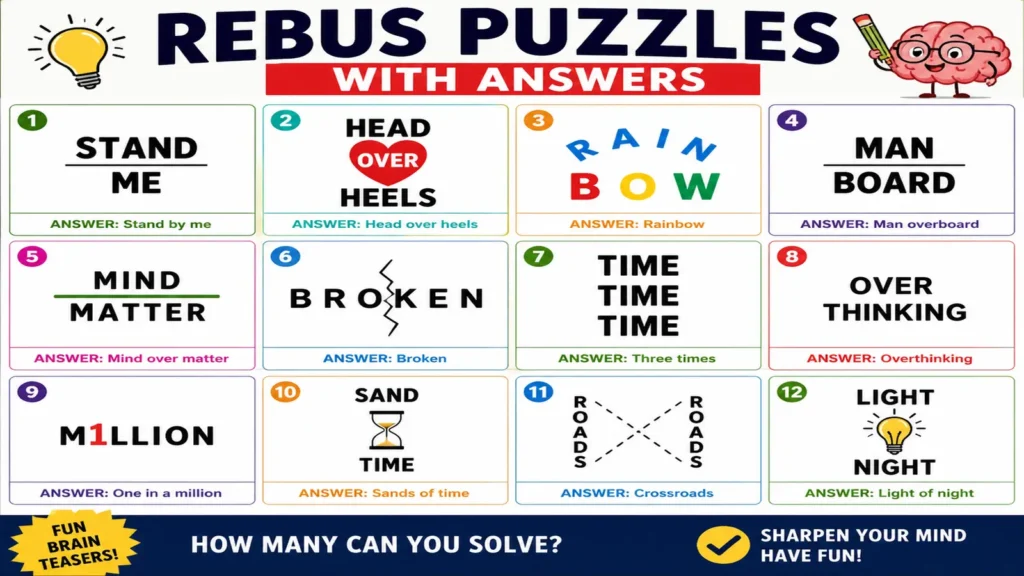
Rebus puzzles are clever word games that hide phrases inside pictures, letters, numbers, and layouts. They are fun for kids, adults, teachers, and families because everyone can guess together.
This guide gives you rebus puzzles with answers, plus simple tips for solving them. You can use them at home, in class, at parties, or during family game night.
Quick Answer
Rebus puzzles with answers are visual word puzzles that show a phrase through placement, size, sound, or symbols. The answer explains the hidden phrase, so each puzzle teaches a useful solving pattern.
TL;DR
• Rebus puzzles use words, symbols, and layout clues.
• Answers help beginners spot common puzzle patterns.
• Easy puzzles work well for kids and classrooms.
• Hard puzzles are great for adults and parties.
• Printable sheets make group play simple.
• Good clues are fair, short, and visual.
How Rebus Puzzles Work
A rebus puzzle hides a phrase in a visual clue. For example, a word may sit above another word, appear broken, or repeat several times.
To solve one, look at what changed first. Then, ask whether the clue shows position, sound, size, number, or direction.
• Word above word often means “over.”
• Word below word often means “under.”
• Tiny text can mean “small” or “little.”
• Huge text may point to “big.”
• Repeated words can show “again” or “many.”
• Missing letters may suggest “without.”
• Split words can mean “broken.”
• Backward words can mean “reverse.”
• Sideways words may signal “turn.”
• Numbers can replace similar sounds.
• Pictures may stand for spoken words.
• Spacing can show near or far apart.
Easy Rebus Puzzles With Answers
Easy rebus puzzles are best when the hidden phrase is familiar. They should feel tricky at first, but clear after the answer appears.
Try these beginner puzzles before moving to harder ones. Also, read the answer after each guess to learn the clue style.
• STAND beside ME — Stand by me.
• HEAD over HEELS — Head over heels.
• STAR inside FISH — Starfish.
• RAIN under BOW — Rainbow.
• SUN above ROOF — Sunroof.
• BOOK inside CASE — Bookcase.
• FOOT inside DOOR — Foot in the door.
• MAN over BOARD — Man overboard.
• LIGHT under HOUSE — Lighthouse.
• EYE beside BALL — Eyeball.
• CAT on WALK — Catwalk.
• TEA inside CUP — Teacup.
Medium Rebus Puzzles With Answers
Medium puzzles use more than one clue. Therefore, solvers may need to notice both the words and their placement.
These examples still use common phrases. However, they require a little more flexible thinking.
• CYCLE CYCLE CYCLE — Tricycle.
• MILLION with ONE inside — One in a million.
• TIME written twice — Two times.
• LINE after LINE — Line after line.
• AGE in the middle — Middle age.
• NOON split apart — Afternoon.
• MIND over MATTER — Mind over matter.
• LONG word written long — Long word.
• SIDE by SIDE — Side by side.
• WORLD around TRIP — Trip around the world.
• HEART cracked open — Broken heart.
• FISH beside TUNA — Tuna fish.
Hard Rebus Puzzles With Answers
Hard rebus puzzles often hide a common saying. Because of this, you must think beyond the exact words shown.
Start by describing the clue out loud. Then, turn that description into a phrase people actually say.
• JUST written between YOU and ME — Just between you and me.
• SECRET placed under COVER — Undercover secret.
• CHANCE written after SECOND — Second chance.
• CYCLE missing its first letter — Recycle.
• EGO written very low — Low self-esteem.
• TROUBLE doubled — Double trouble.
• DEAL written huge — Big deal.
• STEP placed above STEP — Step up.
• LUCK placed beside DRAW — Luck of the draw.
• BREAK inside COFFEE — Coffee break.
• ROADS crossing twice — Crossroads.
• WORDS without letters O — Lost for words.
Funny Rebus Puzzles With Answers
Funny rebus puzzles work well because the answer feels like a joke. Still, the clue should be fair enough to solve.
Use these for parties, team warmups, or quick breaks. In addition, let people explain their guesses aloud.
• FISH wearing TIE — Formal fish.
• COW inside BELL — Cowbell.
• PIG over BANK — Piggy bank.
• DOG under WEATHER — Sick as a dog.
• BEAN beside COOL — Cool beans.
• CHICKEN near ROAD — Why did the chicken cross?
• TOAST over BREAD — Toasted bread.
• HAM inside BURGER — Hamburger.
• BEE beside LINE — Beeline.
• SNAIL under MAIL — Snail mail.
• DUCK near LUCK — Lucky duck.
• GOAT over BOAT — Floating goat.
Rebus Puzzles for Kids
Kids enjoy rebus puzzles when the answers use simple words. For best results, choose school-safe phrases and familiar objects.
Also, give children time to explain their thinking. Their guesses often show strong pattern skills.
• BALL inside BASKET — Basketball.
• BUTTER beside FLY — Butterfly.
• SNOW over MAN — Snowman.
• PAN beside CAKE — Pancake.
• BED under ROOM — Bedroom.
• TREE inside HOUSE — Treehouse.
• FIRE beside FLY — Firefly.
• RAIN beside COAT — Raincoat.
• CUP beside CAKE — Cupcake.
• POP beside CORN — Popcorn.
• NOTE inside BOOK — Notebook.
• STAR above FISH — Starfish.
Rebus Puzzles for Adults
Adults often enjoy rebus puzzles with idioms and sayings. These clues work best when the answer feels clever but not unfair.
Use these in meetings, parties, or trivia nights. However, mix in easy ones to keep everyone included.
• CLOUD over NINE — On cloud nine.
• FENCE with word SIDE twice — Sitting on the fence.
• TIME inside BOTTLE — Time in a bottle.
• LINE drawn through DEAD — Deadline.
• SAND inside CLOCK — Sands of time.
• ROCK beside ROLL — Rock and roll.
• STORM inside BRAIN — Brainstorm.
• BUDGET under CUT — Budget cut.
• PAPER over WORK — Paperwork.
• LIGHT at TUNNEL end — Light at the end.
• SILENCE written loudly — Deafening silence.
• ORDER after CHAOS — Order out of chaos.
Printable Rebus Puzzle Ideas
Printable rebus puzzles are useful for classrooms, parties, and family tables. They also let players write guesses beside each clue.
Keep the page clean and easy to scan. In addition, place answers on a separate page to prevent peeking.
• Use large text for easy reading.
• Leave blank lines under every clue.
• Put answers on page two.
• Add difficulty labels for each round.
• Mix easy and hard puzzles.
• Number every puzzle clearly.
• Use wide spacing between clues.
• Keep images simple and bold.
• Avoid tiny symbols on worksheets.
• Include a timer box for games.
• Add team names at the top.
• Print one answer key for hosts.
How to Solve Rebus Puzzles Faster
Solving rebus puzzles gets easier with a checklist. Instead of guessing wildly, inspect the clue piece by piece.
First, say what you see in plain words. Next, test whether that description sounds like a known phrase.
• Check whether words sit above others.
• Notice anything placed below something.
• Count repeated words or pictures.
• Look for missing letters first.
• Read words backward when needed.
• Try saying numbers out loud.
• Watch for broken or split text.
• Compare large and small words.
• Study unusual spacing between items.
• Look for hidden words inside words.
• Turn the page mentally if needed.
• Match the clue to common sayings.
Common Rebus Clue Patterns
Most rebus puzzles use a small set of patterns. Once you learn those patterns, new puzzles feel much easier.
For example, “man” above “board” can suggest “man overboard.” Meanwhile, repeated words can point toward number phrases.
• Above clues often mean “over.”
• Below clues often mean “under.”
• Inside clues often mean “in.”
• Outside clues often mean “out.”
• Close spacing can mean “near.”
• Wide spacing can mean “far.”
• Repetition may show “twice.”
• Missing pieces suggest “less.”
• Upside-down words suggest “upset.”
• Backward spelling suggests “back.”
• Crossed words suggest “cross.”
• Mixed fonts may signal contrast.
Rebus Puzzles for Family Game Night
Rebus puzzles are perfect for mixed-age groups. Kids can spot visual clues, while adults often know the sayings.
To keep the game fair, play in short rounds. Also, let teams ask for one hint before revealing the answer.
• Split players into balanced teams.
• Start with three easy puzzles.
• Add harder puzzles each round.
• Give one point per answer.
• Award bonus points for explanations.
• Let kids serve as clue readers.
• Use a timer for excitement.
• Offer hints after one minute.
• Keep answer keys hidden nearby.
• Rotate who writes team guesses.
• End with a sudden-death puzzle.
• Celebrate funniest wrong answer.
How to Make Your Own Rebus Puzzles
Making a rebus puzzle starts with a phrase. Choose something short, familiar, and easy to picture.
Then, decide which word can be shown visually. Finally, test the clue on someone before using it.
• Pick a common phrase first.
• Choose one strong visual idea.
• Use position before decoration.
• Keep the clue uncluttered.
• Avoid private family jokes.
• Make the answer easy to say.
• Test with one honest solver.
• Remove details that distract.
• Use bold letters for clarity.
• Add one hint for beginners.
• Save answers on another page.
• Create themed rounds for variety.
FAQs
What is a rebus puzzle?
A rebus puzzle is a visual word puzzle. It uses letters, pictures, symbols, or placement to hide a word or phrase.
How do you solve rebus puzzles?
Start by describing exactly what you see. Then, connect that description to a common saying, object, or phrase.
Are rebus puzzles good for kids?
Yes, rebus puzzles can be great for kids. They build observation, language skills, and creative thinking through play.
What makes a rebus puzzle hard?
A hard rebus puzzle often uses several clues at once. It may combine placement, missing letters, sound, and a familiar saying.
Can I print rebus puzzles for a classroom?
Yes, printable rebus puzzles work well in classrooms. Use large clues, numbered spaces, and a separate answer key.
What is the difference between rebus puzzles and dingbats?
Rebus puzzles often mix pictures and words. Dingbats usually rely more on letter placement, symbols, and visual layout.
Conclusion
Rebus puzzles turn simple words and pictures into clever challenges. They work because the answer is hidden in what you see. You can use rebus puzzles with answers for kids, adults, classrooms, parties, and family game night. They are easy to print, quick to play, and fun to explain. Finally, the best puzzles are clear, fair, and surprising. Start simple, then try harder clues as your solving skills grow.

A playful wordsmith with a knack for misdirection, I craft riddles that tease the brain. My puzzles blend clever clues, clean logic, and a dash of humor—built to challenge beginners and stump seasoned solvers alike. From short, punchy brainteasers to layered mysteries with hidden meanings, I love turning everyday ideas into mind-bending questions that invite curiosity and conversation. When I’m not twisting words into puzzles, I’m collecting strange facts, testing new clue styles, and fine-tuning the art of fair—but fiendish—fun.