
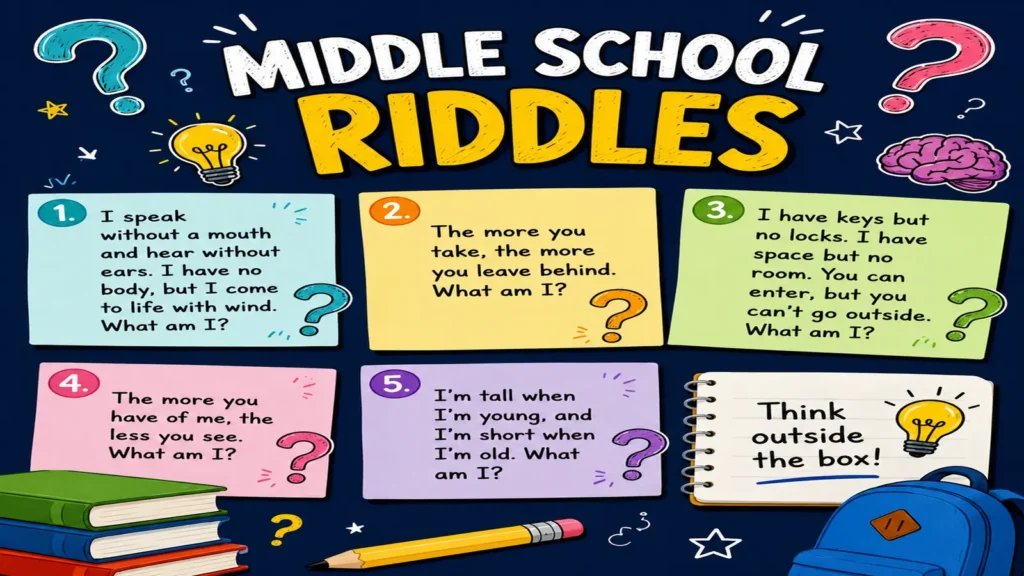
Middle school students love challenges that feel like games. That’s where riddles come in. They mix fun, logic, and creativity in a simple format. This guide shares the best middle school riddles for classrooms and home. You’ll find easy, funny, and tricky options. Each type helps build thinking skills while keeping students engaged.
Quick Answer
Middle school riddles are short puzzles that challenge logic, language, or math skills. They are fun, engaging, and perfect for students aged 11–14.
TL;DR
• Middle school riddles boost thinking and creativity
• They work well in classrooms and group settings
• Easy riddles build confidence quickly
• Hard riddles improve critical thinking skills
• Funny riddles keep students engaged
What Makes Middle School Riddles Unique
Riddles for this age group sit between simple and complex. They must challenge students without frustrating them.
• Designed for developing reasoning skills
• Balance fun with meaningful thinking challenges
• Avoid overly childish or overly complex ideas
• Encourage curiosity and active participation
• Support both individual and group problem-solving
• Fit classroom and home learning environments
• Build confidence through small successes
• Introduce abstract thinking gradually
• Use familiar concepts with creative twists
• Promote discussion among students
• Adapt easily for different grade levels
• Work well as quick brain breaks
Easy Middle School Riddles
These riddles are great starters. They help students warm up and gain confidence.
• What has keys but opens no locks? (Piano)
• What has a face and two hands? (Clock)
• What gets wetter as it dries? (Towel)
• What has a neck but no head? (Bottle)
• What can travel worldwide without moving? (Stamp)
• What has one eye but cannot see? (Needle)
• What begins with T ends with T? (Teapot)
• What has legs but never walks? (Table)
• What has a ring but no finger? (Phone)
• What goes up but never down? (Age)
• What can you catch but not throw? (Cold)
• What has ears but cannot hear? (Corn)
Funny Riddles for the Classroom
Humor keeps students interested. These riddles add laughter to learning.
• Why did math book look sad? (Too many problems)
• What do you call fake spaghetti? (Impasta)
• Why can’t your nose be twelve inches? (Would be a foot)
• What kind of tree fits your hand? (Palm)
• Why did student eat homework? (Teacher said it was piece of cake)
• What runs but never walks? (Water)
• Why was computer cold? (Left windows open)
• What do you call sleeping bull? (Bulldozer)
• Why did cookie go doctor? (Felt crumbly)
• What has four wheels and flies? (Garbage truck)
• Why don’t skeletons fight? (No guts)
• What kind of music do balloons hate? (Pop)
Tricky Riddles That Make You Think
These require a bit more effort. They stretch thinking skills nicely.
• What disappears when you say its name? (Silence)
• What has many teeth but cannot bite? (Comb)
• What comes once in minute twice moment? (Letter M)
• What has cities but no houses? (Map)
• What can fill room but takes no space? (Light)
• What begins but has no end? (Circle)
• What gets bigger when more taken away? (Hole)
• What has no beginning middle end? (Donut)
• What can’t talk but replies? (Echo)
• What runs around yard without moving? (Fence)
• What is always ahead but unseen? (Future)
• What has words but never speaks? (Book)
Hard Riddles for Advanced Students
These challenge even strong thinkers. They require patience and logic.
• I speak without mouth hear without ears (Echo)
• The more you take the more you leave (Footsteps)
• I shave every day but beard stays same (Barber)
• What can’t be used until broken (Egg)
• Feed me and I grow give water I die (Fire)
• I have branches but no fruit trunk (Bank)
• What belongs to you but used by others (Name)
• I’m tall when young short when old (Candle)
• What can fly without wings cry without eyes (Cloud)
• I have keys but no locks space but no room (Keyboard)
• What comes down never goes up (Rain)
• What can’t be seen but fills room (Air)
Short Riddles for Quick Activities
Short riddles are perfect for transitions. They save time while keeping energy high.
• What has one head one foot? (Bed)
• What has teeth no bite? (Zipper)
• What has wings but cannot fly? (Penguin)
• What goes through glass without breaking? (Light)
• What is always running? (Nose)
• What has a bottom at top? (Legs)
• What can you hold without touching? (Breath)
• What has stripes no color? (Zebra shadow)
• What gets sharper more used? (Brain)
• What grows but never alive? (Mountain)
• What is full but still holds more? (Moon)
• What starts with E ends with E (Envelope)
Math-Based Riddles for Students
Math riddles mix fun with learning. They sharpen number skills quickly.
• I am odd take away one become even (Seven)
• Two fathers two sons share three apples (Each gets one)
• If two’s company three’s a crowd what is four (Party)
• What number doubles when flipped? (Six becomes nine)
• Add five to nine get two (Clock time)
• What comes after 3 5 9 (17 pattern)
• I am number multiply me get same (One)
• What number is half of two plus two (Three)
• Which weighs more pound feathers or bricks (Same)
• I am three digits sum equals 15 (Various combos)
• What number missing 2 4 8 16 (32)
• I am between 10 and 20 odd (11,13,15,17,19)
Wordplay Riddles Kids Love
Word riddles play with language. They build vocabulary naturally.
• What word becomes shorter adding letters (Short)
• What begins with P ends with E (Please)
• What word spelled wrong in dictionary (Wrong)
• Remove first letter still sounds same (Queue)
• What has letters but no mail (Alphabet)
• Add letter make new word same sound (Pair pear)
• What word ends sentence (Period)
• What word starts ends same letter (Level)
• What word has silent letters (Many examples)
• Remove letters still pronounce same (Knight night)
• What word reads same backward (Racecar)
• What word hides another inside (There in there)
Logic Riddles for Brain Training
Logic riddles build reasoning skills. They require careful thinking.
• Two people born same day same parents not twins (Triplets)
• A man pushes car stops at hotel bankrupt (Monopoly)
• Before Mount Everest discovered what highest (Everest)
• You see boat full people none married (All single)
• What can’t be put in saucepan (Its lid)
• If plane crashes where bury survivors (Nowhere)
• What has to be broken before used (Egg)
• Which month has 28 days (All months)
• If you pass second place what are you (Second)
• What goes up and down never moves (Stairs)
• What gets larger more you take (Hole)
• What begins ends with same letter (Envelope)
Riddles for Group Games
Group riddles encourage teamwork. Students learn together while having fun.
• Solve clues together in small teams
• Take turns answering within groups
• Award points for correct guesses
• Use timer for added excitement
• Encourage discussion before answers
• Mix easy and hard riddles
• Let students create their own riddles
• Rotate group leaders regularly
• Offer hints if teams get stuck
• Celebrate creative thinking efforts
• Keep sessions short and lively
• Use whiteboard for shared solving
Riddles for Icebreakers
Icebreakers help students relax. Riddles make introductions fun.
• Start class with one simple riddle
• Ask students to explain answers
• Let shy students participate comfortably
• Use humor to reduce tension
• Rotate who reads riddles aloud
• Pair students to solve together
• Use riddles as name-learning tool
• Keep tone light and encouraging
• Allow guesses without pressure
• Reward participation not just accuracy
• Mix funny and easy options
• Transition smoothly into lesson
Printable Riddle Ideas for Teachers
Printable riddles are useful tools. They support structured activities.
• Create worksheets for morning work
• Use riddles in homework packets
• Add visuals for younger learners
• Include answer keys separately
• Mix categories for variety
• Print themed riddle sheets
• Use for substitute teacher plans
• Add space for student explanations
• Laminate for repeated classroom use
• Share with parents for practice
• Include riddles in test breaks
• Organize by difficulty levels
Tips to Solve Riddles Faster
Solving riddles improves with practice. A few strategies can help.
• Read the riddle carefully first
• Look for hidden clues in wording
• Think about double meanings
• Break problem into smaller parts
• Eliminate impossible answers
• Stay calm and patient
• Use logic over guessing
• Ask yourself what seems unusual
• Rephrase riddle in your own words
• Practice regularly with new puzzles
• Discuss answers with others
• Learn from mistakes each time
How Teachers Can Use Riddles Daily
Riddles fit easily into daily lessons. They make learning more engaging.
• Start class with a daily riddle
• Use riddles during transitions
• Add to lesson introductions
• Include in group activities
• Use for early finisher tasks
• Connect riddles to lesson topics
• Encourage student-created riddles
• Build weekly riddle challenges
• Use as quick assessments
• Add to classroom bulletin boards
• Share riddles in announcements
• Reward creative solutions
FAQs
What are good riddles for middle school students?
Good riddles balance fun and challenge. They should be clear, engaging, and age-appropriate.
Why are riddles helpful for kids?
Riddles improve thinking skills and creativity. They also make learning more interactive and enjoyable.
What are tricky riddles with answers?
Tricky riddles often use wordplay or hidden clues. They require careful reading and logical thinking.
How can students get better at solving riddles?
Practice is key. Students improve by solving different types and learning patterns.
Are riddles good for brain development?
Yes, riddles strengthen problem-solving and reasoning skills. They also boost memory and focus.
Conclusion
Riddles are more than just fun. They help students think, laugh, and learn at the same time. Using middle school riddles in daily routines can make any class more engaging. Whether easy or tricky, they bring energy and curiosity into learning.

A playful wordsmith with a knack for misdirection, I craft riddles that tease the brain. My puzzles blend clever clues, clean logic, and a dash of humor—built to challenge beginners and stump seasoned solvers alike. From short, punchy brainteasers to layered mysteries with hidden meanings, I love turning everyday ideas into mind-bending questions that invite curiosity and conversation. When I’m not twisting words into puzzles, I’m collecting strange facts, testing new clue styles, and fine-tuning the art of fair—but fiendish—fun.