
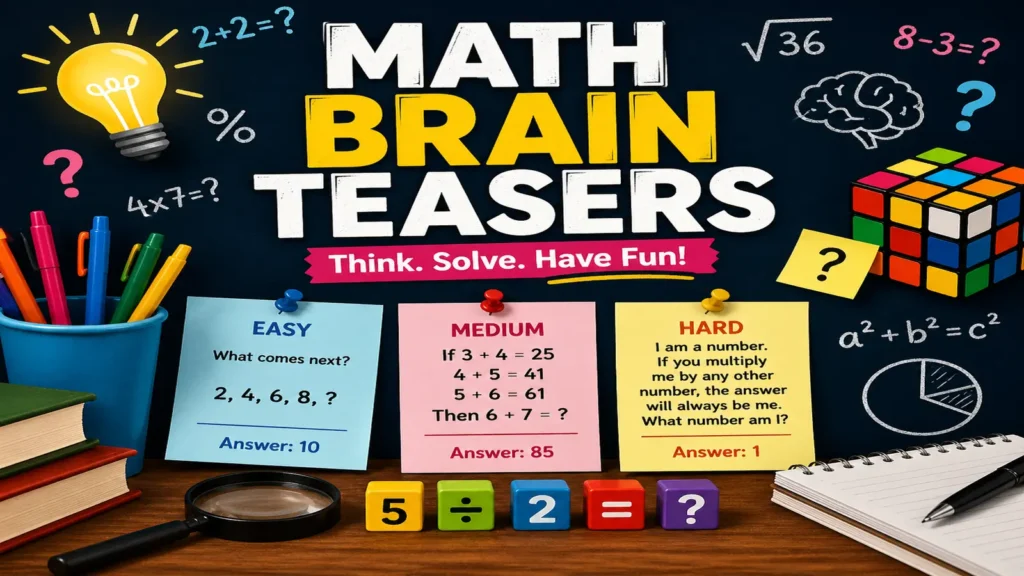
Math can feel scary when it looks like a test. However, it feels different when it becomes a puzzle.
This guide is for students, parents, teachers, and puzzle fans. You will find math brain teasers for quick practice, group fun, and deeper thinking.
Each section gives simple ideas, useful examples, and clear answers. So, you can play, learn, and challenge yourself without pressure.
Quick Answer
Math brain teasers are short puzzles that use numbers, logic, patterns, or shapes. They help readers practice careful thinking while having fun.
TL;DR
• Great for kids, adults, teachers, and families
• Answers help readers check thinking fast
• Use easy puzzles before harder ones
• Patterns often hide the main rule
• Careful reading beats rushing every time
• Printable puzzles work well offline
Easy Math Brain Teasers for Quick Wins
Easy puzzles help readers feel ready. They also make math feel playful instead of stressful.
Start with simple clues and small numbers. Then, increase the challenge once confidence grows.
• Add 8 + 8 + 8 for 24
• Double 6, then subtract 3
• Half of 20 is 10
• Three nickels equal 15 cents
• Ten fingers plus ten toes make 20
• Four sides make one square
• Seven days complete one week
• Twelve months finish one year
• Five pairs of socks make 10 socks
• Nine minus four leaves five
• Six groups of two make 12
• Twenty minus half of ten equals 15
Tricky Number Puzzles With Answers
Number puzzles often look simple at first. However, one small rule can change everything.
Read each symbol and word slowly. Also, check the order before choosing an answer.
• 9 × 9 + 9 – 9 = 81
• 5 + 5 × 2 = 15
• 12 ÷ 3 + 4 = 8
• 7 + 3 × 0 = 7
• 18 – 6 ÷ 3 = 16
• 4 × 4 – 4 = 12
• 20 ÷ 5 × 2 = 8
• 6 + 6 ÷ 6 = 7
• 3 × 3 + 3 = 12
• 10 – 2 × 4 = 2
• 8 ÷ 2 + 6 = 10
• 11 + 1 × 0 = 11
Logic Math Brain Teasers for Deeper Thinking
Logic puzzles ask you to reason, not just count. Because of this, the best answer may feel hidden.
Try listing what must be true first. Then, remove choices that cannot work.
• If all cats have tails, Max likely does
• Two even numbers always sum even
• Three odd numbers always sum odd
• One false clue can mislead everyone
• A square is always a rectangle
• A rectangle is not always square
• Zero added changes no value
• Multiplying by one keeps numbers equal
• Any number times zero becomes zero
• Opposite numbers add to zero
• Larger digits do not always mean larger value
• Equal signs mean both sides match
Pattern and Sequence Brain Teasers
Pattern puzzles reward patience. They also train you to look for rules before guessing.
Some patterns add, subtract, multiply, or alternate. Meanwhile, others change in two ways at once.
• 2, 4, 6, 8, next is 10
• 5, 10, 20, next is 40
• 1, 4, 9, next is 16
• 3, 6, 12, next is 24
• 10, 8, 6, next is 4
• 1, 1, 2, 3, next is 5
• 100, 90, 80, next is 70
• 7, 14, 21, next is 28
• 2, 5, 8, next is 11
• 64, 32, 16, next is 8
• 11, 22, 33, next is 44
• 1, 3, 6, 10, next is 15
Word Problem Brain Teasers That Feel Like Stories
Story puzzles make math easier to picture. However, they can also hide extra details.
Underline the numbers and action words. Next, decide what the puzzle is really asking.
• Mia has 3 apples and buys 4 more
• Ben spends $2 from $10, keeping $8
• Four birds land, then two fly away
• A bus gains five riders, then loses three
• Sam walks two miles, then three more
• Ava bakes 12 cookies and shares six
• Dad cuts one pizza into eight slices
• Ten balloons pop, leaving no balloons
• A dog has four legs, two dogs have eight
• Three kids split nine cards evenly
• Nora saves $5 each week for $20
• A clock strikes noon after eleven o’clock
Visual and Shape Math Brain Teasers
Visual puzzles use space, size, and placement. So, looking carefully matters more than speed.
Turn the page if needed. Also, count hidden sides, corners, and repeated shapes.
• One triangle has three sides
• Two squares can make a rectangle
• A cube has six faces
• Four equal sides can form a square
• Circles have no corners
• A pentagon has five sides
• Two triangles can build one square
• A line of symmetry splits evenly
• Opposite sides of rectangles match
• Three rows of three dots make nine
• A dozen dots can form four groups
• A checkerboard corner has one square
Classroom Math Brain Teasers for Students
Classrooms are perfect for short puzzles. They give students a warm start without heavy pressure.
Use them as bell work, partner tasks, or exit questions. Also, invite students to explain their thinking.
• Post one puzzle before class starts
• Let partners compare answer paths
• Ask students to defend one solution
• Use timers for friendly focus
• Keep harder hints face down
• Rotate puzzle cards weekly
• Celebrate smart mistakes kindly
• Invite quiet students through writing
• Mix number and shape challenges
• Save favorites for review days
• Let groups create answer posters
• End lessons with one quick riddle
Family Game Night Math Brain Teasers
Math puzzles can become a fun group game. In addition, they work across ages when rules stay simple.
Let younger players answer easier rounds. Meanwhile, older players can explain clues or write new puzzles.
• Split players into small teams
• Give one point for clear reasoning
• Offer hints after sixty seconds
• Let kids read the clues aloud
• Use coins as score markers
• Keep answers hidden until voting
• Add bonus points for teamwork
• Allow drawing during shape rounds
• Try three easy puzzles first
• End with a family-made challenge
• Let grandparents choose mystery numbers
• Trade puzzle cards between teams
Hard Math Brain Teasers for Adults
Hard puzzles should feel challenging, not cruel. Therefore, fair clues matter more than fancy numbers.
Many adult puzzles depend on assumptions. So, pause and ask what the question leaves unsaid.
• Three consecutive numbers total 72
• Half a number plus 10 equals 25
• A number doubled then squared becomes 64
• Two numbers multiply to 36 and sum 13
• Four friends split $100 unevenly but fairly
• A train gains speed every minute
• A code doubles letters into numbers
• One wrong assumption ruins the path
• Reversing digits can change the value
• Percent changes do not always cancel
• Average speed differs from speed average
• A fair split may not mean equal
Printable and Screen-Free Math Brain Teasers
Printable puzzles are easy to reuse. They also help readers focus without tabs or notifications.
Keep a small puzzle folder nearby. Then, use it during car rides, quiet time, or early finishes.
• Print puzzles on sturdy paper
• Laminate cards for repeated practice
• Store answer keys separately
• Use clipboards for car trips
• Create folders by difficulty level
• Add blank space for scratch work
• Cut cards for quick stations
• Keep pencils with puzzle packs
• Use envelopes for mystery rounds
• Mark solved cards with stickers
• Save tricky cards for weekends
• Trade finished sheets with friends
How to Solve Math Brain Teasers Faster
Speed improves with better habits. However, rushing usually causes the biggest mistakes.
Start by slowing down for ten seconds. Then, choose a method and test your answer.
• Read the question twice
• Circle important numbers first
• Watch words like half and total
• Check operation order carefully
• Draw a quick sketch
• Try smaller numbers first
• Make a short table
• Guess, test, then adjust
• Look for hidden patterns
• Remove impossible answers early
• Explain your answer aloud
• Recheck the final question
How to Make Your Own Math Brain Teasers
Making puzzles helps you understand them better. It also turns practice into a creative game.
Begin with one clear answer. After that, build a short story or pattern around it.
• Choose the answer before writing
• Use small numbers at first
• Add one clever twist only
• Keep clues fair and clear
• Avoid extra unused details
• Test the puzzle on paper
• Write one helpful hint
• Make the wording short
• Check for two possible answers
• Ask a friend to solve
• Rewrite confusing parts immediately
• Save your best puzzle ideas
FAQs
What are math brain teasers?
Math brain teasers are short puzzles using numbers, shapes, logic, or patterns. They are meant to make you think in a fresh way.
Are math brain teasers good for kids?
Yes, they can be great for kids when the level fits. They help with focus, confidence, and problem solving.
Can adults enjoy math brain teasers too?
Absolutely, adults often enjoy harder puzzles with hidden assumptions. They are also fun for breaks, parties, and family games.
What makes a math brain teaser tricky?
A tricky puzzle usually hides a rule or uses wording carefully. Sometimes the math is easy, but the thinking is not.
How do I solve math brain teasers with answers?
Try solving before looking at the answer. Then, compare your steps with the solution and fix any missed clue.
Are printable math brain teasers useful?
Yes, printable puzzles work well at home, in classrooms, and during travel. They are simple to store and reuse.
What is a good first math brain teaser?
Start with a short number pattern or simple word problem. Choose one with a clear answer and no confusing wording.
Conclusion
Math puzzles work best when they feel playful. They invite readers to slow down, notice clues, and test ideas. Use easy puzzles first, then move into harder rounds. Also, try different styles so every reader finds a favorite. With steady practice, math brain teasers can turn numbers into a fun challenge. They are useful for learning, games, and everyday thinking.

Joseph Morgan is an enigmatist known for creating clever and mysterious riddles. Born in Scotland, he spent his life challenging people to think deeply through puzzles and brainteasers. He became famous for his creative mind and love of mystery.