
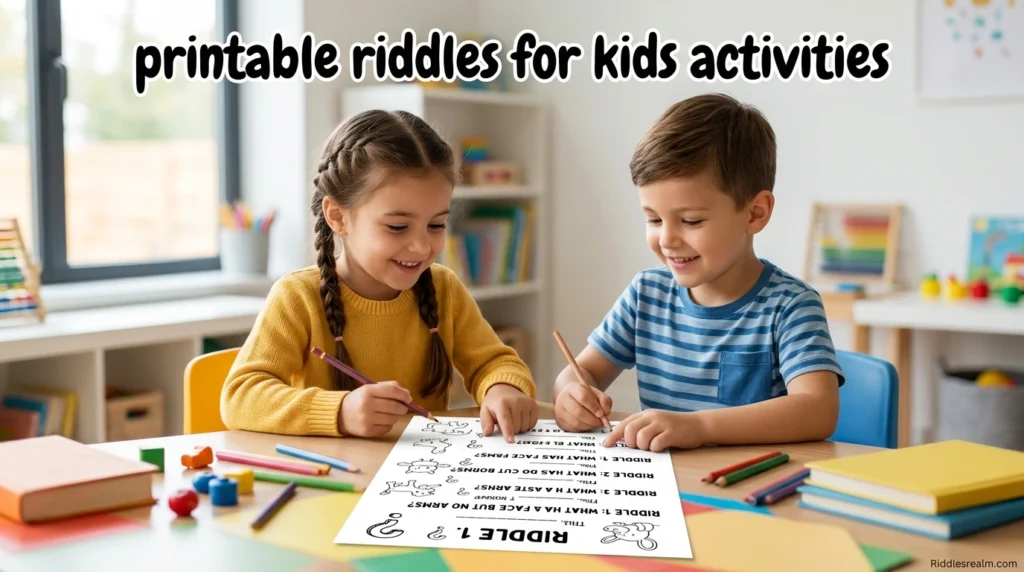
Printable riddles for kids activities are a simple way to make learning feel like play. Kids enjoy guessing answers, laughing at funny clues, and feeling proud when they solve a tricky question. At the same time, parents and teachers can use riddles to build reading skills, vocabulary, logic, creativity, and problem-solving.
Because riddles are short and flexible, they fit almost anywhere. You can use them during classroom brain breaks, family game nights, birthday parties, homeschool lessons, road trips, rainy days, or quiet time at home. Best of all, printable riddle worksheets are easy to prepare. You only need a page, a pencil, and a curious mind. In this guide, you will find fun riddle categories, printable activity ideas, sample riddles with answers, classroom uses, party games, and helpful tips for making riddle pages more exciting for kids.
Table of Contents
- What Are Printable Riddles for Kids Activities?
- Why Printable Riddles Are Great for Kids
- Best Ages for Kids Riddle Worksheets
- How to Use Printable Riddles at Home
- How Teachers Can Use Riddles in the Classroom
- Easy Printable Riddles for Young Kids
- Funny Printable Riddles for Kids
- Animal Riddles for Printable Activities
- Food Riddles for Kids Worksheets
- Logic Riddles and Brain Teasers for Kids
- Rhyming Riddles for Reading Practice
- Holiday and Seasonal Printable Riddles
- Party Riddle Games for Kids
- How to Make a Printable Riddle Worksheet
- Tips for Making Riddles More Fun
- Printable Riddle Activity Ideas by Setting
- Sample Printable Riddle Worksheet
- Best Riddle Categories for Kids
- How Printable Riddles Support Learning
- Common Mistakes to Avoid
- FAQ About Printable Riddles for Kids Activities
- Conclusion
What Are Printable Riddles for Kids Activities?
Printable riddles for kids activities are puzzle pages, riddle cards, worksheets, or activity sheets that children can solve on paper. Each riddle gives clues about an answer without naming it directly.
For example:
Riddle: What has hands but cannot clap?
Answer: A clock.
This type of question makes kids think beyond the obvious meaning of words. Since the answer is hidden in the clue, children must read carefully and connect ideas.
Printable riddle activities can include:
- Riddle worksheets with answer lines
- Riddle cards for group games
- Matching riddle and answer pages
- Multiple-choice riddle quizzes
- Cut-and-paste puzzle sheets
- Riddle treasure hunt clues
- Brain teaser activity pages
- Holiday riddle printables
- Classroom riddle challenges
- Family game night cards
These activities are useful because they are easy to print, share, and reuse. Also, they can be adapted for different ages, reading levels, and settings.
A printable riddle page may be simple, funny, educational, or challenging. However, the main goal is always the same: help kids think, laugh, and learn.
Why Printable Riddles Are Great for Kids
Printable riddles are more than quick entertainment. They support many important learning skills while keeping children engaged.
First, riddles improve reading comprehension. Kids must pay attention to each word because small clues often lead to the answer. As a result, they learn to read more carefully.
Second, riddles build vocabulary. Many riddles include describing words, action words, categories, and double meanings. Because of this, children learn how words can work in different ways.
Third, riddles encourage critical thinking. Kids must compare clues, make guesses, test ideas, and change their answers when needed.
Printable riddles also help children practice:
- Problem-solving
- Logical thinking
- Creative thinking
- Listening skills
- Speaking skills
- Writing skills
- Teamwork
- Confidence
- Patience
- Focus
Another benefit is that riddles feel low-pressure. A child who does not enjoy long worksheets may still enjoy a riddle page because it feels like a game.
In addition, printable riddles are screen-free. Therefore, they are a helpful choice for parents and teachers who want fun offline activities.
Best Ages for Kids Riddle Worksheets
Printable riddles can work for many age groups. However, the difficulty should match the child’s reading level, attention span, and thinking skills.
Ages 4–6: Simple Picture and Object Riddles
Young children enjoy riddles about familiar things. These may include animals, toys, colors, food, weather, and family objects.
At this age, riddles should be short and clear.
Example:
Riddle: I am yellow, long, and monkeys like me. What am I?
Answer: A banana.
For preschool and kindergarten children, picture clues can help. Kids can also draw the answer instead of writing it.
Good printable formats for this age include:
- Picture riddle worksheets
- Circle-the-answer pages
- Draw-the-answer boxes
- Simple matching activities
- One-riddle-per-card games
Ages 7–9: Easy Wordplay and Funny Riddles
Children in early elementary grades can understand simple wordplay and silly answers. They often enjoy joke-style riddles because the answers make them laugh.
Example:
Riddle: What gets wetter the more it dries?
Answer: A towel.
For this age group, printable riddle worksheets can include short answer lines, matching sections, and simple riddle quizzes.
Good activity types include:
- Funny riddle worksheets
- Animal riddle pages
- Food riddle cards
- School-themed riddles
- Partner guessing games
Ages 10–12: Logic Riddles and Brain Teasers
Older kids can handle harder clues, hidden meanings, and logic-based riddles. They enjoy puzzles that make them pause and think.
Example:
Riddle: What belongs to you, but other people use it more than you do?
Answer: Your name.
For upper elementary and middle school students, printable brain teasers can include longer clues, trick questions, and mystery-style puzzles.
Good activity types include:
- Logic riddle worksheets
- Team riddle challenges
- Timed brain teasers
- Mystery clue cards
- Write-your-own-riddle pages
Ages 13+: Harder Riddles and Group Challenges
Teens often enjoy clever riddles, lateral thinking puzzles, and competitive games. They may like riddles that feel challenging without being unfair.
For this age group, use riddles that require deeper reasoning. However, avoid confusing clues that have no clear answer.
Good activity types include:
- Hard riddle quizzes
- Group discussion riddles
- Escape-room-style clues
- Debate-the-answer challenges
- Creative riddle writing tasks
How to Use Printable Riddles at Home
Printable riddles are easy to use at home because they do not need special supplies. You can print a worksheet, cut riddle cards, or read clues aloud.
Here are simple ways to use them:
- Add one riddle to the breakfast table.
- Put a riddle card in a lunchbox.
- Use a riddle worksheet during quiet time.
- Read one riddle before bedtime.
- Create a weekend family riddle contest.
- Start a rainy day puzzle challenge.
- Keep riddle cards in the car for road trips.
- Let siblings quiz each other.
- Use riddles as a screen-free reward.
- Place riddles in a jar for daily fun.
A riddle jar is especially easy to make. Print several riddles, cut them into strips, fold them, and place them in a container. Then, each child can pick one riddle each day.
This works well because it adds surprise. Also, children enjoy choosing their own clue.
Parents can also turn riddles into a family game. One person reads the riddle aloud, while everyone else writes an answer. After that, each person explains their thinking. This encourages communication and builds confidence.
How Teachers Can Use Riddles in the Classroom
Teachers can use printable riddles in many ways. Since riddles are short, they fit into small gaps during the school day.
Brain Breaks
A quick riddle can help students reset between lessons. After a long reading or math task, one riddle can refresh the class.
Teachers can display a riddle on the board, read it aloud, and let students solve it with a partner. Then, the class can discuss the answer.
Morning Work
Printable riddle worksheets make great morning work. Students can enter the classroom, read the riddle, write an answer, and explain the clue that helped them.
This creates a calm start to the day. It also gives students a thinking task right away.
Early Finisher Tasks
Some students finish assignments faster than others. Therefore, riddle activity sheets are useful for early finishers.
Instead of waiting with nothing to do, students can solve a riddle page, create their own riddle, or work on a challenge card.
Reading Practice
Riddles help students read closely. Since each clue matters, students must slow down and think about meaning.
Teachers can ask questions such as:
- What clue helped you most?
- Which word was tricky?
- Did the riddle use a double meaning?
- Why does the answer make sense?
These questions improve reading comprehension.
Vocabulary Lessons
Riddles can support vocabulary because they often use categories, descriptions, and multiple meanings.
For example, a riddle about a “bat” might mean an animal or sports equipment. This helps students understand context.
Team Challenges
Riddle games work well in small groups. Students can solve clues together, share ideas, and explain their reasoning.
Team activities also build cooperation. However, each student should have a chance to speak.
Exit Tickets
At the end of class, a teacher can use one riddle as an exit ticket. Students write the answer and explain one clue.
This is a fun way to end a lesson while still checking thinking skills.
Easy Printable Riddles for Young Kids
Easy riddles are best for beginners, preschoolers, kindergarten students, and early elementary children. These riddles use familiar objects and simple clues.
Easy Riddles with Answers
- Riddle: I have four legs and bark. What am I?
Answer: A dog. - Riddle: I shine in the sky during the day. What am I?
Answer: The sun. - Riddle: I have pages and a cover. You read me. What am I?
Answer: A book. - Riddle: I am cold, white, and fall from the sky. What am I?
Answer: Snow. - Riddle: I help you write and have an eraser. What am I?
Answer: A pencil. - Riddle: I have wheels and take you places. What am I?
Answer: A car. - Riddle: I am sweet, cold, and come in a cone. What am I?
Answer: Ice cream. - Riddle: I am round, orange, and you can bounce me. What am I?
Answer: A ball. - Riddle: I open and close, and you walk through me. What am I?
Answer: A door. - Riddle: I keep your feet warm. What am I?
Answer: Socks.
Printable Activity Idea
Create a “Read, Guess, and Draw” worksheet. Put one riddle in each box. After kids solve the riddle, they draw the answer.
This activity is helpful for young learners because it combines reading, thinking, and art.
Funny Printable Riddles for Kids
Funny riddles are perfect for laughter, parties, classroom fun, and family activities. They often use puns, silly ideas, or surprise answers.
Funny Riddles with Answers
- Riddle: Why did the math book look sad?
Answer: It had too many problems. - Riddle: What do you call a bear with no teeth?
Answer: A gummy bear. - Riddle: Why did the cookie go to the doctor?
Answer: It felt crummy. - Riddle: What kind of tree fits in your hand?
Answer: A palm tree. - Riddle: Why can’t your nose be 12 inches long?
Answer: Because then it would be a foot. - Riddle: What did one wall say to the other wall?
Answer: I’ll meet you at the corner. - Riddle: Why did the student eat his homework?
Answer: Because the teacher said it was a piece of cake. - Riddle: What has ears but cannot hear?
Answer: Corn. - Riddle: Why did the banana go to the doctor?
Answer: It was not peeling well. - Riddle: What do you call cheese that is not yours?
Answer: Nacho cheese.
Printable Activity Idea
Make a “Laugh and Match” worksheet. Put funny riddles on one side and answers on the other side. Kids draw lines to match each riddle with the correct answer.
This activity supports reading, memory, and attention. Also, it gives kids a reason to reread the clues.
Animal Riddles for Printable Activities
Animal riddles are always popular with kids. They work well for science lessons, zoo themes, farm units, nature activities, and party games.
Animal Riddles with Answers
- Riddle: I have a mane and roar loudly. What am I?
Answer: A lion. - Riddle: I am black and white, and I love bamboo. What am I?
Answer: A panda. - Riddle: I hop and carry my baby in a pouch. What am I?
Answer: A kangaroo. - Riddle: I swim in the ocean and have eight arms. What am I?
Answer: An octopus. - Riddle: I am slow, carry my home, and have a shell. What am I?
Answer: A turtle. - Riddle: I buzz around flowers and make honey. What am I?
Answer: A bee. - Riddle: I have stripes and look like a horse. What am I?
Answer: A zebra. - Riddle: I sleep upside down and fly at night. What am I?
Answer: A bat. - Riddle: I have a trunk but do not pack clothes. What am I?
Answer: An elephant. - Riddle: I say “ribbit” and jump near ponds. What am I?
Answer: A frog.
Printable Activity Idea
Create an “Animal Clue Hunt.” Print animal riddles on cards and hide them around the room. Children find each card, solve the clue, and write the answer on a worksheet.
This activity adds movement, so it works well for active learners.
Food Riddles for Kids Worksheets
Food riddles are simple, funny, and easy for children to understand. They are useful for lunchroom activities, cooking themes, nutrition lessons, and birthday parties.
Food Riddles with Answers
- Riddle: I am red, round, and grow on a tree. What am I?
Answer: An apple. - Riddle: I am long, yellow, and easy to peel. What am I?
Answer: A banana. - Riddle: I am made of bread, cheese, and sauce. What am I?
Answer: Pizza. - Riddle: I am green, crunchy, and found in salads. What am I?
Answer: Lettuce. - Riddle: I pop when I get hot. What am I?
Answer: Popcorn. - Riddle: I am sweet, round, and have a hole in the middle. What am I?
Answer: A donut. - Riddle: I come in a shell and can be scrambled. What am I?
Answer: An egg. - Riddle: I am orange, crunchy, and rabbits like me. What am I?
Answer: A carrot. - Riddle: I am cold, creamy, and melt in the sun. What am I?
Answer: Ice cream. - Riddle: I am small, round, and found in a bunch. What am I?
Answer: A grape.
Printable Activity Idea
Use a “Menu Mystery” worksheet. Kids solve food riddles and then create a pretend menu using the answers.
This activity adds writing practice and creativity. It can also connect with lessons about food groups or healthy choices.
Logic Riddles and Brain Teasers for Kids
Logic riddles help children slow down and think carefully. Unlike simple object riddles, these puzzles often use hidden meanings or clever wording.
Logic Riddles with Answers
- Riddle: What has keys but cannot open locks?
Answer: A piano. - Riddle: What has a face and two hands but no arms or legs?
Answer: A clock. - Riddle: What goes up but never comes down?
Answer: Your age. - Riddle: What has a neck but no head?
Answer: A bottle. - Riddle: What can travel around the world while staying in one corner?
Answer: A stamp. - Riddle: What belongs to you, but other people use it more than you do?
Answer: Your name. - Riddle: What has many teeth but cannot bite?
Answer: A comb. - Riddle: What gets bigger the more you take away?
Answer: A hole. - Riddle: What has words but never speaks?
Answer: A book. - Riddle: What has one eye but cannot see?
Answer: A needle.
Printable Activity Idea
Make a “Think Twice” riddle sheet. Add space under each riddle for three short answers:
- My first guess
- My final answer
- The clue that helped me
This teaches kids that changing an answer after thinking is part of good problem-solving.
Rhyming Riddles for Reading Practice
Rhyming riddles are excellent for early reading practice. They support sound awareness, rhythm, fluency, and vocabulary.
Because rhyming riddles sound playful, many kids enjoy reading them aloud.
Rhyming Riddles with Answers
- Riddle: I am small and like to squeak. I hide in holes and cheese I seek.
Answer: A mouse. - Riddle: I shine at night with gentle light. Look up high, I’m round and bright.
Answer: The moon. - Riddle: I wag my tail and love to play. I bark hello throughout the day.
Answer: A dog. - Riddle: I buzz near flowers in the sun. I make sweet honey, yum, yum, yum.
Answer: A bee. - Riddle: I swim with fins and cannot talk. I live in water, not on a walk.
Answer: A fish. - Riddle: I fall from clouds, soft and white. I cover the ground on winter nights.
Answer: Snow. - Riddle: I am round and made to bounce. Catch me quick before I pounce.
Answer: A ball. - Riddle: I have four legs and like to run. I neigh outside and have such fun.
Answer: A horse.
Printable Activity Idea
Create a “Finish the Rhyme” worksheet. Give students most of the riddle, but leave out one rhyming word. Then, ask them to complete the clue and solve the answer.
This activity supports phonics, spelling, and creative thinking.
Holiday and Seasonal Printable Riddles
Holiday riddles make printable activities feel fresh and exciting. They work well for classroom parties, family gatherings, seasonal lessons, and themed activity centers.
Halloween Riddles
- Riddle: I fly at night and sleep upside down. What am I?
Answer: A bat. - Riddle: I am orange, carved, and glow in the dark. What am I?
Answer: A jack-o’-lantern. - Riddle: I say “boo” and float around. What am I?
Answer: A ghost. - Riddle: I wear a pointed hat and ride a broom. What am I?
Answer: A witch.
Thanksgiving Riddles
- Riddle: I gobble and have feathers. What am I?
Answer: A turkey. - Riddle: I am round, orange, and baked in a pie. What am I?
Answer: A pumpkin. - Riddle: I am a meal shared with family and thanks. What am I?
Answer: Thanksgiving dinner. - Riddle: I am red, tart, and often served as sauce. What am I?
Answer: Cranberry.
Christmas Riddles
- Riddle: I have lights, ornaments, and a star on top. What am I?
Answer: A Christmas tree. - Riddle: I am pulled by reindeer and carry gifts. What am I?
Answer: Santa’s sleigh. - Riddle: I am cold, round, and made outside in winter. What am I?
Answer: A snowman. - Riddle: I hang by the fireplace and wait for treats. What am I?
Answer: A stocking.
Spring Riddles
- Riddle: I bloom in gardens and smell sweet. What am I?
Answer: A flower. - Riddle: I fall from clouds and help plants grow. What am I?
Answer: Rain. - Riddle: I come from a caterpillar and have colorful wings. What am I?
Answer: A butterfly. - Riddle: I am a baby bird’s first home. What am I?
Answer: An egg.
Printable Activity Idea
Create seasonal riddle cards. Place them in a holiday basket, party station, or classroom center. Kids can pull one card, solve it, and share the answer.
This makes holiday learning simple and fun.
Party Riddle Games for Kids
Printable riddles can turn a birthday party, classroom celebration, or family gathering into an easy game. Since they are low-cost and quick to prepare, they are useful for busy parents and teachers.
Riddle Treasure Hunt
Print clues that lead kids from one place to another. Each riddle answer tells them where to go next.
Example:
Riddle: I keep food cold and have a door.
Answer: Refrigerator.
Place the next clue near the refrigerator. Continue until kids find a small prize.
Riddle Relay
Divide kids into teams. Each team gets a stack of riddle cards. One player solves a riddle, runs to the answer station, and returns before the next player begins.
This game adds movement and teamwork.
Riddle Bingo
Create bingo boards with answer words. Then, read riddles aloud. Kids cover the correct answer when they solve each clue.
This works well for classrooms, parties, and family nights.
Guess and Grab
Place riddle cards in a bowl. A child picks a card and reads it aloud. If another child answers correctly, that child gets the next turn.
This game is simple, quick, and easy to set up.
Mystery Bag Riddles
Put objects in a bag. Read a riddle about one object. Kids guess the answer, then pull the object from the bag.
This is especially fun for younger children because they can see and touch the answer.
How to Make a Printable Riddle Worksheet
A good printable riddle worksheet should be clear, fun, and age-appropriate. It should also include enough space for kids to write or draw.
Step 1: Choose a Theme
Pick one theme so the worksheet feels focused. Good themes include:
- Animals
- Food
- School supplies
- Weather
- Holidays
- Sports
- Space
- Family
- Nature
- Funny jokes
A theme helps children use what they already know. Also, it makes the printable page more attractive.
Step 2: Choose the Difficulty Level
Match the riddles to the child’s age and reading level.
Use this simple guide:
- Easy: Direct clues and familiar objects
- Medium: Some wordplay or hidden meaning
- Hard: Logic, double meanings, or multi-step thinking
For best results, mix easy and medium riddles. Then, add one or two challenge questions.
Step 3: Add Clear Instructions
Children should know exactly what to do. Use simple directions such as:
- Read each riddle.
- Write the answer on the line.
- Check your answers at the end.
- Draw your favorite answer.
- Write one riddle of your own.
Clear directions help kids work independently.
Step 4: Leave Enough Space
Kids need room to write. Younger children may also need space to draw.
Avoid crowding too many riddles on one page. A clean page feels easier and more inviting.
Step 5: Include an Answer Key
An answer key saves time for parents and teachers. It also lets kids check their own work.
For younger children, place the answer key on a separate page. For older kids, you can put it at the bottom or back.
Step 6: Add a Bonus Challenge
A bonus challenge makes the worksheet more engaging.
Examples include:
- Write your own riddle.
- Draw three answers.
- Circle the funniest riddle.
- Share one riddle with a friend.
- Create a new clue for one answer.
- Sort the answers into categories.
- Explain how you solved the hardest riddle.
These extras help children move from solving to creating.
Tips for Making Riddles More Fun
Riddles are already enjoyable, but a few simple changes can make them even better.
Use Themes Kids Like
Choose themes based on children’s interests. Some kids love animals, while others enjoy dinosaurs, sports, space, superheroes, or food.
When the topic feels familiar, kids become more excited to participate.
Mix Easy and Tricky Riddles
If every riddle is too easy, kids may get bored. However, if every riddle is too hard, they may give up.
A good printable page may include:
- 5 easy riddles
- 3 medium riddles
- 2 challenge riddles
This mix keeps the activity fun and fair.
Let Kids Work Together
Pair work makes riddles more social. Kids can share guesses, explain clues, and help each other think.
This also builds communication skills.
Add Movement
Hide riddle cards around the room. Ask children to walk, search, solve, and record answers.
This turns a simple worksheet into an active game.
Use Timed Challenges Carefully
A timer can make riddle games exciting. However, some children feel pressure when timed.
Therefore, use timers for fun, not stress. You can say, “Let’s see how many we can solve together,” instead of making it a race.
Celebrate Creative Answers
Sometimes children give answers that are not expected but still make sense. When that happens, ask them to explain their thinking.
This supports creativity and flexible reasoning.
Invite Kids to Write Riddles
After solving several riddles, children can create their own. This helps them practice description, word choice, and logical clues.
Use this simple riddle-writing frame:
- My answer is: ________
- It looks like: ________
- It does: ________
- It is found: ________
- My riddle is: ________
Printable Riddle Activity Ideas by Setting
Printable riddles for kids activities can be adapted for almost any place. Below are practical ideas for home, school, homeschool, parties, travel, and libraries.
At Home
Use printable riddles for quiet fun, family bonding, or homework breaks.
Good ideas include:
- Breakfast riddle of the day
- Family riddle contest
- Riddle jar
- Bedtime brain teaser
- Weekend puzzle page
- Sibling riddle swap
- Screen-free afternoon activity
In the Classroom
Teachers can use riddles to support learning and classroom routines.
Good ideas include:
- Morning work page
- Bell ringer activity
- Partner puzzle
- Early finisher worksheet
- Team riddle race
- Reading comprehension warm-up
- Exit ticket question
- Vocabulary review game
During Homeschool Lessons
Homeschool parents can use riddles as flexible learning tools.
Good ideas include:
- Weekly riddle packet
- Subject-themed riddles
- Logic warm-up
- Creative writing prompt
- Read-aloud practice
- Parent-child riddle quiz
At Birthday Parties
Riddles make party games simple and affordable.
Good ideas include:
- Riddle treasure hunt
- Riddle bingo
- Mystery clue cards
- Team guessing game
- Prize box challenge
- Themed party riddles
On Road Trips
Printable riddles are helpful during long car rides.
Good ideas include:
- Travel riddle cards
- Road trip quiz sheet
- Family answer race
- “Read one, pass one” puzzle cards
- Backseat brain teaser challenge
In Libraries or Activity Centers
Riddles are great for reading events, clubs, and group programs.
Good ideas include:
- Riddle bulletin board
- Weekly puzzle station
- Book-themed riddle cards
- Library scavenger hunt
- Reading club brain teaser sheet
Sample Printable Riddle Worksheet
Use this sample format for a simple printable riddle activity page.
Instructions
Read each riddle. Write your answer on the line. Then, check the answer key.
- I have keys but no locks. What am I?
Answer: ____________________ - I am full of holes but still hold water. What am I?
Answer: ____________________ - I have a face and two hands, but I cannot smile. What am I?
Answer: ____________________ - I get wetter as I dry. What am I?
Answer: ____________________ - I am tall when I am young and short when I am old. What am I?
Answer: ____________________ - I have a head and a tail but no body. What am I?
Answer: ____________________ - I can be cracked, made, told, and played. What am I?
Answer: ____________________ - I fly without wings and cry without eyes. What am I?
Answer: ____________________ - I have many rings but no fingers. What am I?
Answer: ____________________ - I am always in front of you but cannot be seen. What am I?
Answer: ____________________
Answer Key
- Piano
- Sponge
- Clock
- Towel
- Candle
- Coin
- Joke
- Cloud
- Tree
- The future
Best Riddle Categories for Kids
Choosing the right category makes printable riddle worksheets more useful. Different categories support different skills, moods, and age groups.
Easy Riddles
Easy riddles are best for young learners, beginners, and quick warm-ups. They usually use familiar objects and simple clues.
Funny Riddles
Funny riddles are great for laughter, parties, lunch breaks, and relaxed classroom moments. They often use puns or silly answers.
Animal Riddles
Animal riddles work well for science, nature, zoo themes, and early learning. They help kids connect clues with animal traits.
Food Riddles
Food riddles are fun because children know the answers from daily life. They are great for lunchroom activities and party worksheets.
Logic Riddles
Logic riddles build reasoning and problem-solving. They are better for older kids or students who enjoy a challenge.
Rhyming Riddles
Rhyming riddles support reading fluency, phonics, and sound patterns. They are useful for early literacy.
Holiday Riddles
Holiday riddles make seasonal events more exciting. They work well for Halloween, Christmas, Thanksgiving, Valentine’s Day, Easter, and summer activities.
Classroom Riddles
Classroom riddles can include school supplies, subjects, teachers, books, and learning themes. They are perfect for morning work and brain breaks.
How Printable Riddles Support Learning
Printable riddles are more than fun puzzle sheets. They can support several learning areas at once.
Reading Skills
Kids must read carefully to understand each clue. They also learn to notice important words.
For example, a clue may say “I have keys but no locks.” Children must understand that “keys” can mean piano keys, not only door keys.
Vocabulary Growth
Riddles introduce describing words, action words, categories, and multiple meanings. As a result, children build stronger word knowledge.
They also learn how context changes meaning.
Critical Thinking
Riddles often hide the answer behind playful wording. Therefore, kids must compare ideas and think beyond the first guess.
This helps them practice flexible thinking.
Writing Skills
When children create their own riddles, they practice sentence structure, clue writing, and clear description.
They also learn how to give helpful clues without giving away the answer.
Speaking and Listening
Reading riddles aloud helps with fluency. Listening to others solve riddles builds attention, patience, and respect.
Group riddle games are especially useful for discussion.
Social Skills
Team riddle games teach turn-taking, cooperation, and respectful problem-solving.
Kids learn that different people may notice different clues. Because of this, teamwork can lead to better answers.
Common Mistakes to Avoid
Printable riddle activities should be fun and clear. However, a few mistakes can make them less effective.
Making Riddles Too Hard
If the riddles are too difficult, children may feel frustrated. Start with easier clues, then add harder ones.
A balanced worksheet keeps kids interested.
Using Unclear Wording
A good riddle should be tricky but fair. Avoid clues that are too vague or confusing.
Children should be able to understand why the answer works.
Skipping the Answer Key
Parents and teachers need an answer key. Kids also enjoy checking their own work.
An answer key saves time and prevents confusion.
Using Too Many Riddles on One Page
Crowded pages can overwhelm young learners. Use enough white space, especially for younger kids.
A clean layout makes the worksheet easier to complete.
Forgetting the Age Group
A riddle that works for a 12-year-old may not work for a 6-year-old. Match the puzzle to the child’s reading level.
Also, use familiar topics for younger children.
Not Explaining the Answers
Some riddles need a short explanation. When kids understand why the answer works, they learn more from the activity.
For example, explain that a piano has “keys,” but they are not used for locks.
FAQ About Printable Riddles for Kids Activities
What are printable riddles for kids activities?
Printable riddles for kids activities are puzzle pages, worksheets, riddle cards, or quiz sheets that children can solve on paper. They usually include clues, answer spaces, and an answer key.
Are riddles good for children’s learning?
Yes, riddles can support reading comprehension, vocabulary, problem-solving, logic, creativity, and speaking skills. They make learning feel like a game, so kids often stay more engaged.
What age group is best for printable riddles?
Printable riddles can work for ages 4 and up when the difficulty is age-appropriate. Younger kids need simple object clues, while older kids can enjoy logic riddles and tricky brain teasers.
How can teachers use printable riddles in class?
Teachers can use printable riddles as morning work, brain breaks, early finisher tasks, reading practice, team games, exit tickets, or vocabulary activities.
What should a kids riddle worksheet include?
A good kids riddle worksheet should include clear instructions, age-appropriate riddles, enough writing space, a fun theme, and an answer key.
Can riddles help with reading comprehension?
Yes, riddles help children read closely. Since each clue matters, kids must pay attention to details, context, and word meaning.
What are the best riddle themes for kids?
Popular riddle themes include animals, food, school, holidays, weather, sports, space, nature, funny jokes, and everyday objects.
How many riddles should be on one printable page?
For younger kids, 5 to 8 riddles per page is usually enough. For older children, 10 to 15 riddles can work well if the page is not too crowded.
Are printable riddles good for parties?
Yes, printable riddles are excellent for birthday parties, classroom celebrations, family gatherings, and holiday events. They can be used for treasure hunts, bingo, team games, and quiz challenges.
How can kids create their own riddles?
Kids can choose an answer, list clues about it, hide the answer, and turn the clues into a question. For example, they can describe what it looks like, where it is found, and what it does.
Conclusion
Printable riddles for kids activities are simple, fun, and useful for learning. They help children read carefully, think creatively, solve problems, and laugh along the way. Also, they work in many settings, including classrooms, homes, parties, libraries, homeschool lessons, and road trips.
The best part is that riddles do not need fancy supplies. A printed page, a pencil, and a curious mind are enough. You can use easy riddles for young kids, funny riddles for laughter, animal riddles for themed lessons, logic riddles for brain workouts, and holiday riddles for seasonal fun. So, print a riddle sheet, gather the kids, and start the guessing game. A small clue can lead to a big smile, and one clever answer can turn an ordinary moment into a memorable activity.

A modern riddle-maker who builds clever, pocket-sized puzzles with sharp wordplay and elegant misdirection. Her clues are clean, surprising, and designed to make you think twice—then smile when it clicks.