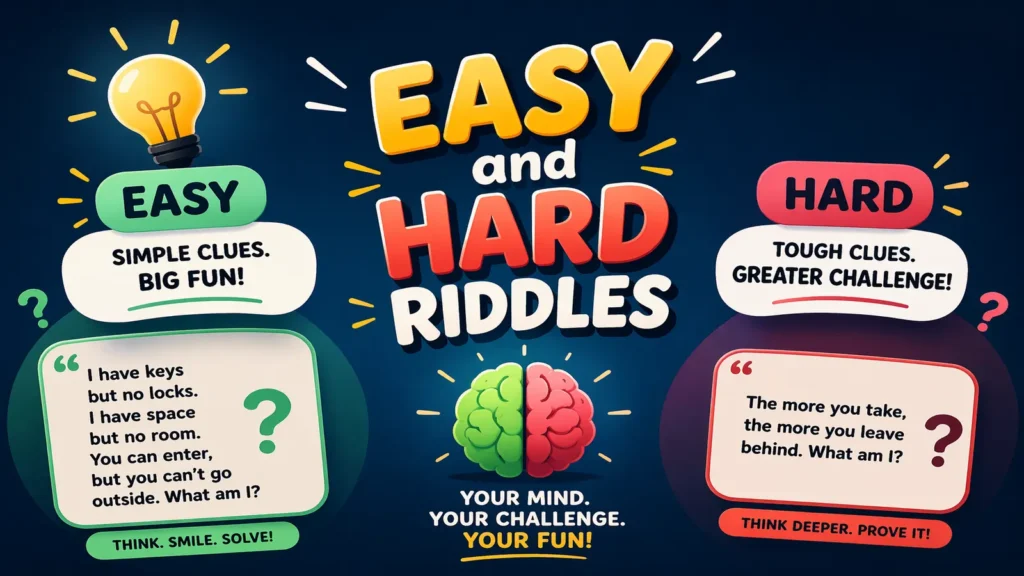
Riddles work for many kinds of readers. Some people want a quick laugh. Others want a real mental challenge. This guide is for both groups. It gives you examples, sorting ideas, and simple ways to enjoy them at home, in class, or with friends. If you are looking for Easy and Hard Riddles, you do not need one giant list alone. You need a smart mix that matches the moment, the audience, and the level of challenge you want.
Quick Answer
Easy and hard riddles both use clues, but they challenge you in different ways. Easy and Hard Riddles work best when the wording feels fair and the answer feels satisfying. Start with simple ones, then move into trickier wordplay and deeper logic.
TL;DR
• Easy riddles build confidence quickly
• Hard riddles reward patience and detail
• Tricky wording often beats long clues
• Funny riddles make group play easier
• Kid-friendly prompts still feel clever
• Fair answers matter more than difficulty
What Makes a Riddle Easy or Hard
A riddle feels easy when the clue points clearly toward one idea. A hard one hides that path a little better. Often, the best hard riddles stay short, yet they force you to rethink a key word.
Difficulty also depends on the audience. A kid may find one prompt tricky, while an adult solves it instantly.
• Easy riddles use familiar everyday objects
• Hard riddles hide meaning behind simple words
• Short clues can still mislead sharply
• Clear images help younger solvers answer
• Double meanings raise the challenge level
• Fair wording matters more than length
• Obscure answers usually feel less satisfying
• Good misdirection points somewhere believable
• Strong riddles reward second looks
• Word order can change everything
• Concrete clues feel easier to grasp
• Abstract clues slow people down
Easy Riddles to Warm Up Fast
Easy riddles are great openers. They help readers settle in and feel smart right away. Because of that, they work well for blogs, classes, and casual game nights.
These warm-ups should feel clean and friendly. The answer should arrive with a quick smile.
• What has keys but no locks? A piano.
• What gets wetter while drying? A towel.
• What has hands but cannot clap? A clock.
• What has one eye but cannot see? A needle.
• What goes up and never falls? Your age.
• What has a face but no eyes? A clock.
• What has many teeth without biting? A comb.
• What can fill rooms without weight? Light.
• What has pages but is not paper? A calendar.
• What has a neck but no head? A bottle.
• What belongs to you but others use? Your name.
• What kind of tree fits your hand? A palm.
Hard Riddles for Deep Thinkers
Hard riddles feel rewarding because they slow you down. At first, the clue seems simple. Then the wording starts pulling in two directions.
Good hard riddles do not depend on random trivia. Instead, they test patience, language, and logic.
• What runs yet never walks? Water.
• What breaks whenever you name it? Silence.
• What grows larger when removed? A hole.
• What has cities without people? A map.
• What can travel while staying cornered? A stamp.
• What tastes better than it smells? Your tongue.
• What can open, yet never close? An egg.
• What comes once in minutes? The letter M.
• What has branches but no leaves? A bank.
• What starts with T and ends full? Teapot.
• What can be caught, never thrown? A cold.
• What flies with wheels on roads? Garbage truck.
Funny Riddles for Friends and Family
Funny riddles lower the pressure. They keep people engaged, even when the answer is silly. That is why they work so well during dinners, road trips, and quick breaks.
The best ones feel light, not groan-worthy. A little surprise helps a lot.
• What building has the most stories? A library.
• Which animal jumps higher than houses? Any animal.
• What room has no windows? Mushroom.
• What kind of coat goes on wet? Paint.
• What has stripes and still says meow? Tiger.
• What gets sharper with use? Your brain.
• What has wheels and flies? Trash truck.
• What month has twenty-eight days? Every month.
• What black-and-white thing is read? Newspaper.
• What has bark but never bites? Tree.
• What can you hold without hands? Breath.
• What lives in winter upside down? Icicle.
Tricky Riddles with Twist Answers
Tricky riddles look easy on purpose. They lure you toward the obvious answer first. Then, right at the end, the clue flips.
These are perfect when you want a sharper surprise. They also keep readers scrolling because the reveal feels fun.
• What has a head and tail? Coin.
• What has words but never speaks? Book.
• What goes through keys, not doors? Piano.
• What has a ring but no finger? Phone.
• What comes down, not up? Rain.
• What gets shorter while working? Candle.
• What has a bed but never sleeps? River.
• What has a mouth without talking? River.
• What has a bottom, not pants? Bottle.
• What has holes yet holds water? Sponge.
• What has a cover but no pages? Pillowcase.
• What has numbers but cannot count? Clock.
Riddles for Kids That Still Feel Smart
Kids do best with bright images and direct language. Still, the riddle should not talk down to them. A strong kid-friendly riddle feels playful, not childish.
Short prompts also help young readers stay focused. Meanwhile, the answers should come from familiar things.
• What has four legs and a back? Chair.
• What has ears but cannot hear? Cornfield.
• What can run but never walk? Faucet water.
• What has a horn without honking? Rhino.
• What has wings but will not fly? Penguin.
• What has a shell and can crack? Nut.
• What rings but is not jewelry? Bell.
• What has lines but no paper? Notebook.
• What has a spine without bones? Book.
• What has a lid without a box? Trash can.
• What has arms but cannot hug? Jacket.
• What has buttons but no shirt? Keyboard.
Riddles for Adults Who Want More Challenge
Adults often enjoy clues with a little more tension. The wording can be tighter, and the answer can hide behind a second meaning. However, the answer still needs to feel fair.
These examples lean into that style. They ask you to pause before you guess.
• What is always ahead, never arrived? Tomorrow.
• What has no beginning, middle, end? Circle.
• What can be made, told, played? Joke.
• What loses a head, stays same? Pillowcase.
• What has many locks, one key? Hair.
• What can fall without injury? Night.
• What can speak without a mouth? Echo.
• What can be seen, never touched? Shadow.
• What gets bigger through sharing? Idea.
• What dies when food enters? Fire.
• What opens with words, not keys? Conversation.
• What rises after breaking? Daybreak.
Riddles for Classrooms, Parties, and Team Games
Group settings need quick, clear prompts. If the clue drags, people lose interest. Because of this, short riddles often work better than long ones.
Mixed-age groups also need balance. Start easy, then raise the difficulty once the room warms up.
• Use easy rounds to build momentum
• Mix kid prompts with adult twists
• Read each clue slowly once
• Allow team whispers before answering
• Keep score only if helpful
• Add bonus rounds for fast solvers
• Rotate readers to share attention
• Print cards for easier passing
• Save hardest prompts for later
• Use funny clues between tough ones
• Pair riddles with small prizes
• End with a crowd favorite
How to Solve Riddles Without Overthinking
Many people miss simple answers because they chase complex ones. First, slow down and look at each word. Then ask what the clue literally says.
Next, test common objects before abstract ideas. Very often, the answer is closer than it seems.
• Read the clue two times
• Stress unusual words in your head
• Look for double meanings first
• Check for object-based answers
• Remove assumptions before guessing
• Think literal before symbolic
• Break long clues into parts
• Ask what seems impossible here
• Notice tense, number, and order
• Say possible answers aloud
• Step away if stuck
• Return with a fresh angle
How to Write Your Own Good Riddles
Writing riddles is easier when you start with the answer. Pick one object or idea first. After that, list traits people know, then hide the most obvious one.
Good riddles give fair clues. They tease, but they do not cheat.
• Start with one clear answer
• List visible traits and uses
• Hide the most obvious clue
• Add one playful twist
• Keep each line short
• Avoid facts few people know
• Test it on one friend
• Remove extra words quickly
• Use rhythm for better flow
• Make the reveal feel earned
• Write easy and hard versions
• Stop before it turns messy
Common Mistakes That Ruin a Riddle
A weak riddle usually fails for one reason. Either the answer feels random, or the clue feels too vague. Sometimes both problems show up together.
Fortunately, these mistakes are easy to fix. Clearer wording helps almost every time.
• Multiple answers weaken the payoff
• Hidden trivia makes clues unfair
• Too many words kill suspense
• Too few clues feel random
• Overused answers feel stale
• Forced rhymes can sound awkward
• Vague pronouns create confusion
• Weak reveals disappoint readers
• Misdirection should still feel honest
• Repetition makes collections feel flat
• Tone shifts can break flow
• Unclear grammar blocks good guessing
Best Ways to Use Riddles Every Day
Riddles are flexible. You can use them at breakfast, in the classroom, or during a work break. As a result, they fit many routines without much effort.
Small daily uses often work best. A quick prompt can spark attention, laughter, or conversation.
• Start dinner with one short riddle
• Add one to morning meetings
• Use them in classroom transitions
• Share a daily family challenge
• Post one on a bulletin board
• Use riddles during road trips
• Add them to party invites
• Include one in newsletters
• Try a lunch-break puzzle swap
• Keep cards near the coffee table
• Turn chores into guessing games
• Save favorites in one notebook
FAQs
What is the difference between easy and hard riddles?
Easy riddles usually point toward a familiar object or idea. Hard riddles rely more on misdirection, double meanings, or unusual wording.
Are riddles good for kids and adults?
Yes, because the format is flexible. You can make them simple for young readers or more layered for older ones.
What are the best easy riddles to start with?
Start with objects most people know, like clocks, towels, books, and bottles. Those answers feel fair and help build confidence fast.
Why do some riddles sound easy but feel hard?
Usually, the words push you toward the wrong meaning first. Once you notice the twist, the answer seems obvious.
How do I make a hard riddle fair?
Give enough clues to point in one direction, even if the path is hidden. A fair hard riddle surprises people without making them feel tricked.
Can riddles work in classrooms and team games?
Yes, especially when the prompts are short and easy to read aloud. They work well for warm-ups, breaks, and quick group contests.
Conclusion
Some days call for simple wins. Other days call for a real mental workout. That is why a mix matters so much. Try a few styles, notice what makes you smile, and keep the good ones close. The best Easy and Hard Riddles are the ones that fit the room, the age group, and the mood without losing their spark.

Christopher McLagan is a celebrated riddle maker known for crafting clever brain teasers and mind-bending puzzles. His work blends classic riddles, logic challenges, and lateral thinking brain teasers designed to spark curiosity and critical thinking. Widely admired in online puzzle communities, McLagan creates engaging riddle questions and answers for both kids and adults. His signature style delivers surprising twists, clean humor, and satisfying “aha” moments that keep readers coming back for more.