
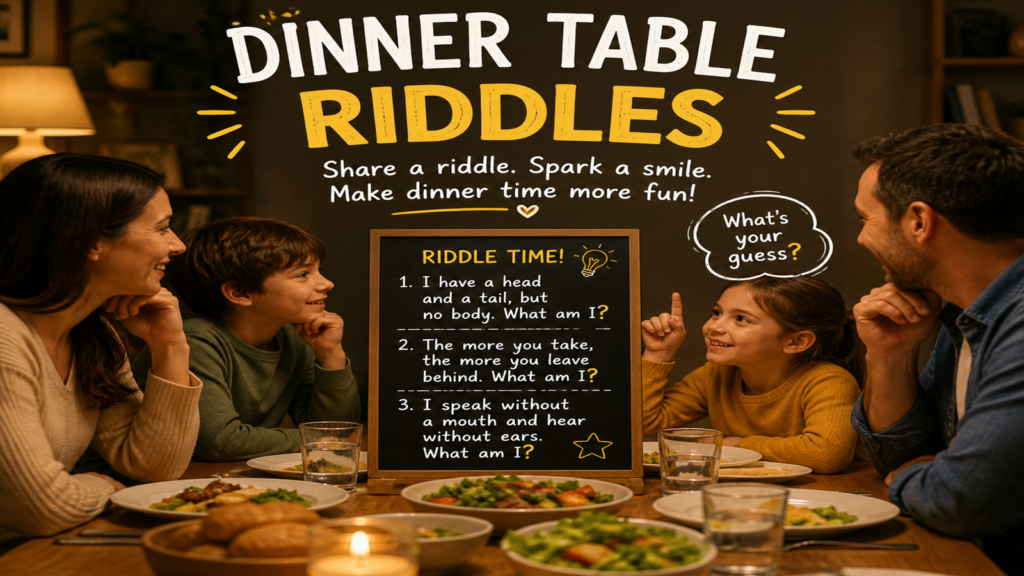
Dinner can feel rushed or quiet in many homes. However, adding simple games can change everything. That’s where dinner table riddles come in. They spark laughter, boost thinking, and bring people closer. In addition, they work for all ages. This guide shares easy, funny, and tricky riddles you can use tonight.
Quick Answer
Dinner table riddles are short puzzles shared during meals. They make conversations fun and interactive. Families use them to bond and stay engaged.
TL;DR
• Riddles make dinner more fun and engaging
• Easy riddles work best for younger kids
• Funny riddles create instant laughter
• Tricky riddles challenge older family members
• Use riddles to spark conversation naturally
Why Dinner Table Riddles Bring People Together
Riddles create shared moments during meals. They also help people talk more freely. As a result, dinner becomes more enjoyable.
• Encourage laughter across all age groups
• Break awkward silence during meals
• Help kids feel included in conversations
• Create friendly competition at the table
• Build stronger family connections daily
• Improve listening and attention skills
• Offer screen-free entertainment options
• Make routine dinners more exciting
• Support creative thinking through puzzles
• Help shy members join conversations
• Add structure to family interaction time
• Turn meals into memorable experiences
Easy Dinner Table Riddles for Kids
Simple riddles work best for younger minds. They keep kids engaged without frustration.
• What has hands but cannot clap? A clock
• What has legs but cannot walk? A table
• What gets wetter as it dries? A towel
• What has one eye but cannot see? A needle
• What goes up but never comes down? Age
• What has a face and two hands? A clock
• What can you catch but not throw? A cold
• What has a neck but no head? A bottle
• What runs but never walks? Water
• What has keys but no locks? Piano
• What has ears but cannot hear? Corn
• What has a tail but no body? Coin
Funny Dinner Table Riddles Everyone Will Love
Humor keeps everyone relaxed and smiling. These riddles add joy to the table.
• Why did the tomato blush? It saw salad dressing
• Why don’t eggs tell jokes? They might crack up
• Why did bread go to school? To get butter
• Why don’t skeletons fight? No guts
• Why was the math book sad? Too many problems
• Why did the cookie cry? Felt crummy
• Why did the banana split? No appeal
• Why did milk laugh? It was pasteurized
• Why did chicken join band? Had drumsticks
• Why did spoon stay calm? It had control
• Why did chef smile? Loved cooking jokes
• Why did plate blush? Saw fork flirting
Short Dinner Table Riddles for Quick Laughs
Short riddles keep the pace lively. They fit perfectly between bites.
• What has four wheels and flies? Garbage truck
• What begins with T ends with T? Teapot
• What has a thumb and fingers? Glove
• What gets bigger the more taken? Hole
• What has one head and one foot? Bed
• What can travel world staying corner? Stamp
• What has many teeth but cannot bite? Comb
• What has a ring but no finger? Phone
• What has branches but no fruit? Bank
• What is full of holes yet holds water? Sponge
• What goes through cities without moving? Road
• What has a bed but never sleeps? River
Tricky Dinner Table Riddles for Adults
Some riddles need deeper thinking. Adults often enjoy these challenges.
• What can fill a room but takes no space? Light
• What disappears when you say its name? Silence
• What has cities but no houses? Map
• What can you hold without touching? Breath
• What is always in front but unseen? Future
• What has keys but opens nothing? Keyboard
• What can break without falling? Promise
• What is yours but others use? Name
• What gets sharper the more used? Brain
• What has no beginning or end? Circle
• What can you keep after giving? Word
• What is harder to catch faster it runs? Breath
Classic Dinner Table Riddles That Never Get Old
Classic riddles still work today. They are simple yet clever.
• What walks on four legs morning? Human
• What has roots nobody sees? Mountain
• What can fly without wings? Time
• What has no life but grows? Fire
• What can run but never walks? River
• What has a heart that doesn’t beat? Artichoke
• What gets broken without being held? Promise
• What has one eye always open? Needle
• What can’t talk but replies? Echo
• What has a bottom at top? Leg
• What gets bigger more you take? Hole
• What has no hands but claps? Thunder
Food-Themed Riddles Perfect for Mealtime
Food riddles fit naturally during dinner. They match the setting perfectly.
• What is orange and sounds like parrot? Carrot
• What fruit is always sad? Blueberry
• What has layers and makes cry? Onion
• What is sweet and sticky? Honey
• What is yellow and curved? Banana
• What food is always joking? Corny
• What is round and cheesy? Pizza
• What is hot and comforting? Soup
• What food can fly? Chicken wings
• What is green and crunchy? Lettuce
• What melts but isn’t ice? Chocolate
• What is soft and baked? Bread
Brain Teaser Riddles to Spark Conversation
Brain teasers push thinking further. They also lead to longer talks.
• What comes once minute twice moment? M
• What has keys but no doors? Piano
• What gets lost once spoken? Secret
• What can you see in water? Reflection
• What has no shadow? Darkness
• What has no weight but heavy? Thought
• What can you hear but not see? Sound
• What goes forward never back? Time
• What grows but never alive? Shadow
• What can you hold but not see? Breath
• What stays same yet changes? Age
• What moves without legs? Wind
Riddles That Turn Dinner Into a Game Night
Riddles can become full games. That adds excitement quickly.
• Assign turns to each family member
• Give points for correct answers
• Set time limits for each riddle
• Offer small rewards for winners
• Use teams for larger groups
• Rotate who asks the riddles
• Mix easy and hard questions
• Keep score on paper or phone
• Let kids create their own riddles
• Add bonus rounds for fun
• Encourage cheering for answers
• End with a final challenge round
Tips for Using Riddles at the Dinner Table
Good timing improves the experience. A few tips help things flow smoothly.
• Start with easy riddles first
• Watch for attention levels
• Keep tone light and fun
• Avoid overly confusing riddles
• Encourage everyone to guess
• Don’t rush answers too quickly
• Celebrate creative guesses
• Mix humor with thinking puzzles
• Adjust difficulty by age group
• Use riddles between courses
• Let quiet members participate
• Keep sessions short and lively
How to Create Your Own Dinner Table Riddles
Making riddles can be fun too. It also boosts creativity.
• Think of common objects nearby
• Use simple descriptive clues
• Add a twist to confuse slightly
• Keep answers clear and logical
• Test riddles on family members
• Use rhymes for fun effect
• Focus on everyday situations
• Avoid overly complex wording
• Make clues short and playful
• Use humor when possible
• Adjust difficulty for audience
• Practice delivery for impact
Common Mistakes to Avoid When Telling Riddles
Some habits can reduce fun. Avoiding them keeps energy high.
• Don’t explain too early
• Avoid repeating same riddles often
• Don’t make riddles too hard
• Avoid ignoring quieter participants
• Don’t rush through multiple riddles
• Avoid unclear or vague clues
• Don’t dismiss wrong answers
• Avoid overly long explanations
• Don’t dominate the conversation
• Avoid forcing participation
• Don’t skip fun reactions
• Avoid making it competitive only
Best Times to Use Riddles During Meals
Timing matters for engagement. Pick moments when people are relaxed.
• Start while waiting for food
• Use during dessert time
• Add between meal courses
• Play after everyone sits
• Use when conversation slows
• Try during weekend dinners
• Use at family gatherings
• Add during holidays
• Try at casual meals
• Use when kids seem bored
• Add before clearing table
• End meal with final riddle
How Dinner Table Riddles Help Kids Learn
Riddles support learning in fun ways. Kids benefit without realizing it.
• Improve problem-solving skills
• Boost memory through repetition
• Encourage creative thinking
• Build vocabulary naturally
• Improve listening abilities
• Strengthen logical reasoning
• Help with quick thinking
• Promote curiosity about words
• Build confidence in speaking
• Encourage participation socially
• Support language development
• Make learning enjoyable daily
FAQs
What are some good dinner table riddles?
Good riddles are simple, fun, and easy to understand. They should match the age group at your table.
Are riddles good for kids during dinner?
Yes, riddles help kids think and stay engaged. They also make meals more enjoyable.
How many riddles should you ask at dinner?
A small number works best. Around five to ten riddles keeps things fun without overload.
Can riddles improve thinking skills?
Yes, riddles boost problem-solving and creativity. They also improve focus over time.
What makes a riddle funny?
A funny riddle has a surprising or silly answer. Wordplay often adds humor.
Should riddles be easy or hard?
Use a mix of both. Easy riddles engage kids, while harder ones challenge adults.
Conclusion
Dinner doesn’t have to feel routine or quiet. Small changes can create big impact. Riddles are a simple way to bring joy and connection. By using dinner table riddles, families can laugh, think, and bond every day. Try a few tonight and see the difference.

Christopher McLagan is a celebrated riddle maker known for crafting clever brain teasers and mind-bending puzzles. His work blends classic riddles, logic challenges, and lateral thinking brain teasers designed to spark curiosity and critical thinking. Widely admired in online puzzle communities, McLagan creates engaging riddle questions and answers for both kids and adults. His signature style delivers surprising twists, clean humor, and satisfying “aha” moments that keep readers coming back for more.