
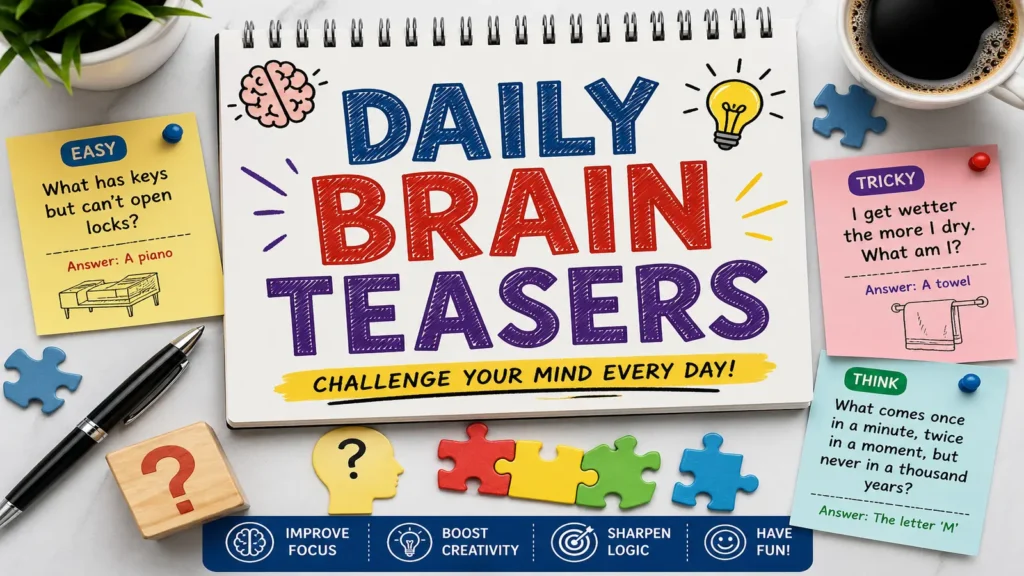
Daily brain teasers are a simple way to add fun thinking to your day. They work well for kids, adults, families, teachers, and busy teams.
You do not need special tools or long free time. Instead, one short puzzle can spark focus, laughter, and better problem-solving.
This guide gives you easy ideas, tricky examples, and smart ways to play. You can use them at breakfast, school, work, or bedtime.
Quick Answer
Daily brain teasers are short puzzles that challenge logic, memory, words, numbers, or observation. They are useful because they make thinking feel fun and active.
TL;DR
• Try one short puzzle each morning.
• Mix easy, tricky, and visual formats.
• Use answers after honest attempts.
• Play solo, with kids, or at work.
• Keep a notebook for favorites.
• Choose fun over perfect scores.
Why Daily Brain Teasers Are Worth Your Time
A daily puzzle gives your brain a small, playful challenge. Also, it can break routine without feeling like homework.
The best part is the low pressure. You can solve one in two minutes, then move on.
• They make quiet moments more interesting.
• They help you notice small details.
• They reward patient, careful reading.
• They turn waiting time into play.
• They encourage flexible thinking habits.
• They make family conversations easier.
• They add energy to morning routines.
• They support classroom warm-up activities.
• They create quick workplace icebreakers.
• They offer screen-free entertainment options.
• They help shy players join conversations.
• They make mistakes feel less serious.
How to Build a Brain Teaser Habit
A good habit starts small. So, pick one time of day and keep it easy.
You can also connect puzzles to something you already do. For example, try one after breakfast or before your first meeting.
• Place puzzle cards near your coffee.
• Save favorites in one small notebook.
• Set a two-minute solving limit.
• Rotate puzzle types every week.
• Read the clue twice before answering.
• Ask for hints before revealing answers.
• Share one puzzle at dinner.
• Keep hard puzzles for weekends.
• Use easy puzzles after busy days.
• Let kids choose Friday’s challenge.
• Track streaks with simple checkmarks.
• Stop while the game feels fun.
Easy Brain Teasers to Start With
Easy brain teasers are great for beginners. However, easy does not mean boring.
They often use simple tricks, hidden meanings, or everyday logic. As a result, they help new solvers gain confidence fast.
• What has hands but cannot clap?
• Answer: A clock.
• What gets wetter while drying?
• Answer: A towel.
• What has keys but opens nothing?
• Answer: A piano.
• What can travel without moving?
• Answer: A stamp.
• What has teeth but cannot bite?
• Answer: A comb.
• What comes down but never rises?
• Answer: Rain.
• What has one eye but cannot see?
• Answer: A needle.
• What has legs but never walks?
• Answer: A table.
Tricky Word Brain Teasers
Word teasers work because language can be sneaky. Therefore, read every clue slowly before guessing.
Some answers hide inside common meanings. Meanwhile, others depend on spelling, sound, or a tiny twist.
• Which word becomes shorter when letters are added?
• Answer: Short.
• What word starts and ends with E?
• Answer: Envelope.
• Which month has twenty-eight days?
• Answer: All of them.
• What begins with T, ends with T?
• Answer: Teapot.
• Which word is spelled wrong in dictionaries?
• Answer: Wrong.
• What has many letters but no words?
• Answer: A mailbox.
• What five-letter word has one left?
• Answer: Stone.
• Which room has no doors?
• Answer: Mushroom.
Logic Brain Teasers for Sharp Thinking
Logic teasers ask you to test each clue. Instead of guessing fast, slow down and look for limits.
A fair logic puzzle should make sense after the answer. In addition, it should not depend on hidden facts.
• Two mothers have two daughters together.
• They buy three tickets and enter.
• How can that happen?
• Answer: Grandmother, mother, and daughter.
• A driver goes wrong way safely.
• No police officer stops him.
• Why does nothing happen?
• Answer: He is walking.
• Three switches control three bulbs elsewhere.
• You may enter once afterward.
• How can you identify each?
• Answer: Use heat, light, and off.
• A man sees without glasses.
• Yet he cannot see nearby.
• What is the reason?
• Answer: He is looking far away.
• One guard lies, one tells truth.
• Ask one question to escape.
• Answer: Ask what the other guard says.
Math Brain Teasers Without the Stress
Math teasers should feel playful, not scary. Also, many use patterns more than heavy calculation.
Start with small numbers and clear steps. Then, once confidence grows, try puzzles with missing values.
• What number comes next: 2, 4, 8?
• Answer: 16.
• If two apples cost four dollars?
• One apple costs how much?
• Answer: Two dollars.
• What is half of ten plus ten?
• Answer: Fifteen.
• Five birds sit on a fence.
• Two fly away suddenly.
• How many remain sitting?
• Answer: Three.
• A dozen eggs lose three.
• How many are left?
• Answer: Nine eggs.
• What number doubles when turned upside down?
• Answer: Six becomes nine.
Visual Brain Teasers and Pattern Puzzles
Visual teasers train you to look again. However, the trick is often hiding in plain sight.
These puzzles can use shapes, colors, shadows, or missing details. Because of this, they work well on screens and paper.
• Find the different symbol in a row.
• Spot one reversed letter quickly.
• Count triangles inside one large triangle.
• Match shadows to the correct object.
• Notice which circle is slightly smaller.
• Find the hidden animal outline.
• Choose the shape that completes pattern.
• Compare two pictures for changes.
• Count squares, not just boxes.
• Follow arrows before reading labels.
• Look for repeated color sequences.
• Turn the page for new clues.
Daily Brain Teasers for Work and Meetings
Work puzzles should be short, clean, and friendly. They should bring people in, not embarrass anyone.
Use them before meetings, during breaks, or in team chats. Also, choose puzzles that can be solved aloud.
• Start meetings with one easy puzzle.
• Use team chat for daily clues.
• Avoid puzzles needing private knowledge.
• Pick answers under one minute.
• Let different people host weekly.
• Share hints before full solutions.
• Celebrate creative wrong answers.
• Choose clean jokes for everyone.
• Keep score only for fun.
• Use puzzles after long updates.
• Try picture puzzles on Fridays.
• End with the answer clearly.
Brain Teasers for Kids and Families
Kids enjoy puzzles more when adults stay patient. So, give hints before giving the answer.
Family play works best with mixed difficulty. For example, let younger kids answer easy clues first.
• Let children read clues aloud.
• Give hints in small steps.
• Praise the thinking process.
• Choose safe, kind puzzle themes.
• Use animals, food, and school objects.
• Keep bedtime puzzles gentle.
• Let siblings invent new clues.
• Draw answers when words are hard.
• Use silly voices for fun.
• Avoid teasing slow guessers.
• Repeat favorites during car rides.
• Make Sunday a family challenge.
Brain Teasers for Adults and Seniors
Adults often like puzzles that feel clever. Still, the best daily teasers should not feel stressful.
Seniors may enjoy wordplay, memory games, and gentle logic puzzles. In addition, group solving can make puzzles social.
• Try one puzzle with breakfast.
• Use large-print puzzle cards.
• Share riddles during phone calls.
• Mix memory and word challenges.
• Choose calm puzzles before bed.
• Revisit classics with new twists.
• Keep hard puzzles for afternoons.
• Play with friends over coffee.
• Use notebooks for solved favorites.
• Skip timers when relaxing.
• Read clues out loud.
• Enjoy the laugh after solving.
Printable and Phone-Free Brain Teaser Ideas
Printable puzzles are useful when you want fewer screens. Also, they work well for classrooms, trips, and waiting rooms.
You can print worksheets or make your own cards. Meanwhile, a puzzle jar keeps choices fresh without much planning.
• Print a weekly puzzle sheet.
• Cut riddles into small cards.
• Store clues in a jar.
• Add answers on folded backs.
• Keep pencils beside worksheets.
• Make travel packs for kids.
• Use sticky notes for hints.
• Laminate favorites for reuse.
• Trade puzzle cards with friends.
• Create a classroom challenge board.
• Place one clue on lunchboxes.
• Save blank cards for inventions.
Common Mistakes to Avoid
Brain teasers stop being fun when they feel unfair. Therefore, choose puzzles with clear answers and reasonable clues.
Another mistake is rushing to reveal the solution. Instead, offer hints so people can enjoy the “aha” moment.
• Do not shame wrong guesses.
• Avoid clues with unclear wording.
• Do not repeat one puzzle type.
• Skip puzzles that feel mean.
• Avoid answer spoilers too early.
• Do not force timed play.
• Choose age-friendly difficulty levels.
• Avoid inside jokes for groups.
• Do not overexplain simple answers.
• Replace stale puzzles often.
• Check answers before sharing.
• Keep the mood light.
FAQs
What are daily brain teasers?
They are short puzzles you solve once a day. They can use words, numbers, logic, pictures, or simple tricks.
Are brain teasers good for kids?
Yes, when the clues match their age. Also, kids should get hints and encouragement before answers are shown.
What is a good brain teaser for today?
Try this: What has a face and hands but no arms? The answer is a clock.
How long should a daily brain teaser take?
Most should take one to five minutes. However, harder weekend puzzles can take longer.
Are riddles and brain teasers the same?
They overlap, but they are not always identical. Riddles often use wordplay, while teasers may use logic or patterns.
Can I use brain teasers at work?
Yes, as long as they are short and friendly. They work best as light openers or break activities.
Where can I find printable brain teasers?
You can use puzzle books, worksheets, or homemade cards. Also, you can copy your favorites into a notebook.
Conclusion
Daily puzzles are small, but they can brighten ordinary moments. They give people a reason to pause, think, and smile. The best routine is simple and flexible. Choose one daily brain teaser, try it honestly, then enjoy the answer. Finally, keep the habit playful. A good puzzle should leave you curious for tomorrow.

Joseph Morgan is an enigmatist known for creating clever and mysterious riddles. Born in Scotland, he spent his life challenging people to think deeply through puzzles and brainteasers. He became famous for his creative mind and love of mystery.