
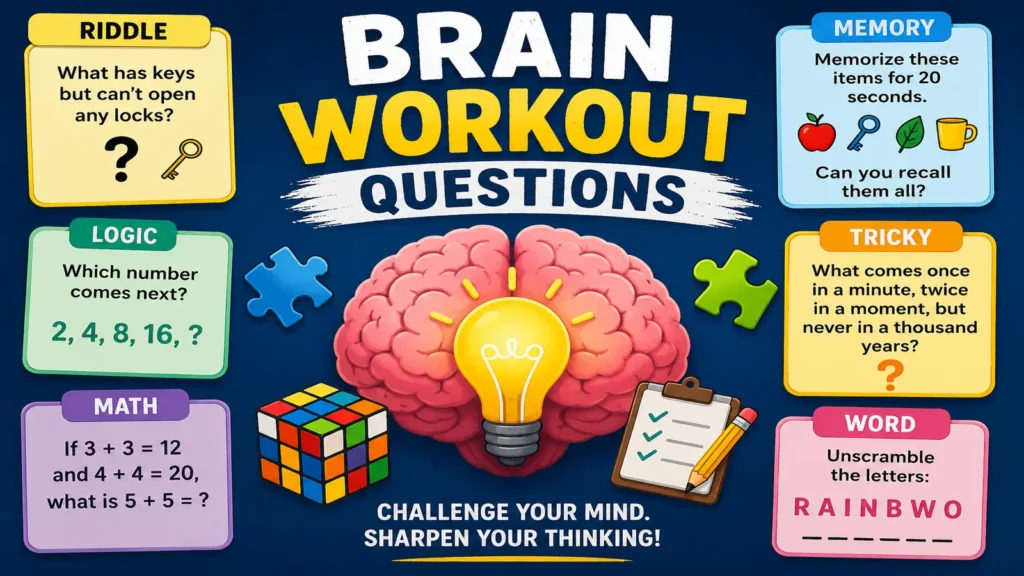
Staying mentally sharp takes practice, just like staying physically active. Fortunately, brain workout questions make mental exercise fun and simple. You can use them during breaks, family nights, study sessions, or morning routines. Many people enjoy riddles, logic games, and memory tests because they challenge everyday thinking. In addition, these activities often improve focus, problem-solving, and creativity. This guide shares practical brain workout questions for adults, teens, and curious learners who want stronger thinking skills.
Quick Answer
Brain workout questions are short mental challenges that improve focus, reasoning, memory, and creativity. They include riddles, logic puzzles, trivia, and critical thinking exercises. Regular practice keeps your mind active and engaged.
TL;DR
• Brain questions strengthen reasoning and attention
• Daily practice builds stronger mental flexibility
• Logic puzzles improve careful decision-making habits
• Memory games support faster information recall
• Group challenges create fun social learning moments
• Variety keeps mental exercises enjoyable longer
Why Brain Workout Questions Matter
Mental challenges push your brain beyond automatic habits. Because of this, your thinking stays flexible and alert. Short exercises also fit easily into busy schedules.
Research suggests mentally active people often maintain stronger attention and recall skills. Meanwhile, fun questions reduce boredom during learning sessions. Consistent practice matters more than difficulty.
• Mental challenges increase problem-solving confidence
• Quick puzzles encourage flexible thinking patterns
• Brain games support healthy attention habits
• Short riddles strengthen processing speed
• Word challenges improve communication skills
• Logic exercises train careful observation
• Trivia questions expand general knowledge
• Daily practice creates mental discipline
• Creative puzzles inspire fresh ideas
• Pattern recognition improves decision accuracy
• Team activities build stronger collaboration
• Brain workouts make learning more enjoyable
Easy Questions to Warm Up Your Brain
Simple questions help your mind switch into thinking mode. Starting easy also reduces frustration for beginners. As a result, people stay motivated longer.
Warm-up questions work best during mornings or study breaks. Keep sessions short at first. Then slowly increase challenge levels over time.
• What has hands but cannot clap?
• Which month has twenty-eight days?
• What gets wetter while drying things?
• What belongs to you but others use?
• Which word becomes shorter with letters added?
• What has one eye without sight?
• Which building contains the most stories?
• What runs yet never walks anywhere?
• What comes once in a minute?
• Which room has no windows or doors?
• What travels globally while staying cornered?
• What begins with an ending sound?
Logic Questions That Test Clear Thinking
Logic questions reward patience and observation. Instead of rushing, you must examine details carefully. Therefore, these exercises improve structured thinking habits.
Many employers value logical thinking because it supports strong decisions. Furthermore, logic practice often improves planning and organization skills.
• Three switches control hidden light bulbs
• Two fathers and two sons fish together
• A farmer crosses river with animals
• Five machines make five products quickly
• A clock strikes thirteen unexpectedly today
• One sister has twice another’s age
• Four people cross bridge with flashlight
• A train travels opposite another direction
• Eight identical balls hide one heavier
• A prisoner chooses between dangerous doors
• Two ropes burn unevenly for timing
• Several hats reveal hidden logical clues
Memory Questions for Better Recall
Memory practice strengthens attention to detail. However, recall improves only with repeated effort. Small daily exercises usually work best.
You can practice memory skills almost anywhere. Grocery lists, names, and directions become easier with regular training.
• Repeat six numbers backward quickly
• Name yesterday’s breakfast without hesitation
• Recall five objects from another room
• Remember every stop during your commute
• Memorize shopping items within thirty seconds
• Repeat a short story accurately afterward
• Recall names from recent introductions correctly
• Remember license plates during short walks
• Visualize furniture placement from memory
• Recall lyrics from favorite childhood songs
• Memorize three facts from today’s article
• Repeat random words after one minute
Critical Thinking Questions for Adults
Critical thinking questions encourage deeper analysis. Rather than accepting easy answers, you examine evidence carefully. Because of this, judgment improves over time.
Adults often enjoy realistic scenarios more than classic riddles. Practical questions also connect directly to workplace and life decisions.
• Why might first impressions mislead people?
• What creates strong trust between strangers?
• When should rules bend during emergencies?
• Which habits waste the most daily time?
• How do advertisements shape buying choices?
• Why do groups sometimes make poor decisions?
• What makes communication fail during stress?
• When does confidence become harmful arrogance?
• Which risks deserve careful consideration first?
• Why do people resist changing opinions?
• How can distractions damage productivity levels?
• What defines fair treatment at work?
Fun Trick Questions That Fool Most People
Trick questions challenge assumptions instead of intelligence. Often, the simplest answer hides behind misleading wording. Therefore, careful listening matters.
These questions work well during parties or classroom breaks. In addition, they create laughter and friendly competition.
• How many animals entered Noah’s ark?
• Which weighs more, feathers or bricks?
• Can a man marry his widow’s sister?
• What appears twice within every moment?
• How far can a fox run woodsward?
• Which letter sounds identical in queue?
• Why cannot your nose reach eleven inches?
• Which side of chicken contains feathers?
• What kind of tree fits your hand?
• Why did math book look unhappy?
• Which word stays pronounced incorrectly everywhere?
• What has keys without opening locks?
Math-Based Brain Workout Questions
Math puzzles sharpen reasoning and pattern recognition. Still, they do not require advanced skills. Most challenges use everyday numbers.
Quick calculations also improve focus under pressure. Consequently, many people use number games before studying or working.
• Multiply three numbers for matching total sums
• Find missing number inside visual pattern
• Split twelve apples among friends evenly
• Determine next number within sequence quickly
• Calculate total angles inside simple shape
• Double pennies daily for one month
• Estimate people inside crowded stadium section
• Share pizza slices without leftovers remaining
• Compare percentages during shopping discounts accurately
• Solve clock angle challenge mentally fast
• Count squares hidden inside larger grid
• Discover shortest route between destinations logically
Word Questions That Strengthen Vocabulary
Word games improve language flexibility and comprehension. Moreover, they help conversations feel smoother and more confident. Reading skills also benefit from verbal exercises.
Vocabulary challenges work well during commutes or lunch breaks. Keep a notebook for new words and clever clues.
• Rearrange letters to form hidden animals
• Find synonyms for common emotion words
• Identify opposites within short sentence pairs
• Create rhyming chains from simple words
• Guess missing letters from word patterns
• Unscramble mixed words before timer ends
• Replace weak verbs with stronger alternatives
• Find longest word from random letters
• Spot spelling mistakes inside quick paragraph
• Build sentences using unusual vocabulary terms
• Discover hidden words inside longer words
• Match idioms with correct meanings carefully
Lateral Thinking Questions for Creative Minds
Lateral thinking ignores obvious paths. Instead, it searches for unusual possibilities and hidden assumptions. Creative problem-solvers often enjoy these puzzles most.
These questions reward imagination and flexibility. Consequently, they help people approach real challenges differently.
• A man pushes car toward hotel desperately
• Woman lives twentieth floor yet walks daily
• Detective finds dead body beside puddle indoors
• Empty room suddenly fills with dangerous water
• Person survives plane crash without parachute somehow
• Candle problem requires unexpected creative solution
• Driver passes police despite broken traffic rules
• One match lights several items strategically
• Blind man chooses correct socks effortlessly
• Farmer owns seventeen sheep after storm
• Woman buys shoes yet remains barefoot afterward
• Elevator rider changes behavior during rainstorms
Group Brain Workout Questions for Friends and Family
Group questions create energy and teamwork naturally. Meanwhile, friendly competition keeps everyone engaged longer. Families often use these games during holidays or road trips.
Social learning also improves listening and communication skills. Therefore, group activities benefit both kids and adults.
• Guess object using only three clues
• Solve mystery story before timer expires
• Build longest word from shared letters
• Answer trivia categories under pressure together
• Continue story using creative surprise twists
• Identify songs from short humming clips
• Explain movie plots using five words
• Draw clues without speaking during rounds
• Race solving riddles against another team
• Match famous quotes with correct speakers
• Create impossible inventions from random items
• Debate funniest answer for silly questions
Fast Daily Brain Challenges
Short daily exercises keep mental habits consistent. However, long sessions often feel exhausting for beginners. Small wins build stronger routines over time.
Many people prefer five-minute challenges before work. Others enjoy evening brain games instead. Choose whichever schedule feels sustainable.
• Solve one riddle during breakfast daily
• Memorize phone numbers without writing anything
• Read article headlines and summarize quickly
• Count backward from hundred by sevens
• Switch hands while brushing your teeth
• Learn one unfamiliar word every morning
• Complete crossword clue before leaving home
• Observe surroundings for hidden visual patterns
• Recall previous day events before sleeping
• Play quick trivia game during breaks
• Practice mental math while shopping casually
• Describe random objects using vivid details
Questions That Improve Focus and Attention
Attention exercises train your brain to ignore distractions. Because of this, work and study sessions feel easier. Focus also improves through consistent repetition.
Concentration challenges should stay short and engaging. Otherwise, mental fatigue reduces effectiveness quickly.
• Spot differences between nearly identical images
• Count specific letters inside paragraph blocks
• Listen carefully for repeated spoken words
• Follow multi-step directions without writing notes
• Track bouncing objects across moving screens
• Identify missing details from short stories
• Complete patterns without outside distractions nearby
• Watch clock second hand silently moving
• Detect background sounds during quiet moments
• Repeat instructions after hearing them once
• Focus breathing while ignoring surrounding noise
• Find hidden objects inside crowded scenes
Digital Games and Apps for Brain Practice
Digital brain games remain popular across all ages. Many apps include logic, memory, and vocabulary challenges. Still, balance matters more than endless screen time.
Experts often recommend mixing digital activities with real-world learning. In addition, social interaction supports stronger mental health habits.
• Puzzle apps provide quick portable challenges
• Trivia games encourage broad knowledge growth
• Strategy games improve planning under pressure
• Word apps strengthen spelling and vocabulary
• Memory games train short-term recall abilities
• Logic platforms test reasoning consistency regularly
• Daily quiz apps support learning habits
• Pattern games improve visual recognition speed
• Timed challenges sharpen rapid decision-making skills
• Multiplayer quizzes create healthy competition online
• Brain training apps track personal progress
• Educational games combine learning with entertainment
How to Build a Brain Workout Routine
Strong routines stay realistic and flexible. Therefore, avoid overwhelming schedules at the beginning. Consistency matters much more than perfection.
Try combining several question styles during the week. As a result, different thinking skills continue developing together.
• Schedule five-minute sessions every single morning
• Mix logic, memory, and vocabulary exercises
• Increase difficulty levels gradually each month
• Practice with friends for extra motivation
• Use printed puzzles during screen-free evenings
• Keep notebook tracking favorite challenge types
• Rotate activities to prevent mental boredom
• Reward consistency with enjoyable small treats
• Set weekly goals for puzzle completion
• Choose activities matching personal interests naturally
• Rest mentally after intense challenge sessions
• Celebrate progress instead of chasing perfection
FAQs
What are brain workout questions?
Brain workout questions are puzzles, riddles, trivia, and logic challenges that stimulate thinking skills. They improve focus, reasoning, memory, and creativity through active mental engagement.
Do brain teasers really help your brain?
Brain teasers may strengthen attention, pattern recognition, and problem-solving habits. However, experts also recommend sleep, exercise, and social activity for overall brain health.
How often should I practice mental exercises?
Short daily sessions often work best for long-term consistency. Even ten minutes each day can support stronger mental habits.
Are brain workout questions good for kids and adults?
Yes, people of all ages can benefit from mental challenges. Difficulty levels should match the person’s experience and comfort.
What types of questions improve critical thinking most?
Scenario-based questions, logic puzzles, and open-ended discussions usually improve critical thinking effectively. These activities encourage careful analysis and flexible reasoning.
Can brain games improve memory?
Memory games may help attention and recall through repeated practice. Consistent habits generally produce better results than occasional long sessions.
Conclusion
Brain workout questions offer a simple way to keep your mind active every day. They combine fun, curiosity, and practical thinking skills into short exercises anyone can enjoy. In addition, many activities fit easily into busy schedules. You do not need expensive tools or advanced knowledge to challenge your brain. Start with easy puzzles, then slowly explore tougher questions over time. Most importantly, stay consistent and enjoy the process while building stronger mental habits.

Christopher McLagan is a celebrated riddle maker known for crafting clever brain teasers and mind-bending puzzles. His work blends classic riddles, logic challenges, and lateral thinking brain teasers designed to spark curiosity and critical thinking. Widely admired in online puzzle communities, McLagan creates engaging riddle questions and answers for both kids and adults. His signature style delivers surprising twists, clean humor, and satisfying “aha” moments that keep readers coming back for more.