
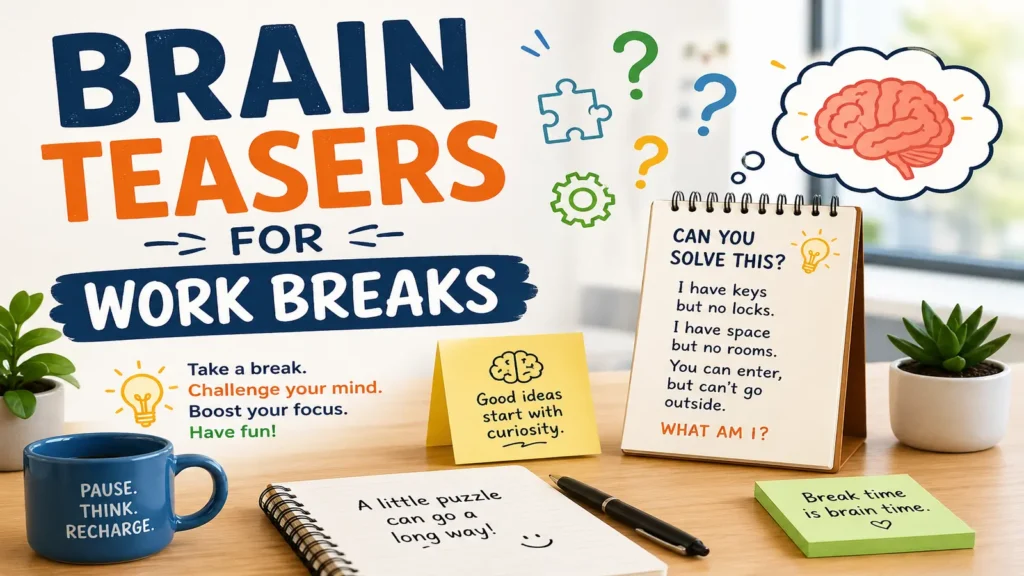
Work can feel heavy when your brain stays locked on one task. A short puzzle can help shift attention, spark a laugh, and make a break feel useful. This guide gives you brain teasers for work breaks that are quick, clean, and easy to share. Use them at your desk, in a break room, or during a team call. You will find simple riddles, logic puzzles, word games, number challenges, and answers. Most take less than two minutes.
Quick Answer
Brain teasers for work breaks are short puzzles used to refresh attention and add light fun. They work best when they are simple, optional, and easy to solve together.
TL;DR
• Pick puzzles that match your team’s mood
• Keep most breaks under five minutes
• Use answers to prevent lingering confusion
• Choose clean humor for shared spaces
• Rotate puzzle types to avoid boredom
How to Use Brain Teasers During Work Breaks
A good puzzle break should feel easy, not forced. Start with one quick question, then reveal the answer after guesses slow down.
Also, choose puzzles that fit the room. A quiet desk break needs a different puzzle than a lively team lunch.
• Set a two-minute thinking timer
• Share one puzzle before coffee
• Keep answers ready nearby
• Let people pass without pressure
• Avoid puzzles about private topics
• Use clean language every time
• Pick simple prompts for Mondays
• Save harder puzzles for Fridays
• Invite guesses before revealing answers
• Celebrate funny wrong answers kindly
• Rotate hosts once weekly
• End before energy drops
Easy Brain Teasers for a Fast Reset
Easy puzzles are perfect when people feel tired. They create a small win without draining more energy.
Use these when the team needs a quick pause. In addition, they work well for solo desk breaks.
• What gets wetter while drying? Answer: towel
• What has keys but opens nothing? Answer: piano
• What has hands but cannot clap? Answer: clock
• What has teeth but cannot bite? Answer: comb
• What has a face but no eyes? Answer: clock
• What runs but never walks? Answer: water
• What has a neck but no head? Answer: bottle
• What has rings but no fingers? Answer: phone
• What has legs but cannot walk? Answer: table
• What has words but never speaks? Answer: book
• What breaks before you use it? Answer: egg
• What rises but never sleeps? Answer: bread
Logic Brain Teasers for Focus
Logic puzzles ask people to slow down and notice details. However, they should still feel fair during a break.
Try these when your brain needs a clean switch. They reward careful reading more than deep knowledge.
• Three switches control three bulbs. Test once. Answer: heat
• A farmer crosses safely with a fox. Answer: boat order
• Two doors, one truth teller. Ask one question. Answer: opposite door
• A man pushes his car, then pays. Answer: Monopoly
• You see me once in June. Answer: letter e
• The more you remove, larger I get. Answer: hole
• I speak without a mouth. Answer: echo
• I have cities but no houses. Answer: map
• I am always ahead, never seen. Answer: future
• I shrink when I take a bath. Answer: soap
• I can fill a room silently. Answer: light
• I move faster when standing still. Answer: clock hand
Funny Brain Teasers for Coworkers
Funny puzzles can loosen a tense day. Still, the best ones make the question silly, not the people.
Use these in shared spaces or casual chats. They are short enough for a laugh between tasks.
• Why did the calendar panic? Its days were numbered
• What file never complains? A paper file
• Why was the keyboard tired? Too many shifts
• What coffee tells secrets? A spill-the-beans latte
• Why did the stapler smile? It felt attached
• What desk item loves drama? The highlighter
• Why did the memo blush? It was circulated
• What meeting never ends? One without snacks
• Why did the pen quit? It felt drained
• What chair tells jokes? A stand-up seat
• Why did paper feel lucky? It had margins
• What printer loves music? One that jams
Team Brain Teasers for Small Groups
Team puzzles work best when everyone can add one idea. Because of this, avoid puzzles that reward only speed.
Use these with pairs or small groups. Then ask teams to explain how they reached the answer.
• Name three uses for a binder clip
• Build a story from five office objects
• Find four things shaped like circles
• List jobs a pencil could do
• Create a silent signal for “done”
• Sort desk items by usefulness
• Guess one object by three clues
• Make a puzzle using sticky notes
• Solve a riddle in pairs
• Invent a team mascot from supplies
• Rank break snacks by crunch level
• Describe teamwork without saying team
Visual and Observation Brain Teasers
Visual puzzles do not always need pictures. You can use letters, patterns, spacing, and simple layouts.
These work well on whiteboards or chat messages. Meanwhile, they help people practice careful scanning.
• Spot the odd word: team teem team
• Count every F: Finished files feel fine
• Which is different: O O 0 O
• Find the hidden word: tBREAKime
• Which line feels longest: —- —–
• Count the triangles in a drawn star
• Find two matching paper clips nearby
• Notice three blue items around you
• Scan a paragraph for double spaces
• Find one object with no corners
• Spot the missing weekday sequence
• Count keyboards visible on camera
Word Brain Teasers for Desk Breaks
Word puzzles are easy to share and quick to answer. Also, they do not require props or special tools.
These are great for quiet breaks. They work especially well in email, chat, or printed cards.
• What word starts and ends with e? Envelope
• What word becomes shorter when added? Short
• Which word has many letters? Mailbox
• What word sounds like one letter? Sea
• What word hides a meal? Breakfast
• What month has an ant? January
• What word has silent music? Note
• Which word contains a workplace tool? Staple
• What word sounds like two letters? Queue
• What word begins with end? Endless
• Which word has a hidden pen? Open
• What word carries meaning twice? Message
Number Brain Teasers Without Heavy Math
Number puzzles should feel playful, not like homework. Therefore, use patterns, counting, and simple reasoning.
These are useful for quick focus breaks. They also work for people who dislike formal math.
• What comes next: 2, 4, 8, 16? Answer: 32
• Which number has no letters? None do
• Add five to nine, get two. Answer: clock
• Three people share three apples. Answer: one each
• What number doubles when flipped? Six
• What has four wheels and flies? Garbage truck
• Count from ten backward silently
• Find a number hidden in tone
• What is half of eight? Zero
• Which month has 28 days? All months
• What number sounds like food? Eight
• Which number is always even? Seven, oddly
Brain Teasers for Remote Teams
Remote puzzles should be easy to read on screen. Keep them short, because chat moves quickly.
Also, let people answer with emojis or initials. That keeps the break light and camera-friendly.
• Post one riddle in team chat
• Ask for answers by emoji
• Use polls for multiple choices
• Reveal solutions after two minutes
• Let late readers still guess
• Share one puzzle after lunch
• Keep prompts mobile-friendly
• Avoid tiny visual details
• Use threads for answer guesses
• Add a hint before revealing
• Invite volunteers to host Fridays
• Save winners from public pressure
Brain Teasers for Meeting Openers
A meeting opener should warm up the room fast. However, it should not steal time from the meeting.
Choose puzzles with short answers. Next, connect the mood to the work ahead.
• Start with one clean riddle
• Use a timer everyone sees
• Ask for silent first guesses
• Reveal answers before agenda starts
• Pick puzzles tied to focus
• Avoid tricking new teammates harshly
• Let the host read clearly
• Keep openers under three minutes
• Use easy puzzles for serious meetings
• Try logic prompts before planning
• Choose humor before casual updates
• Stop while people still smile
Tips for Running a Brain Teaser Break
Good puzzle breaks need simple rules. Otherwise, a fun pause can become confusing or awkward.
Keep the mood relaxed and fair. In addition, make sure the puzzle fits your workplace culture.
• Tell everyone the time limit
• Give one clue if needed
• Never mock a wrong answer
• Share answers clearly afterward
• Mix easy and tricky rounds
• Use fresh puzzles each week
• Keep a shared puzzle list
• Ask teammates for favorites
• Match puzzles to group energy
• Skip puzzles during urgent deadlines
• Choose inclusive topics only
• End with a quick laugh
Answers and Explanations
Some brain teasers work because they hide a small twist. Once you see the twist, the answer feels obvious.
Use these explanations to teach the pattern. Then coworkers can solve similar puzzles faster next time.
• “Wetter while drying” means towel use
• “Keys” can mean piano keys
• “Hands” can mean clock hands
• “Teeth” can mean comb teeth
• “Runs” can mean flowing water
• “Rings” can mean phone sounds
• “Breaks before use” describes eggs
• “Car payment” points toward Monopoly
• “Cities without houses” describes maps
• “Future” is ahead but unseen
• “Shorter” changes when letters are added
• “Clock math” uses time, not totals
FAQs
What are good brain teasers for work?
Good work brain teasers are short, clean, and easy to explain. Logic riddles, word puzzles, and funny office questions usually work well.
How long should a work brain teaser break last?
Most puzzle breaks should last two to five minutes. That gives people a reset without pulling them away too long.
Are brain teasers good for remote teams?
Yes, when they are easy to read and answer in chat. Use short prompts, simple clues, and quick answer reveals.
What makes a brain teaser office-friendly?
An office-friendly brain teaser avoids insults, private topics, and awkward humor. It should feel welcoming to different ages and roles.
Can brain teasers help before meetings?
They can help people shift attention before a meeting starts. Keep the puzzle simple, then move into the agenda quickly.
Should answers be shown right away?
Not right away, but do not wait too long. A short guessing window keeps the break fun and clear.
Conclusion
A smart break does not need to be long. Sometimes one clean puzzle is enough to refresh the room. Use brain teasers for work breaks when people need a pause, laugh, or quick mental switch. Keep them simple, kind, and easy to share. Finally, save your favorites in one place. That makes every future break easier to start.

Joseph Morgan is an enigmatist known for creating clever and mysterious riddles. Born in Scotland, he spent his life challenging people to think deeply through puzzles and brainteasers. He became famous for his creative mind and love of mystery.