
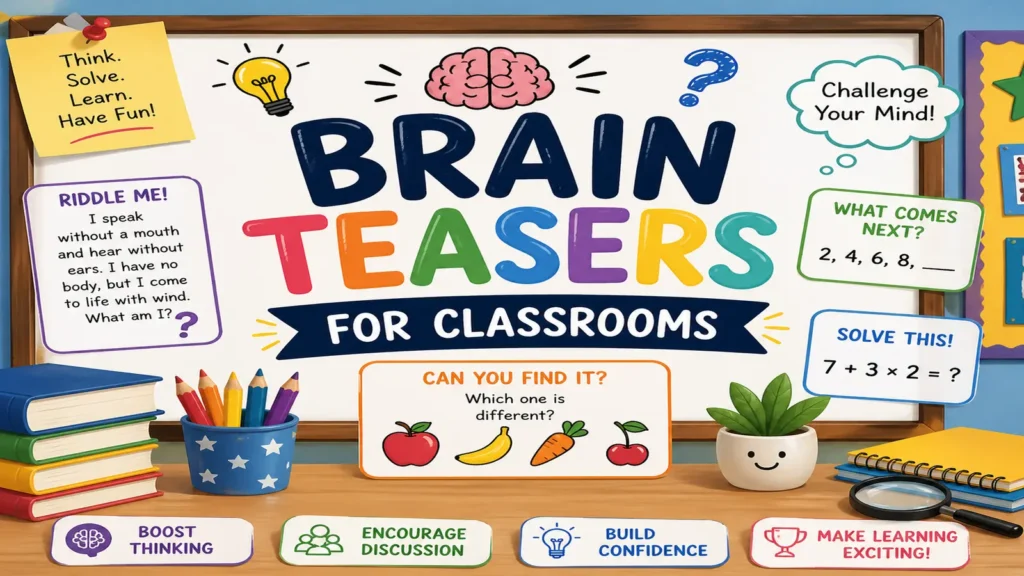
Brain teasers for classrooms help teachers turn spare minutes into useful thinking time. They work during morning work, transitions, early-finisher time, or quick class resets. Students enjoy them because they feel like games. Teachers like them because they build focus, patience, and discussion skills. This guide gives you ready-to-use ideas for elementary and middle school groups. You will also find simple ways to keep puzzles fair, fun, and quick.
Quick Answer
Brain teasers for classrooms are short puzzles, riddles, or logic challenges teachers use to spark thinking. They work best when students can solve, explain, and discuss them in a few minutes.
TL;DR
• Use short puzzles for smooth class starts
• Match difficulty to student age
• Give hints before giving answers
• Let students explain their thinking
• Save harder puzzles for partner work
• Use humor to reset classroom energy
What Makes a Brain Teaser Work in Class?
A strong classroom brain teaser is short, clear, and fair. It should make students think, not feel tricked.
Also, the best puzzles invite talk. Students should be able to explain how they found the answer.
• Takes five minutes or less
• Uses simple, clear wording
• Has one fair answer
• Allows more than one strategy
• Fits the current class mood
• Works without special supplies
• Encourages students to explain
• Feels challenging, not impossible
• Avoids confusing hidden knowledge
• Gives quiet students entry points
• Can be shown on the board
• Ends with a quick discussion
• Builds curiosity before instruction
• Lets wrong answers become clues
Easy Brain Teasers for Elementary Classrooms
Elementary students need concrete clues and familiar ideas. Therefore, school objects, animals, colors, and daily routines work well.
Keep answers simple at first. Then invite students to explain the clue that helped them.
• What has hands but cannot clap? Clock
• What has keys but opens nothing? Piano
• What gets wetter while drying? Towel
• What has teeth but cannot bite? Comb
• What has legs but never walks? Table
• What has pages but never talks? Book
• What has a face but no eyes? Clock
• What has a neck but no head? Bottle
• What has one eye but cannot see? Needle
• What grows when you feed it? Fire
• What breaks before you use it? Egg
• What is full of holes but holds water? Sponge
• What flies without wings? Time
• What room has no doors? Mushroom
Tricky Brain Teasers for Middle School
Middle school students enjoy puzzles with a twist. However, the twist should still feel fair after the answer.
These teasers work well as partner challenges. Students can compare reasoning before the class shares answers.
• What word becomes shorter when letters are added? Short
• What month has 28 days? Every month
• What belongs to you but others use? Your name
• What goes up and never comes down? Age
• What can run but never walks? Water
• What has cities but no houses? Map
• What has a bank but no money? River
• What can fill a room without space? Light
• What question can never be answered yes? Are you asleep?
• What has many rings but no fingers? Tree
• What comes once in minute, twice in moment? Letter M
• What starts with E and has one letter? Envelope
• What has words but never speaks? Dictionary
• What can travel while staying still? Stamp
• What gets sharper the more it works? Mind
Visual Brain Teasers Students Can Solve Together
Visual brain teasers help students notice details. In addition, they give strong readers and developing readers a shared task.
Use them on slides, paper cards, or the board. Ask students to describe exactly what they see.
• Find the missing shape in a pattern
• Spot five changes between pictures
• Count triangles inside one large triangle
• Match shadows to classroom objects
• Find the object facing another direction
• Solve a simple rebus picture clue
• Identify the odd icon in a row
• Complete a color sequence rule
• Compare two almost matching clocks
• Decode arrows into a hidden word
• Arrange picture cards into order
• Find symmetry in a drawing
• Count squares in a grid image
• Turn a picture upside down mentally
• Match puzzle pieces to outlines
Math Brain Teasers for Warm-Ups
Math brain teasers should feel playful, not like extra homework. So, keep numbers small and thinking clear.
These are great before math lessons. They help students warm up their reasoning muscles.
• I am even and less than ten: eight
• Add two numbers to make eleven
• Find the next number: 2, 4, 8, 16
• Which weighs more, feathers or bricks? Same pound
• Double me, then add two: ten
• Three groups of four make twelve
• What number has two digits and sums nine?
• Remove one side from a square shape
• Make twenty using four fives
• Find the missing total in a table
• Pick the number that breaks the pattern
• Count corners on two joined squares
• Share twelve pencils among three desks
• Guess my number between ten and twenty
• Compare half of eight with four
Word Brain Teasers for Reading and Language Time
Word teasers make language feel active. They also help students notice spelling, sound, and meaning.
Use them before reading, writing, or vocabulary lessons. Meanwhile, let students invent their own after practice.
• What word starts and ends with E? Envelope
• What word has silent letters? Knife
• What five-letter word sounds like one letter? Queue
• What word reads the same backward? Level
• What word contains another school word? Notebook
• Change one letter to make a new word
• Find the hidden animal in “carpet”
• Make three words from “teacher”
• Sort words by number of syllables
• Guess the word from three clues
• Find two meanings for “bat”
• Match homophones with correct pictures
• Build a sentence using one mystery word
• Remove a letter and keep a word
• Solve a rhyming riddle aloud
Logic Brain Teasers for Critical Thinking
Logic teasers ask students to follow clues. Because of this, they build patience and careful thinking.
Encourage students to cross out wrong ideas. Next, ask them to explain their final answer.
• Three friends sit in clue order
• Match pets to owners using hints
• Decide who arrived first at school
• Find which statement must be true
• Choose the door with honest clues
• Sort lunch boxes by color hints
• Place books using shelf directions
• Find the missing student schedule
• Match sports to players from clues
• Pick the correct backpack owner
• Solve a simple yes-or-no mystery
• Arrange four events by time
• Find the only possible classroom seat
• Test clues before guessing answers
• Explain why other choices fail
Funny Classroom Brain Teasers and Riddles
Funny brain teasers can reset tired students. Still, the humor should stay kind and school-safe.
Use these during transitions or after a demanding lesson. A quick laugh can help students refocus.
• Why did the pencil go to school? To be sharp
• What did zero say to eight? Nice belt
• Why was math book sad? Too many problems
• What school supply is king? Ruler
• Why did paper win? It was on a roll
• What subject do snakes love? Hiss-tory
• Why did clock get detention? It tocked too much
• What do books wear outside? Jackets
• Why did student eat homework? Teacher called it cake
• What is a teacher’s favorite nation? Explanation
• Why was broom late? It swept in
• What pencil tells jokes? A pun-cil
• Why did glue smile? It stuck around
• What desk loves music? A table with rhythm
Brain Teasers for Bell Ringers and Morning Work
Bell ringers should help students settle fast. Therefore, choose puzzles students can start without help.
Post one puzzle before students enter. Then review the answer in two calm minutes.
• Write one riddle on the board
• Project a picture puzzle silently
• Place puzzle cards on desks
• Use notebooks for answer attempts
• Let students circle clue words
• Ask for one written explanation
• Collect answers with sticky notes
• Use timers to protect lesson time
• Rotate puzzle types each weekday
• Offer easier Monday challenges
• Save tricky puzzles for Fridays
• Let pairs compare before sharing
• Keep answer keys nearby
• Start discussion with “What changed?”
• Praise clear reasoning over speed
Brain Teasers for Fast Finishers
Fast finishers need meaningful choices. Otherwise, extra time can turn into wandering or distraction.
Brain teasers give these students quiet challenge. They also avoid making early finishers feel punished.
• Keep puzzle cards in a folder
• Offer three difficulty levels
• Let students choose a challenge
• Include answer checks on backs
• Add reflection space for reasoning
• Use puzzles after completed work
• Avoid making teasers mandatory every time
• Let students create new clues
• Build a class puzzle bank
• Invite students to rate difficulty
• Store silent options for testing days
• Give partner puzzles after approval
• Use dry-erase sleeves for reuse
• Reward helpful explanations, not speed
• Rotate old puzzles out monthly
Team Brain Teasers for Group Work
Team brain teasers work best with clear roles. Otherwise, one student may take over.
Give each group a recorder, reader, checker, and speaker. As a result, more students join the thinking.
• Assign one clue reader
• Give each student a role
• Use puzzles with several steps
• Require groups to show reasoning
• Let teams request one hint
• Ask quiet members to verify answers
• Compare strategies after solving
• Use chart paper for clues
• Give bonus credit for teamwork
• Rotate speakers each round
• Limit guesses before explanation
• Encourage respectful disagreement
• Celebrate revised thinking aloud
• Use puzzles during review days
• Finish with one class takeaway
How to Use Brain Teasers Without Wasting Class Time
Brain teasers work best with structure. A fun puzzle can still waste time without limits.
Set a timer, give one hint, and close quickly. Finally, connect the puzzle to effort, strategy, or listening.
• Choose puzzles before class starts
• Set a clear time limit
• Display directions in one place
• Read tricky wording aloud
• Give hints in small steps
• Stop before energy drops
• Explain the answer clearly
• Ask students what clue mattered
• Avoid arguing over weak wording
• Keep answers age-appropriate
• Use partner talk for hard puzzles
• Save long puzzles for centers
• Avoid puzzles during rushed lessons
• Track favorite formats over time
• Repeat routines until smooth
FAQs About Classroom Brain Teasers
What are brain teasers for classrooms?
They are short puzzles, riddles, or logic questions used during class. Teachers use them to build focus, reasoning, and discussion.
How long should a classroom brain teaser take?
Most should take two to five minutes. However, group logic puzzles can take longer during centers.
Are brain teasers good for learning?
Yes, when they are used with purpose. They can support problem-solving, language, number sense, and teamwork.
What age group can use classroom brain teasers?
Students from kindergarten through middle school can use them. The key is matching vocabulary and difficulty to the class.
Should teachers give hints?
Yes, hints help students keep trying. Start with a small clue before revealing the answer.
Can brain teasers help fast finishers?
Yes, they give early finishers quiet, meaningful work. They also keep students thinking without adding heavy assignments.
What makes a brain teaser too hard?
A puzzle is too hard when students lack the needed words or background. It may also be too vague to solve fairly.
Conclusion
Brain teasers for classrooms are simple, flexible, and fun. They help teachers use small moments with purpose. They also give students a safe way to think, guess, explain, and try again. That matters because learning often begins with curiosity. Start with easy puzzles, then build challenge slowly. Soon, brain teasers can become a favorite classroom routine.

A modern riddle-maker who builds clever, pocket-sized puzzles with sharp wordplay and elegant misdirection. Her clues are clean, surprising, and designed to make you think twice—then smile when it clicks.