
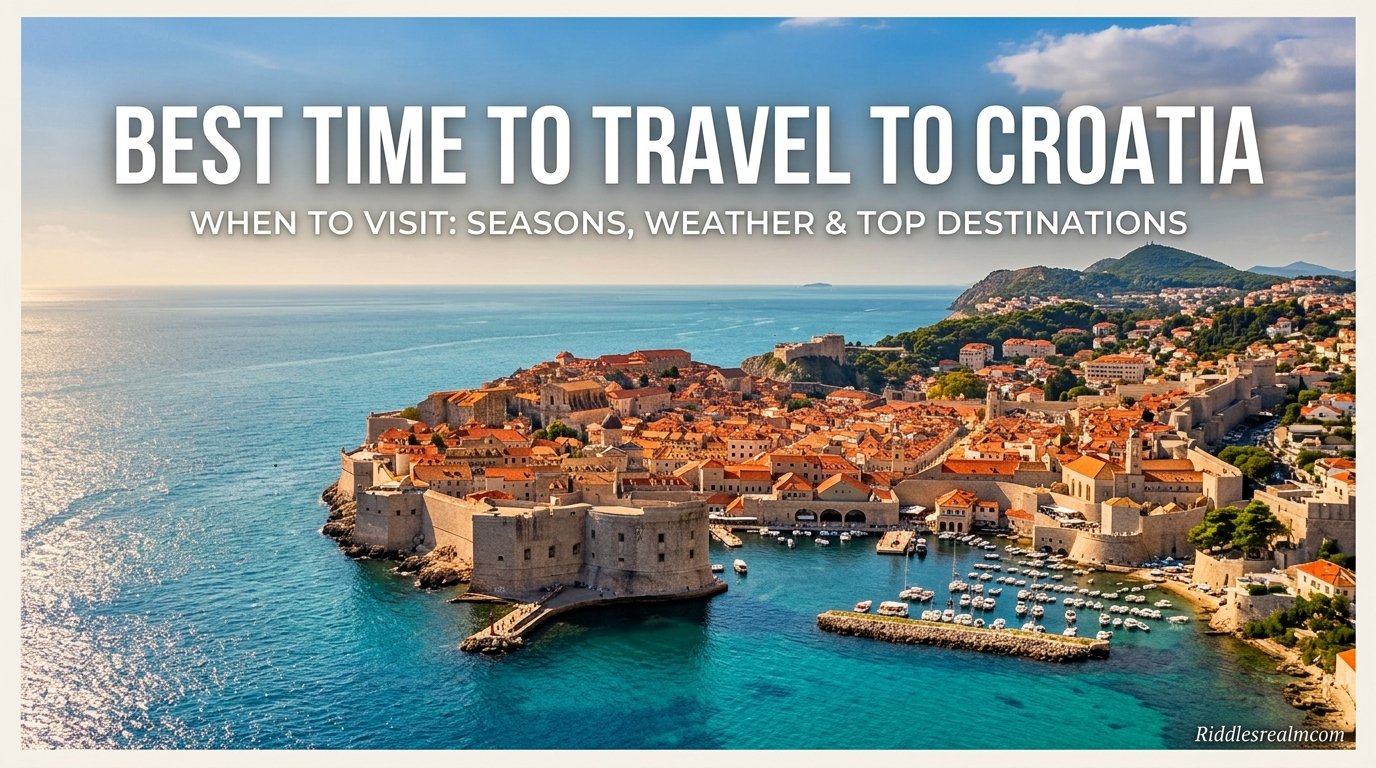
Croatia’s coastline stretches for more than a thousand miles along the Adriatic Sea, and the weather along that coast can look completely different depending on where you stand and when you arrive. The best time to travel to Croatia depends on what you actually want from the trip: warm sea water for swimming, thin crowds on Dubrovnik’s Stradun, or lower hotel prices in Split.
Picking the wrong month can mean discovering the water is too cold to swim in comfortably, paying peak-season prices for a room, or standing in line behind tour groups at Plitvice Lakes. This guide breaks down Croatia’s weather month by month, compares the four seasons side by side, and matches timing to specific activities like sailing, sightseeing, and skiing, so you can plan around what matters to you.
Along the way, you’ll see why coastal weather and inland weather aren’t the same trip, why sea temperature lags behind air temperature by weeks, and where the shoulder season quietly beats peak summer on cost and comfort. There’s also a full festival calendar, since events in cities like Dubrovnik and Rijeka can shift hotel prices on specific dates. Here’s everything you need to know before you book.
Featured Snippet
The best time to travel to Croatia depends on your priorities. For beaches and swimming, visit from June to September. For fewer crowds, pleasant weather, and better prices, choose May, June, September, or October. Winter is best for budget travelers, Christmas markets, and cultural sightseeing rather than coastal vacations.
- Understanding Croatia’s Climate Before You Book
- Croatia Weather by Month
- Best Time to Visit by Season
- Choosing Your Season — Weather, Cost, and Crowds Compared
- Best Time to Visit by Activity
- Where in Croatia Should You Go?
- Croatia’s Festival and Event Calendar
- When to Book for the Best Deals
- FAQs
- Conclusion
Understanding Croatia’s Climate Before You Book

Croatia isn’t one climate zone. The country splits into two distinct weather patterns, and knowing which one applies to your itinerary changes how you pack and when you book. A traveler planning a coastal-only trip to Dubrovnik and Split needs a different packing list and a different set of travel dates than someone splitting time between Zagreb and the islands, and mixing the two up is one of the most common planning mistakes first-time visitors make.
Coastal Mediterranean Climate vs. Continental Interior
The Dalmatian Coast, including Dubrovnik, Split, and the islands, has a Mediterranean climate: hot, dry summers and mild, wet winters. Zagreb and the inland regions sit under a continental climate instead, with colder winters, hotter and more humid summers, and a wider daily temperature swing.
The gap between the two is real. On a summer afternoon, Dubrovnik and Zagreb can differ by 10°F or more, and Zagreb sees more rain spread across the year while the coast concentrates its rainfall in the cooler months. Humidity plays a role too: inland summers can feel heavier and stickier than the coast, where sea breezes cut the heat during the day. If your trip covers both the coast and the interior, treat them as two separate weather forecasts, not one Croatia-wide average, and pack layers if your route moves between the two.
See also Tea Travel: The Ultimate Guide
Air Temperature vs. Sea Temperature
Air temperature tells you what to wear. Sea temperature tells you whether you’ll actually want to get in the water, and the two don’t move together. The Adriatic warms up slowly through spring and stays warm into early fall, lagging behind air temperature by several weeks in both directions.
That lag matters for trip timing. In May, air temperatures on the coast can already feel like summer, but the sea is often still cool enough to make swimming brief. By September, the reverse happens: air temperatures start to ease off, but the sea holds its warmth, which is part of why fall is a quietly good swimming month in Croatia.
Croatia Weather by Month
The table below covers the Dalmatian Coast (Dubrovnik and Split area), since that’s where most visitors spend their beach and sailing time. Inland Zagreb runs several degrees cooler in winter and can run hotter and stickier in mid-summer.
| Month | Avg. Air Temp (Coast) | Sea Temp | Rainfall | Crowd Level |
| January | 46-54°F | Low 50s°F | Moderate-high | Low |
| February | 47-56°F | Low 50s°F | Moderate | Low |
| March | 50-61°F | Low-mid 50s°F | Moderate | Low |
| April | 56-68°F | Mid 50s°F | Moderate | Low-moderate |
| May | 64-76°F | Low-mid 60s°F | Low-moderate | Moderate |
| June | 72-83°F | Upper 60s-low 70s°F | Low | High |
| July | 77-88°F | Mid-upper 70s°F | Very low | Very high |
| August | 77-88°F | Upper 70s°F | Very low | Very high |
| September | 70-81°F | Mid-upper 70s°F | Low | Moderate-high |
| October | 61-72°F | Upper 60s°F | Moderate | Moderate |
| November | 53-63°F | Low 60s°F | High | Low |
| December | 47-56°F | Mid-upper 50s°F | Moderate-high | Low |
Sea temperatures here reflect the Dalmatian Coast; the northern Kvarner Gulf and Istria tend to run a few degrees cooler.
Best Time to Visit by Season

Spring (April–May)
Spring brings mild coastal days, wildflowers along hiking trails, and hotel rates well below summer peaks. Late April and May are strong for sightseeing in Dubrovnik and Split without fighting cruise-ship crowds, and Plitvice Lakes looks its most dramatic with high water flow from spring runoff. Restaurants and konobas along the coast start reopening for the season in April, though some smaller island establishments stay closed until closer to June. The tradeoff is the sea: it’s still on the cool side for extended swimming until late May, so pack for hiking and sightseeing rather than beach days if you’re traveling in April.
Summer (June–August)
Summer is peak season for a reason. Air and sea temperatures both sit at their warmest, island hopping and sailing conditions are reliable, and every coastal town is fully open for business. It’s also the most crowded and most expensive stretch of the year, with Dubrovnik’s Old Town drawing heavy foot traffic and hotel prices climbing well above shoulder-season rates. Ferries between the mainland and popular islands like Hvar and Korčula run their fullest schedules in summer, which helps with flexibility, but the same ferries also fill up fastest, so booking a specific crossing in advance is worth the effort during peak weeks. Book flights and central Dubrovnik or Hvar hotels months ahead if you’re set on July or August.
Fall (September–October)
September often gets overlooked, but it holds onto summer’s sea warmth while crowds and prices start to drop. Early October still works well for swimming and sailing along the southern coast, and both months are excellent for hiking, wine harvest visits in Istria, and city walks without the July heat. Restaurant reservations get easier to land, and popular spots that required booking weeks ahead in August often take walk-ins by late September. Rain becomes more frequent by late October, especially inland, so travelers heading toward Zagreb or Plitvice later in the month should pack a rain layer.
See also 15 Best Places to Travel in December in the USA (Winter Escapes for Every Traveler) 2026
Winter (November–March)
Winter on the coast is mild and wet rather than cold, with Dubrovnik rarely dropping below freezing, while Zagreb and the interior see genuinely cold temperatures and occasional snow. This is the off-season for beach travel but a good window for city breaks, Christmas markets in Zagreb, and last-minute travel deals, since availability opens up and prices fall. Some smaller coastal hotels and restaurants close entirely between November and March, particularly on the islands, so travelers set on a winter coastal trip should stick to larger towns like Dubrovnik and Split where more stays open year-round.
Choosing Your Season — Weather, Cost, and Crowds Compared
| Season | Weather | Avg. Cost | Crowds | Best For |
| Spring (Apr-May) | Mild, sea still cool | Moderate | Low-moderate | Sightseeing, hiking, budget travel |
| Summer (Jun-Aug) | Hot, sea warm | High-peak | Very high | Beaches, sailing, island hopping |
| Fall (Sep-Oct) | Warm days, cooling nights | Moderate | Moderate | Swimming without crowds, wine season |
| Winter (Nov-Mar) | Mild coast, cold interior | Low | Low | City breaks, culture, budget trips |
Shoulder season, meaning May-June and September-October, is where the three factors actually line up in a traveler’s favor. The sea is swimmable, prices sit below peak, and towns like Split and Rovinj feel lived-in rather than overrun. If your dates are flexible, this window is worth prioritizing over July and August.
Best Time to Visit by Activity

Swimming and Beach Season
The Adriatic is comfortably swimmable from June through September, with July and August offering the warmest, most reliable water. Confident swimmers who don’t mind brisker water can start in late May or stretch into early October, especially in the south around Dubrovnik, where the sea holds its warmth longest.
Sailing and Island Hopping
Sailing season on the Adriatic runs roughly May through October, with June, July, and September standing out as the sweet spot for wind conditions and daylight hours. The Maestral, a steady daytime sea breeze, makes for reliable sailing in summer afternoons, while the Bura, a strong, cold wind from the north, is more common in winter and can disrupt ferry and boat schedules.
Sightseeing and City Exploring
Spring and fall are the strongest months for walking tours through Dubrovnik’s city walls, Split’s Diocletian’s Palace, and Zagreb’s Upper Town. Midday heat in July and August can make extended walking uncomfortable, and cruise-ship arrivals crowd the Old Town streets during peak summer hours. Visiting Dubrovnik’s city walls early in the morning, before the day’s cruise groups disembark, is one of the most reliable ways to see the sights without the crowds, regardless of season.
Skiing and Winter Activities
Croatia isn’t a major ski destination, but Sljeme, the mountain above Zagreb, offers modest skiing and snowboarding in a typical winter, usually from December through February depending on snowfall. It’s a small-scale option best suited to travelers already visiting Zagreb rather than a standalone ski trip.
See also 15 Best Travel Laundry Detergent Solutions for Every Trip [2026]
Where in Croatia Should You Go?

Dalmatian Coast and Dubrovnik
The Dalmatian Coast, anchored by Dubrovnik and Split, is where most first-time visitors spend the bulk of their trip. It runs warmest and driest of any region, peaks hardest in July and August, and offers the widest window for swimming and sailing. Islands like Hvar and Korčula sit within this same coastal climate but can feel slightly breezier than the mainland towns, which locals often welcome during the hottest weeks of summer.
Zagreb and the Inland Regions
Zagreb has a genuine four-season climate, with cold winters, warm summers, and none of the coast’s sea-moderated mildness. It works well as a spring, fall, or even winter city break, particularly during the Advent season when the city’s Christmas markets are in full swing. Summer in Zagreb runs hot and can feel muggier than the coast on still days, which is part of why many travelers treat the city as a shoulder-season or winter stop rather than a midsummer one.
Plitvice Lakes National Park
Plitvice sits inland and is best visited in spring or early fall. Spring brings the highest water flow and the most dramatic waterfalls, while fall adds turning foliage color to the lakes. Summer is the most crowded period, and parts of the park’s trail network can close in icy winter conditions.
Croatia’s Festival and Event Calendar

Local events can shift hotel availability and pricing in specific cities on specific dates, even outside peak season.
| Event | Location | Timing | Effect on Travel |
| Rijeka Carnival | Rijeka | January-February | Hotel demand spikes in Rijeka |
| Festivity of Saint Blaise | Dubrovnik | February 3 | Local celebrations, moderate demand |
| Easter celebrations | Nationwide | March-April (varies by year) | Family travel raises coastal demand |
| Dubrovnik Summer Festival | Dubrovnik | July-August | Adds to already-peak summer pricing |
| Ultra Europe | Split | July | Major demand spike in Split |
| Advent in Zagreb | Zagreb | Late November-January | High demand for Zagreb hotels |
Checking a city’s event calendar before locking in travel dates can prevent an unpleasant surprise on hotel pricing, even in a month that otherwise looks like off-season.
When to Book for the Best Deals
Booking lead time varies sharply by season. For July and August travel, especially in Dubrovnik, Hvar, or Split, book flights and centrally located hotels three to six months ahead, since rooms in popular neighborhoods sell out early. Shoulder-season trips in May, June, September, or October have more flexibility, and booking six to ten weeks out usually secures good rates without much risk of properties selling out.
Winter travel, from November through March, is where late booking pays off. Airlines and hotels often drop prices closer to departure since demand is thin, and travelers with flexible dates can find meaningful discounts booking just a few weeks ahead. One exception is Zagreb during Advent, when Christmas market demand pushes hotel bookings up even in an otherwise slow travel month, so that stretch is worth booking earlier than the rest of winter.
FAQs
What is the cheapest month to visit Croatia?
January and February are typically the cheapest months, with low hotel demand across the coast and inland. Flights also tend to be less expensive outside the June-through-August window.
What is the most beautiful time to visit Croatia?
Late spring and early fall are widely considered the most visually rewarding, combining green landscapes or turning foliage with fewer crowds at landmarks like Plitvice Lakes and Dubrovnik’s Old Town.
What is the average temperature in Croatia in summer?
Coastal areas average 77-88°F in July and August, while inland Zagreb runs slightly warmer and more humid during the same months.
Is it warm in Croatia in October?
Yes, coastal Croatia stays warm into October, with air temperatures typically in the low-to-mid 60s to low 70s°F and sea temperatures still swimmable for many travelers.
How many days do you need in Croatia?
Ten to fourteen days lets most first-time visitors cover Dubrovnik, Split, and at least one island without rushing. A week is workable for a coastal-only trip focused on one or two base cities, while three weeks or more allows time to add Zagreb and Plitvice Lakes without cutting beach or sailing time short.
Conclusion
There’s no single best month for every trip to Croatia, only the best month for what you’re after. Peak summer delivers the warmest sea and the fullest island-hopping conditions, at the cost of crowds and top-dollar pricing. Shoulder season in May, June, September, or October offers a genuine middle ground: swimmable water, lighter crowds, and lower rates. Winter suits travelers chasing city culture and budget prices over beach time. Match the season to your priorities, check the local festival calendar for your target cities, and book according to how far out your travel dates fall.

A modern riddle-maker who builds clever, pocket-sized puzzles with sharp wordplay and elegant misdirection. Her clues are clean, surprising, and designed to make you think twice—then smile when it clicks.
Okay, gem79vip… felt a bit fancier than usual, haha! VIP treatment, you know? Seriously though, the site looks slick and the games are fun. Give gem79vip a try if you’re feelin’ a bit posh!
Betobetcasino is a real deal casino. They got all sorts of games there, just like you were right in Vegas. Totally worth a visit! betobetcasino.
VT88io is a cool site. Easy to navigate and lots of games to play. I signed up a while ago and I still return often. Give it a shot! vt88io
This is probably the best platform for local players right now. The game variety is insane and the login process is very secure. Give jilikobetph a try.
[2316]tk bet official login | বিকাশ ডিপোজিট ও সেরা ক্যাসিনো বোনাস,tk bet এর মাধ্যমে অনলাইন স্লট গেমের নিয়ম জানুন এবং অ্যাপ ডাউনলোড করে সহজেই খেলা শুরু করুন। বিকাশ দিয়ে দ্রুত ডিপোজিট করে সেরা বোনাসটি লুফে নিন। visit: tk bet
I love the variety of games here! The interface is very user friendly and I had no issues getting into my account. Best bet is 90jiliclubcasinologin for a fun night.
[6054]luckydays Login Oficial | Slots en Vivo y Depósitos con Oxxo,Accede a luckydays y descarga la app apk para disfrutar las mejores slots en vivo. Recarga fácil en Oxxo y descubre cómo ganar en la ruleta online. ¡Regístrate hoy! visit: luckydays
Secure and reliable. I appreciate how easy it is to access my account without any glitches. If you are looking for a steady portal, magnum188login is the way to go.
Best login portal I have used for this game. No more broken links or downtime, just straight to the fun at luckyplayphlogin.
[9752]KB33 বাংলাদেশ: লগইন, রেজিস্টার এবং সেরা ক্যাসিনো গেম অ্যাপ ডাউনলোড,KB33 বাংলাদেশ-এ স্বাগতম! সেরা ক্যাসিনো গেম অ্যাপ ডাউনলোড করুন এবং সহজেই লগইন ও রেজিস্টার করে আপনার বেটিং যাত্রা শুরু করুন। নিরাপদ পেমেন্ট এবং উত্তেজনাপূর্ণ গেমিং অভিজ্ঞতার জন্য আজই KB33-এ যোগ দিন। visit: kb33
[6304]Tigerbet Login PH – Legit Slots at GCash Casino sa Pilipinas,Mag-tigerbet login ph na para sa legit online slots GCash. I-download ang APK at alamin kung paano maglaro ng baccarat. Sumali at mag-register na rito! visit: tigerbet
Honestly the best place to access my account. The login process is super smooth and I never encounter any glitches. Highly recommend jiligologin for everyone!
I have been rolling with this platform for months and the experience stays consistently good. The promotions are easy to claim and the games run without any hiccups. Definitely one of the more trustworthy options I have come across. ufa656login
I really enjoy the atmosphere here. The winning streaks have been amazing lately and the registration was a breeze. Visit vngen88 for some action.
The promotions here are actually worth it. I managed to win a decent amount thanks to the welcome bonus. Big thanks to br7788bet9.
Feeling like a total VIP here. The rewards program at ph55vip777 is honestly the best in the market.
Finally found a platform that doesn’t lag during peak hours. The registration process was a breeze. Great job guys at phjljl1.
The variety of games here is insane. I spent the whole weekend exploring and I’m still finding new favorites. buy138slot is definitely my new go-to spot.
The gaming options are top notch and the GCash integration is just perfect for us locals. Really enjoying my time on gcashnustargameph.
I love the daily bonuses they offer. It really keeps things exciting and gives me a bit more play time. I am loving vnjun888com so far.
I was surprised by how easy it is to withdraw my winnings. No hidden fees and no long waits. I really trust pkwwwb777.
Everything works perfectly on my browser. No crashes and the loading time is minimal. parkjililogin is a solid choice for any player.
[6437]okbet login at registration | online slots via GCash,Gamitin ang okbet login app para mabilis na maglaro. Mag-okbet register account na at subukan ang online slots gcash deposit. Mag-sign up na rito! visit: okbet
Login is seamless and the account management is very straightforward. No unnecessary hassle just pure gaming. 3lcomlogin is just efficient.
This site is a hidden gem. The graphics are crisp and the gameplay is just addictive. If you are looking for something fresh, try vnzx88acom.
Best platform I have encountered in a long time. The bonuses are generous and the support team is very helpful. Log in to brazino777entrar now
[3012]bdbet লগইন এবং অ্যাপ ডাউনলোড | সেরা অনলাইন স্লট গেম সাইট,bdbet লগইন করার নিয়ম জানুন এবং অ্যাপ ডাউনলোড করুন। বিকাশ দিয়ে অনলাইন ক্যাসিনো ডিপোজিট করে লাইভ ক্যাসিনো খেলার নিয়মাবলী দেখুন। আজই জয়েন করুন। visit: bdbet
[484]betvi লগইন ও অ্যাপ ডাউনলোড | বিকাশ দিয়ে অনলাইন ক্যাসিনো,betvi লগইন করে সেরা স্লট গেম সাইটের অভিজ্ঞতা নিন। সহজেই betvi app download করুন এবং বিকাশ দিয়ে অনলাইন ক্যাসিনো গেম উপভোগ করতে আজই যোগ দিন। visit: betvi
Super handy app for keeping up with my bets on the go. It is much faster than the mobile browser version. ph1xbetapp is a game changer for me.
Great customer support and a very friendly community feel. It makes the whole gaming experience much more enjoyable. Love using indwin7login.
Really impressed with the variety of slots here. I managed to hit a nice win yesterday and the withdrawal was seamless. Love br55wwbet.
Really impressed with the variety of games available here. It’s definitely one of the top choices for players in the Philippines. Check out phpin777 if you want some real action.
Honestly, the game variety here is insane. I spent all weekend exploring the different slots on ze777game and I’m genuinely impressed by the graphics. Great vibes overall! ze777game
Love the vibe here! It feels like a real community and the live dealer games are super engaging. Give swerte999live a try
Finally found a platform that doesn’t lag during big events. The betting odds are very competitive. Highly recommend br1para1bet to everyone.
Apaldoapp is pretty slick! I’ve been using it and it’s got a decent selection. Definitely worth checking out if you’re looking for something new and fun. apaldoapp
The VIP treatment here is no joke. I feel like a valued player and the rewards are actually generous. Keep up the good work guys. 9096vipbet
Really impressed with the security and transparency of this platform. It feels safe to deposit and play here. Trust phbunos88
Great vibes and even better rewards. I really appreciate how straightforward the rules are here. Definitely visit bdm444 for some quality entertainment.
[2396]Olx128: Login Daftar Akun Slot Gacor Deposit Dana,Olx128 memudahkan login dan daftar akun untuk akses slot gacor deposit dana. Pelajari cara main baccarat online dan download apk casino terpercaya di sini. visit: olx128