
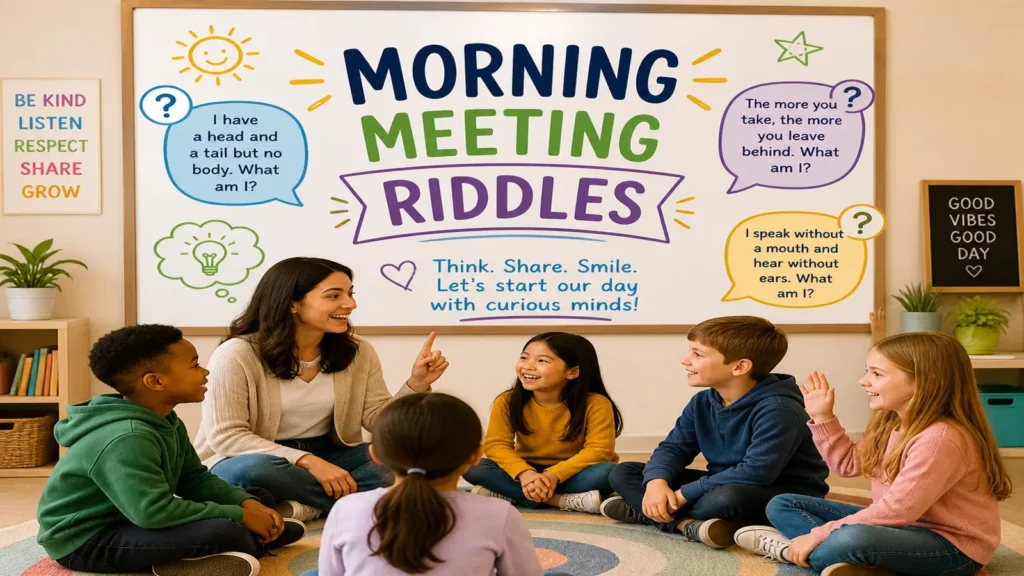
Every group starts stronger with a quick mental spark. A simple puzzle can shift attention and build early energy.
In classrooms and offices, morning meeting riddles help people connect faster. They turn quiet starts into active thinking moments.
This guide explores creative ways to use riddles for engagement, teamwork, and focus. Each section offers ready ideas you can use immediately.
The Morning Ritual That Starts With Riddles
Morning sessions often feel slow at first. A short riddle changes that pace instantly.
It creates curiosity and pulls attention into the group space.
• Sets tone for active engagement
• Breaks early silence quickly
• Encourages group participation
• Builds shared focus moment
• Shifts mind into thinking mode
• Creates friendly atmosphere early
• Helps reduce morning distraction
• Supports smoother session flow
• Sparks curiosity naturally
• Improves readiness for tasks
• Encourages verbal interaction
• Establishes positive group rhythm
Why Puzzle Warmups Change Group Energy
Mental warmups activate thinking speed and attention. They help groups transition into focus faster.
They also reduce hesitation in speaking early.
• Activates cognitive response quickly
• Improves attention stability early
• Reduces mental sluggishness
• Builds group awareness
• Encourages early speaking
• Strengthens listening behavior
• Boosts curiosity levels
• Creates shared thinking space
• Supports emotional comfort
• Improves engagement flow
• Encourages active participation
• Helps group coordination
Classroom Spark With Riddle Starters
Students respond strongly to playful challenges. It helps them settle into learning mode faster.
Riddles also create safe participation for all learners.
• Improves classroom attention
• Encourages early participation
• Builds learning readiness
• Supports memory activation
• Strengthens listening skills
• Helps shy learners speak
• Increases student confidence
• Creates fun learning entry
• Reduces morning distraction
• Encourages peer interaction
• Builds classroom unity
• Supports active learning
Workplace Teams and Mental Activation
Teams benefit from quick thinking starters before meetings. It improves clarity and communication flow.
It also reduces early meeting stress.
• Improves meeting focus
• Encourages team communication
• Reduces workplace tension
• Builds collaboration mindset
• Supports idea sharing
• Strengthens group trust
• Encourages early engagement
• Improves problem solving
• Creates positive start
• Boosts team morale
• Enhances discussion flow
• Supports remote connection
Simple Starter Riddle Set
Starter riddles are easy and fast to solve. They help build confidence early in sessions.
They are ideal for mixed groups.
• What has keys no doors
• What runs never walks
• What gets wetter drying
• What has face no eyes
• What can be caught not thrown
• What has hands no clapping
• What grows smaller used
• What has bed never sleeps
• What has ring no finger
• What moves without feet
• What gets bigger removed
• What belongs used others
Humor-Based Warmup Challenges
Funny riddles lighten the environment quickly. Humor helps reduce group tension.
They make participation feel easier.
• Why did banana visit doctor
• What kind of tree fits hand
• Why did clock go school
• What do sleeping cows say
• Why did pencil travel abroad
• What has legs but sits still
• Why did math book cry
• What gets tired over use
• Why did cookie feel sick
• What room has no doors
• Why did fish avoid homework
• What jumps but has no legs
Logic Path Riddles for Thinking
Logic riddles build deeper reasoning skills. They require structured thinking steps.
They are ideal for advanced groups.
• If all A equals B then
• What changes when reversed fully
• If path splits which chosen
• What grows without moving place
• What remains after removal all
• If nothing changes what true
• What increases when divided repeatedly
• What disappears when solved correctly
• If order shifts what changes
• What stays same when flipped
• What connects ideas without sound
• If logic breaks what follows
Ultra-Short Brain Sparks
Short riddles work best for time-limited meetings. They create instant engagement.
They require quick thinking responses.
• What runs but never rests
• What has face no eyes
• What grows smaller when used
• What has keys no locks
• What moves without legs
• What gets wetter while drying
• What has ring no sound
• What opens but no door
• What has bank no money
• What goes up never down
• What is full but light
• What can break but not touch
Child-Friendly Puzzle Set
Kids need simple and clear wording. These riddles are easy to understand.
They support learning and fun together.
• What animal says moo
• What color sky above
• What shape has three sides
• What do bees make
• What do we drink daily
• What helps us see better
• What flies but not bird
• What do plants need grow
• What has stripes runs fast
• What do you wear feet
• What shines at night sky
• What barks and has tail
Adult-Level Challenge Cards
Adult puzzles use abstract thinking. They focus on workplace reasoning.
They encourage deeper discussion.
• What grows when shared knowledge
• What strengthens under pressure
• What changes with perspective shift
• What improves through collaboration
• What weakens when ignored
• What builds trust slowly
• What connects without wires
• What solves before action
• What increases with experience
• What improves decision speed
• What disappears when understood
• What remains after simplification
Group Competition Puzzle Format
Competition adds energy to sessions. It encourages teamwork and interaction.
It also improves engagement levels.
• Divide into equal teams
• Assign rotating leaders each round
• Score correct answers points
• Use timed response rounds
• Add bonus explanation points
• Encourage team discussion first
• Rotate challenge difficulty levels
• Track scores on board
• Reward teamwork effort
• Keep friendly competition tone
• Include final bonus round
• Mix puzzle types evenly
Answer-Explained Riddle Bank
Answers help reinforce learning clearly. Explanation improves understanding depth.
It supports group discussion.
• Show correct answer after attempt
• Explain reasoning step clearly
• Encourage group reflection
• Compare different answers
• Highlight key logic steps
• Reinforce correct thinking patterns
• Support memory retention
• Clarify confusing riddles
• Encourage follow-up questions
• Build learning confidence
• Strengthen understanding depth
• Improve future performance
Running a Smooth Session Flow
Good structure improves engagement quality. Timing matters in every session.
It keeps attention stable.
• Start with easy warmup
• Move to medium difficulty
• Limit each riddle time
• Encourage group participation
• Avoid long explanations early
• Rotate speaking turns
• Keep tone light always
• Balance participation evenly
• End with fun challenge
• Maintain steady pacing
• Watch group energy level
• Adjust difficulty as needed
Mistakes That Break Engagement
Poor structure reduces impact quickly. Avoiding mistakes keeps flow strong.
It ensures better participation.
• Using overly hard puzzles
• Allowing one voice dominate
• Skipping explanation phase
• Making sessions too long
• Repeating same format often
• Ignoring group feedback
• Poor timing control
• Unclear wording used
• No participation balance
• Lack of variation
• Overloading with content
• Weak facilitation flow
Creative Format Experiments
New formats keep sessions fresh. Variety improves long-term engagement.
It prevents routine boredom.
• Act out riddle clues
• Draw answers visually
• Turn riddles into stories
• Use emoji clue games
• Add music timing rounds
• Create mystery object games
• Use group voting system
• Mix trivia with riddles
• Build chain puzzle stories
• Let participants create riddles
• Use themed weekly sets
• Add movement-based clues
Digital and Printable Usage Ideas
Riddles work across platforms easily. They adapt to modern learning tools.
They support hybrid environments.
• Use slideshow presentation mode
• Share in messaging apps
• Print daily riddle sheets
• Add to virtual meetings
• Use online quiz tools
• Send email warmups daily
• Create mobile-friendly cards
• Store in shared documents
• Use whiteboard sessions
• Rotate digital hosting roles
• Add QR code access
• Integrate classroom systems
FAQs
What are morning meeting riddles used for?
They help start meetings with quick thinking activities. They improve focus and group interaction early in sessions.
Why do riddles improve engagement?
They activate curiosity and attention quickly. This makes people more involved in group discussions.
Can riddles be used in remote meetings?
Yes, they work well in virtual sessions. They help remote teams feel more connected.
How long should a riddle session last?
Most sessions work best in five to ten minutes. This keeps energy high without slowing meetings.
Are riddles good for children?
Yes, they improve learning and participation. Simple riddles help children build confidence.
What makes a good icebreaker riddle?
A good riddle is short, clear, and easy to understand. It should encourage curiosity and quick thinking.
Conclusion
Morning sessions become more engaging when simple puzzles are used. They help groups think faster and connect better. Using morning meeting riddles regularly builds stronger participation habits. Over time, it creates smoother and more active group interactions.

Joseph Morgan is an enigmatist known for creating clever and mysterious riddles. Born in Scotland, he spent his life challenging people to think deeply through puzzles and brainteasers. He became famous for his creative mind and love of mystery.