
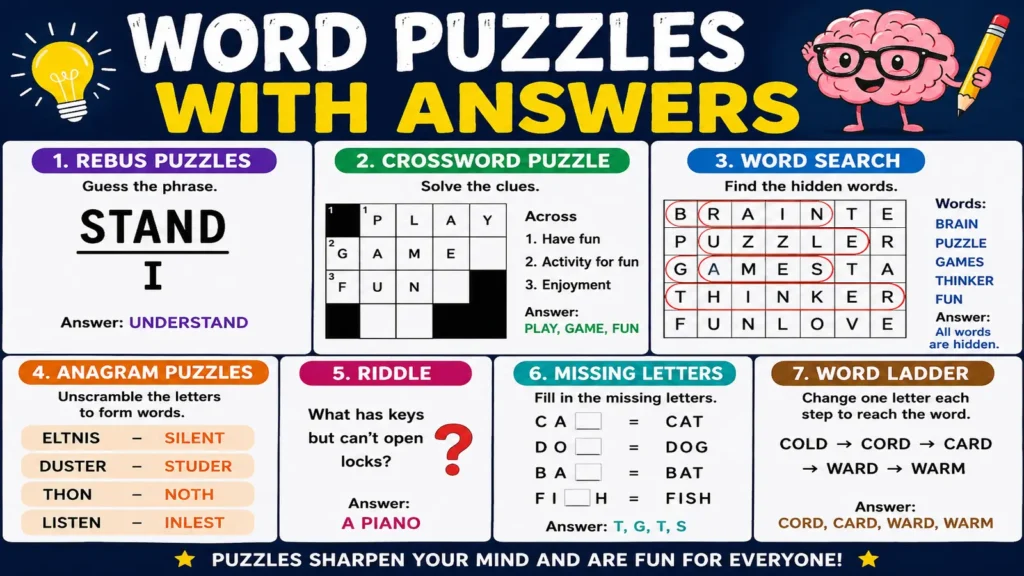
Many people enjoy puzzles because they challenge the mind without feeling stressful. Word games also create fun moments during family nights, classrooms, and quiet evenings at home. Today, puzzle fans enjoy everything from classic crosswords to modern phone apps. Some games focus on speed, while others reward patience and creativity. This guide explores the best word puzzles with answers for beginners and experienced players alike. You will also discover solving tips, puzzle styles, and fun examples to try immediately.
Quick Answer
Word puzzles with answers are games that challenge players to solve hidden words, clues, patterns, or riddles. They improve focus while providing entertainment for kids and adults. Popular examples include crosswords, rebus puzzles, word searches, and anagrams.
TL;DR
• Word puzzles entertain while sharpening thinking skills
• Rebus puzzles use pictures and hidden meanings
• Crosswords reward vocabulary and clue recognition
• Daily puzzle apps remain popular in 2026
• Printable puzzles work well during parties
• Simple strategies improve solving speed dramatically
Why Word Puzzles Stay Popular
Word puzzles continue attracting players because they combine fun with mental challenges. In addition, many games fit easily into busy daily routines.
Friends and families also enjoy solving puzzles together during road trips, holidays, and quiet weekends. Because of this, puzzle games remain timeless.
• Quick puzzles fit short lunch breaks
• Families enjoy solving clues together
• Many games work without internet access
• Puzzle apps offer fresh daily challenges
• Teachers use puzzles during lessons
• Brain teasers encourage creative thinking
• Crosswords reward patient problem solving
• Mobile games support casual competition
• Word searches help children learn spelling
• Puzzle books remain affordable entertainment
• Rebus puzzles create funny conversations
• Daily streaks motivate regular play
Easy Word Puzzles for Beginners
New players often start with simple games that build confidence quickly. Fortunately, beginner puzzles usually follow clear patterns and familiar words.
Short puzzles feel less intimidating, so players stay motivated longer. Meanwhile, repeated practice improves vocabulary naturally.
• Find hidden fruits inside a grid
• Unscramble letters to form animal names
• Match simple clues with short answers
• Circle repeated words inside paragraphs
• Complete rhyming word pairs carefully
• Solve missing-letter vocabulary games
• Identify opposites from clue lists
• Connect words sharing common endings
• Rearrange months into correct order
• Guess words using picture hints
• Spot hidden colors inside sentences
• Build simple compounds from clues
Rebus Puzzles That Make You Think
Rebus puzzles use symbols, spacing, and pictures to represent phrases creatively. As a result, players must think beyond literal meanings.
Many rebus games appear funny at first glance. However, the hidden answers often become obvious after careful observation.
• “Cycle cycle cycle” means tricycle
• “Stand” under “I” means understand
• Tiny “job” suggests odd jobs
• Word inside another means hidden meaning
• Upside-down text hints reversed phrases
• Large spacing suggests social distancing
• Repeated rain words imply heavy storms
• Broken letters often signal heartbreak
• Backward writing hints turning back
• Small “big” means little big ideas
• Floating words suggest daydreaming thoughts
• Stacked terms can imply crowded rooms
Crossword Puzzles and Clue Tricks
Crosswords reward vocabulary, patience, and pattern recognition. Still, beginners often struggle because clues use misleading wording.
Experienced players learn common clue tricks over time. Therefore, solving becomes faster and more enjoyable with practice.
• Question marks usually signal wordplay
• Short clues often hide simple answers
• Plural clues need plural solutions
• Fill easiest answers before difficult ones
• Pencil marks help during uncertain guesses
• Theme puzzles share connected ideas
• Repeated letters narrow possible choices
• Synonym clues require flexible thinking
• Crossword abbreviations appear very frequently
• Daily practice improves solving confidence
• Black squares separate answer groups
• Long answers reveal puzzle themes
Word Search Challenges for All Ages
Word searches remain popular because they feel relaxing yet rewarding. In addition, players of nearly every age can participate comfortably.
Teachers often use these puzzles during reading lessons and vocabulary exercises. Meanwhile, adults enjoy them during travel and downtime.
• Hidden animals increase observation skills
• Holiday themes create seasonal excitement
• Timed challenges improve scanning speed
• Diagonal words raise puzzle difficulty
• Large grids require stronger concentration
• Classroom puzzles reinforce spelling practice
• Family competitions encourage teamwork naturally
• Puzzle books work during long flights
• Mystery themes add extra suspense
• Colored markers simplify completed searches
• Circular word paths create fresh challenges
• Music themes attract younger players
Fun Anagram Puzzles With Answers
Anagrams scramble letters into new words or phrases. Because of this, players must rearrange patterns mentally.
These puzzles improve spelling awareness while encouraging flexible thinking. Short anagrams usually work best for beginners.
• “Silent” rearranges into “listen”
• “Below” becomes “elbow” easily
• “Save” turns into “vase”
• “Dusty” transforms into “study”
• “Night” changes into “thing”
• “Angel” forms the word “glean”
• “State” reshuffles into “taste”
• “Heart” rearranges into “earth”
• “Brag” quickly becomes “grab”
• “Schoolmaster” creates “the classroom”
• “Players” changes into “parsley”
• “Fired” becomes “fried” instantly
Tricky Riddles That Test Logic
Riddles challenge players to think creatively instead of literally. Therefore, many answers feel surprising at first.
Some riddles depend on wordplay, while others require logic. Either way, careful reading usually reveals important clues.
• What has keys but no locks? Piano
• What runs without legs? Water
• What has hands but cannot clap? Clock
• What gets wetter while drying? Towel
• What has one eye? Needle
• What rises without moving? Bread dough
• What belongs to you but others use? Name
• What breaks without falling? Dawn
• What travels silently through walls? Light
• What comes once in a minute? Letter M
• What flies without wings? Time
• What loses its head every morning? Pillow
Picture Word Puzzles Explained
Picture word puzzles mix images with hidden meanings and phrases. Because of this, players rely on visual clues heavily.
These games work well during parties and classrooms. Furthermore, they encourage creative group discussions.
• Fish inside bowl means trapped feelings
• Large eye suggests public attention
• Tiny umbrella hints light rain
• Broken chain represents freedom gained
• Clock beside road means time travel
• Pencil crossing book suggests homework
• Mountain over cloud means high hopes
• Heart beside arrow signals romance
• Empty plate hints skipped meals
• Ladder near stars means ambition
• Puzzle pieces form teamwork ideas
• Footprints leading away imply departure
Daily Puzzle Games Trending in 2026
Daily puzzle apps remain extremely popular because they provide short entertainment bursts. Many players also enjoy sharing scores online.
Modern games combine classic mechanics with fresh themes and streak systems. As a result, puzzle culture keeps expanding.
• Daily word games encourage consistent routines
• Timed rounds increase competitive excitement
• Puzzle streaks motivate returning players
• Mobile apps support quick brain breaks
• Social sharing creates friendly competition
• Theme puzzles refresh gameplay regularly
• Hint systems reduce player frustration
• Multiplayer modes build online communities
• Colorful interfaces attract younger audiences
• Offline access helps during travel
• Puzzle archives preserve older challenges
• Short sessions fit busy schedules
Puzzle Strategies That Actually Help
Strong puzzle habits matter more than natural talent. Fortunately, simple methods improve solving speed noticeably.
Many experienced players follow steady routines rather than guessing randomly. Therefore, consistency often beats luck.
• Solve easiest clues before harder ones
• Scan entire puzzle before answering
• Eliminate impossible choices quickly
• Write tentative answers lightly first
• Break long words into smaller chunks
• Look for repeated sound patterns
• Rest briefly during difficult puzzles
• Practice daily using mixed puzzle types
• Read clues twice before guessing
• Start with familiar vocabulary themes
• Use context clues carefully always
• Avoid rushing under time pressure
Word Puzzles for Kids and Families
Family-friendly puzzles create shared learning experiences at home. Additionally, children improve reading and spelling through regular play.
Simple games often work best during family gatherings and classroom activities. Short rounds also keep younger players engaged longer.
• Alphabet hunts build letter recognition
• Animal clues entertain younger children
• Team races encourage friendly cooperation
• Printable sheets simplify classroom planning
• Picture clues reduce reading pressure
• Rhyming games improve listening skills
• Seasonal puzzles match holiday activities
• Large-print puzzles help early readers
• Group solving teaches communication skills
• Reward charts motivate consistent practice
• Simple clues prevent player frustration
• Colorful pages attract curious learners
Challenging Word Puzzles for Adults
Adult puzzle fans often prefer tougher clues and layered wordplay. Consequently, advanced puzzles demand patience and sharper reasoning.
Competitive players also enjoy tracking solving streaks and completion times. Some communities even host puzzle tournaments online.
• Cryptic clues require deeper interpretation
• Multi-step riddles increase solving difficulty
• Long anagrams challenge memory skills
• Timed crossword races create excitement
• Hidden themes reward careful observation
• Logic grids demand organized thinking
• Rare vocabulary expands language knowledge
• Puzzle marathons test concentration endurance
• Word ladders encourage strategic planning
• Advanced rebus puzzles confuse beginners
• Hard clues reward persistence eventually
• Expert solvers study recurring patterns
Printable Puzzle Ideas for Parties
Printable puzzles work well during birthdays, school events, and office gatherings. Moreover, they require very little preparation.
Hosts can mix puzzle styles to match different age groups. As a result, everyone stays entertained longer.
• Holiday crosswords create festive energy
• Trivia word searches spark conversations
• Team puzzle relays increase excitement
• Baby shower games entertain guests
• Classroom contests reward participation fairly
• Wedding puzzles personalize celebrations creatively
• Halloween riddles add spooky fun
• Icebreaker games help strangers interact
• Travel-themed puzzles suit vacation parties
• Sports clues energize competitive groups
• Mini puzzles fill waiting periods
• Puzzle stations encourage casual participation
How Word Puzzles Help Your Brain
Word puzzles exercise memory, attention, and pattern recognition regularly. However, they should remain enjoyable rather than stressful.
Short puzzle sessions can also provide relaxing breaks from screens and busy schedules. Meanwhile, learning new words keeps the mind active.
• Vocabulary practice strengthens communication skills
• Pattern recognition improves mental flexibility
• Crossword clues train memory recall
• Puzzle routines encourage mental focus
• Word games reduce boredom quickly
• Creative thinking grows through riddles
• Daily challenges support healthy habits
• Solving clues builds confidence steadily
• Group games strengthen social interaction
• Hidden-word games improve concentration
• Logical puzzles sharpen reasoning abilities
• Brain teasers encourage curiosity naturally
FAQs
What are the easiest word puzzles for beginners?
Word searches, simple riddles, and short anagrams work best for beginners. These puzzles use familiar words and straightforward rules.
Are word puzzles good for children?
Yes, many puzzles improve spelling, vocabulary, and reading confidence. Family puzzle games also encourage teamwork and communication.
What is the difference between a rebus and a crossword?
Rebus puzzles rely on pictures and symbols. Crosswords depend mainly on written clues and vocabulary knowledge.
How often should I play word puzzles?
Short daily sessions usually work well for most people. Even ten minutes can improve puzzle-solving confidence over time.
Can adults benefit from word puzzles too?
Absolutely. Adults enjoy puzzles for relaxation, creativity, and mental focus. Competitive puzzle games also create fun personal challenges.
Which puzzle apps are popular right now?
Daily word games, crossword apps, and rebus puzzle platforms remain popular during 2025 and 2026. Many include streak tracking and multiplayer modes.
Conclusion
Word puzzles continue bringing people together through creativity, challenge, and entertainment. Some players enjoy quick daily games, while others prefer long problem-solving sessions. Fortunately, there is a puzzle style for nearly every age and skill level. Crosswords, rebus games, riddles, and anagrams each offer unique rewards. Whether you enjoy solo brain teasers or family competitions, word puzzles with answers provide endless ways to stay entertained and mentally active.

A playful wordsmith with a knack for misdirection, I craft riddles that tease the brain. My puzzles blend clever clues, clean logic, and a dash of humor—built to challenge beginners and stump seasoned solvers alike. From short, punchy brainteasers to layered mysteries with hidden meanings, I love turning everyday ideas into mind-bending questions that invite curiosity and conversation. When I’m not twisting words into puzzles, I’m collecting strange facts, testing new clue styles, and fine-tuning the art of fair—but fiendish—fun.