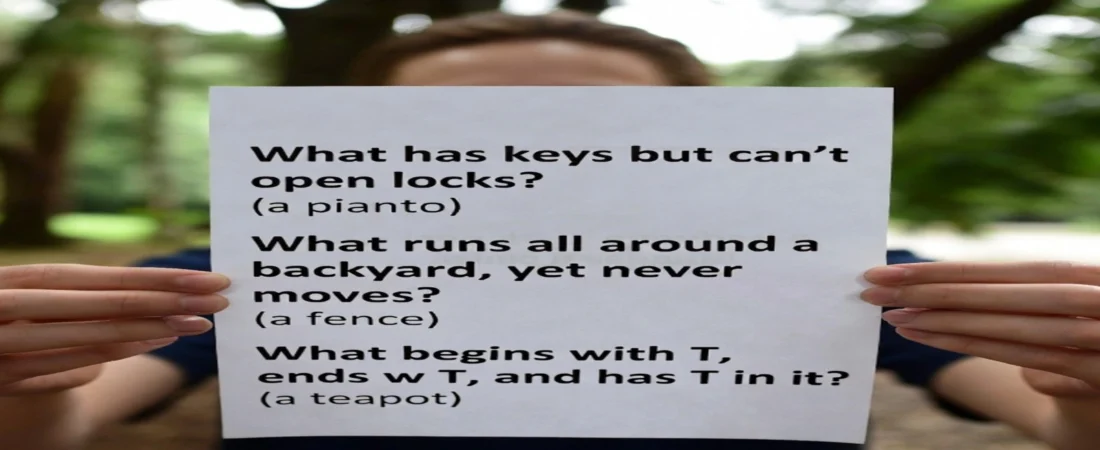
Riddles are one of the easiest ways to wake up your mind. They are quick, playful, and easy to share. Also, they work for solo breaks, family time, road trips, and game night. This guide is for anyone who wants to test your brain with these riddles without digging through cluttered lists. You will get easy picks, funny twists, logic challenges, and tougher brain-benders. Better yet, every section is easy to scan.
Quick Answer
If you want to test your brain with these riddles, start easy and build up. A good mix includes short, funny, logical, and hard riddles, so your mind stays engaged.
TL;DR
• Start with easy riddles to build momentum
• Short riddles work best for quick breaks
• Funny riddles make group play smoother
• Logic riddles reward slow, careful thinking
• Hard riddles are better after warm-ups
Why Brain Riddles Stay Fun
Riddles feel simple at first. Then they flip your expectations. Because of that, they are fun for kids, adults, and groups.
They also come in many styles. Some test words, while others test logic or numbers. That variety keeps the challenge fresh.
• They reward curiosity over speed
• Quick wins build confidence fast
• Harder ones stretch flexible thinking
• Funny twists lower the pressure
• Short formats fit busy schedules
• Group solving sparks lively reactions
• Solo solving feels quietly satisfying
• Clever answers stick in memory
• Simple wording hides tricky turns
• Every age can join in
• They turn waiting time playful
• One good riddle invites another
Easy Warm-Up Riddles
Start here if you want a gentle win. These are simple enough to solve, yet still make your brain pivot.
Read each one once before guessing. Then check whether the answer came from logic or a sneaky word twist.
• What gets wetter while drying? A towel
• What has hands, but cannot clap? A clock
• What has one eye, yet cannot see? A needle
• What goes up, yet never returns? Your age
• What has many teeth, yet never chews? A comb
• What can fill a room without weight? Light
• What has a neck, but no head? A bottle
• What runs, but never takes steps? Water
• What has pages, but tells no story? A calendar
• What belongs to you, others say often? Your name
• What gets sharper the more you use it? Your mind
• What has a face, but no feelings? A coin
Short Riddles for Busy Days
Sometimes you want a fast challenge. These are perfect for coffee breaks, car rides, or a quick scroll.
Even better, short riddles usually hide the trick in plain sight. So read slowly before you answer.
• What has four wheels and flies? A garbage truck
• What has keys, but opens nothing? A piano
• What breaks when spoken? Silence
• What has a ring, but no finger? A phone
• What comes down, but never climbs? Rain
• What has a bed, but never sleeps? A river
• What has a thumb, but no pulse? A glove
• What travels widely from one corner? A stamp
• What has towns, but no buildings? A map
• What grows larger when removed from? A hole
• What can you catch, but not toss? A cold
• What has a spine, but no bones? A book
Funny Riddles That Still Make You Think
A good laugh helps people relax. However, the best funny riddles still sneak in a little challenge.
Use these when you want smiles first and answers second. They work especially well in groups.
• What kind of room lacks walls? A mushroom
• Which animal outjumps every house? Any animal
• What coat appears only when wet? Paint
• What kind of tree fits your hand? A palm
• What has stripes and says meow? A tiger
• What building has the most stories? A library
• What tastes better than it smells? Your tongue
• What comes once in a minute? The letter M
• Why is a nose not twelve inches? Then it’s a foot
• What do ghosts serve on dessert? I-scream
• What has ears, yet hears nothing? A cornfield
• Why was the math book sad? Too many problems
Wordplay Riddles That Twist Language
Word riddles are all about language. Instead of facts, they play with sound, spelling, or double meaning.
Because of that, the answer often feels obvious later. Still, the first guess is often wrong.
• What starts with E and ends with E? An envelope
• What word loses a letter, yet remains shorter? Short
• What has one letter, but many words? A mailbox
• What is found once in year? The letter Y
• What begins T, ends T, full of T? A teapot
• What five-letter word sounds like one? Won
• What word is always spelled wrong? Wrong
• What can be made, told, and played? A joke
• What word has three doubles inside? Bookkeeper
• What has a bark, but no bite? A tree
• What can you hold, but never touch? A conversation
• What ends every story first? The letter S
Logic Riddles for Careful Thinkers
Logic riddles ask you to slow down. The answer usually appears after you question one hidden assumption.
So do not rush. Instead, ask what the riddle quietly wants you to believe.
• A widow’s husband died. Can she remarry him? No
• One match, dark room, lamp first. What lights first? The match
• Three ducks in a line. How many total? Three
• Two fathers and two sons fish. How many people? Three
• A driver passed red lights legally. Why? He walked
• Which month has twenty-eight days? All of them
• A plane crashes on a border. Where bury survivors? Nowhere
• A man shaves many faces, not his own. Barber
• A girl falls off a ladder unharmed. Lowest rung
• Seven-minute hourglass and eleven-minute one. Measure fifteen? Flip strategically
• A doctor and boy crash. Doctor says, “My son.” Parent
• You see me once in June, twice in November. The letter E
Number Riddles Without Heavy Math
Number riddles can look scary. In truth, many depend more on patterns than hard calculation.
That makes them great for mixed groups. Even people who hate math can still enjoy them.
• I am odd; remove one letter, become even. Seven
• Add me to myself and get eight. Zero? No, infinity sideways trick
• Which is heavier, pound feathers or bricks? Same weight
• Two coins total thirty cents, one not nickel. Quarter and nickel
• If two is company, three is what? A crowd
• What comes after 999? 1000
• Double me and I stay small. The letter W
• Half of two plus two equals? Three
• I am a number, upside down same. Eight
• Take one from nineteen, what remains? Twenty, if Roman numerals
• How many sides has a circle? Two sides
• What number keeps growing on birthdays? Your age
Hard Riddles for Adults
Now the tricks get sharper. These riddles use misdirection, hidden meanings, or a sneaky point of view.
Take your time here. The first answer is rarely the right one.
• I speak without lips and answer without thought. An echo
• The more you take, the more remains. Footsteps
• Feed me and I grow; water kills me. Fire
• I have cities, rivers, and roads, but no life. A map
• A woman shoots husband, holds him underwater, still dines later. Photo
• I shrink every time I serve. A bar of soap
• I can be cracked, made, and shared. A code
• I follow you by day, vanish by night. A shadow
• I have no lungs, yet need air. A tire
• Rich people want me less than poor people. Nothing
• I can be stolen without hands. An idea
• I open with a key, but no lock. A clue
Riddles to Use at Parties and Game Night
Party riddles should move fast. They need clear setups and fun reveals, so everyone can jump in.
That is why these work well aloud. They are easy to hear, yet hard to guess right away.
• What has a head, tail, but no body? A coin
• What gets bigger by taking away? A pit
• What can circle Earth while staying put? A stamp
• What has many branches, but no leaves? A bank
• What has legs, but never walks? A table
• What has a mouth, but never speaks? A river
• What goes through glass without breaking it? Light
• What has a bottom at the top? Your legs
• What comes before thunder, after lightning? The letter N
• What has a lock, but no door? A keyboard
• What rises when rain falls? An umbrella
• What can wave, but has no arm? A flag
Kid-Friendly Riddles for Family Time
Family riddles should feel playful, not frustrating. So the clues stay simple and the answers feel fair.
These are light enough for kids, yet still fun for grown-ups. That balance keeps everyone involved.
• What has whiskers, but is not a cat? A broom
• What wears laces, but never runs? A shoe
• What has a shell, but no beach? A nut
• What has buttons, but no shirt? A remote
• What has a zipper mouth? A backpack
• What has a roof, but no chimney? A car
• What has windows, but no curtains? A bus
• What carries books, but never reads? A shelf
• What has a lid, but no box? An eye
• What has petals, but never walks? A flower
• What has wings, but may not fly? A fan
• What gets eaten, yet never chews? A sandwich shop sign
Riddles for Work Breaks and Icebreakers
Workplace riddles should stay clean and quick. They also need answers people can get without too much setup.
Use these in chats, meetings, or lunch breaks. They spark talk without taking over the room.
• What can open minds, but not doors? A question
• What gets shared, yet becomes lighter? Good news
• What has deadlines, but no pulse? A project
• What climbs all day without legs? Your inbox count
• What moves faster after lunch? The clock
• What has a team, but no jersey? An office
• What spreads quickly, but needs no feet? A rumor
• What can break tension without force? A joke
• What fills a calendar without weight? Plans
• What gets clearer when discussed? A problem
• What grows shorter near Friday afternoon? Patience
• What can solve itself after sleep? A puzzle
How to Get Better at Solving Riddles
You do not need special talent to improve. Instead, you need better habits and a little patience.
Most people miss riddles because they rush. So the goal is to slow your first reaction.
• Read the clue twice before guessing
• Watch for hidden double meanings
• Question every obvious assumption
• Break long clues into parts
• Test simple answers first
• Notice words about shape and sound
• Ask what is literal here
• Ask what is metaphor here
• Say the riddle out loud
• Look for everyday objects first
• Treat numbers as patterns, not homework
• Practice across several riddle styles
FAQs
Are riddles actually good mental exercise?
Yes, riddles make you pause, compare clues, and rethink your first guess. Because of that, they can feel like a quick mental stretch without turning into homework.
What kind of riddles are best for adults?
Adults often enjoy harder logic, wordplay, and misdirection. Still, short funny riddles are great when you want a quick win.
How do I make riddles fun for kids?
Keep the language simple and the clues fair. Also, mix easy wins with a few trickier ones, so kids stay confident.
What should I do if I get stuck on a riddle?
Step away for a minute and come back fresh. Often, the hidden trick becomes clear once you stop forcing one answer.
Are short riddles easier than long riddles?
Not always. Short riddles can hide the trick better because every word matters more.
What makes a riddle feel hard?
Usually, it is not the answer itself. The challenge comes from misdirection, word choice, or one false assumption.
Conclusion
Riddles are simple, but they never feel small. A few lines can flip your thinking, spark a laugh, or wake up a slow afternoon. That is why so many people still test your brain with these riddles at home, at work, and with friends. Start with the easy ones, then climb toward the tricky stuff. The best part is the replay value. You can solve them alone, share them with a group, and come back for more tomorrow.

Christopher McLagan is a celebrated riddle maker known for crafting clever brain teasers and mind-bending puzzles. His work blends classic riddles, logic challenges, and lateral thinking brain teasers designed to spark curiosity and critical thinking. Widely admired in online puzzle communities, McLagan creates engaging riddle questions and answers for both kids and adults. His signature style delivers surprising twists, clean humor, and satisfying “aha” moments that keep readers coming back for more.