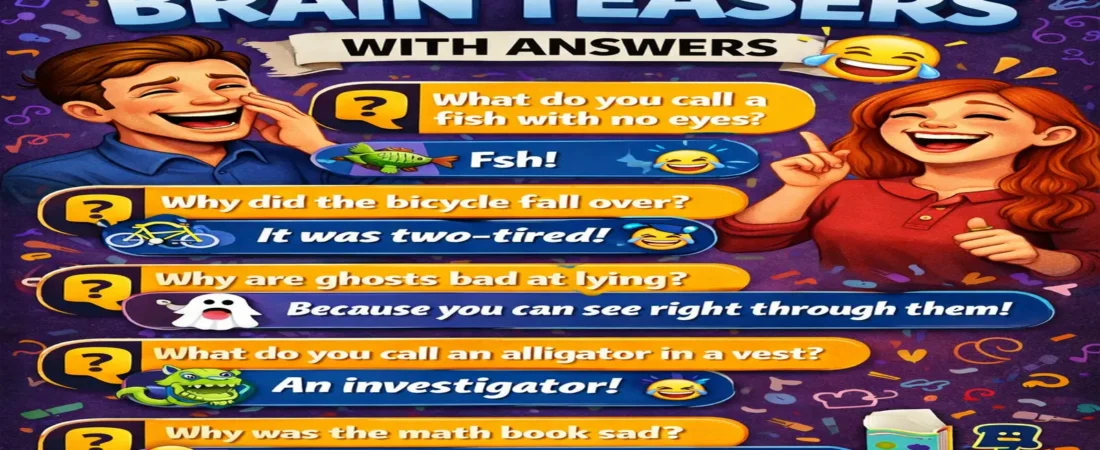
Funny brain teasers are perfect for families, teachers, hosts, and anyone who wants a quick laugh. They wake up the mind, but they also break awkward silence. That mix is why people keep coming back to them. This guide is for readers who want funny brain teasers with answers that are easy to use right away. You will find quick picks, kid-friendly options, adult-ready choices, and simple tips. So, whether you need a party icebreaker or a classroom warm-up, you are covered.
Quick Answer
Funny brain teasers with answers are short puzzles that mix logic with a laugh. The best ones feel surprising, clear, and easy to share. They work because the answer seems obvious only after you hear it.
TL;DR
• Funny teasers work best when setups stay short
• Wordplay often gets the biggest laughs
• Kids enjoy simple clues and familiar objects
• Adults like smart twists and false assumptions
• Group settings need quick answers and clear wording
• Strong teasers surprise, then make sense
What Makes a Brain Teaser Funny
A funny brain teaser does two jobs at once. First, it makes you think. Then, it flips your expectation in a playful way.
That second part matters most. Without a clean twist, the puzzle feels flat instead of fun.
• Short setups keep attention from drifting
• Surprise answers create the laugh moment
• Simple wording makes twists easier to catch
• Familiar topics help people join quickly
• Clean humor works with more audiences
• Sneaky wording adds playful confusion
• Smart puns make answers feel rewarding
• Everyday objects spark quick mental pictures
• Fast reveals keep energy moving
• Silly images help the joke stick
• Clear logic stops frustration from rising
• A neat payoff makes sharing easier
Short Funny Brain Teasers With Answers
Short brain teasers are easy to use anywhere. You can drop one into a text, lunch break, or family chat.
Because they move fast, they feel light. That makes them great for warming up a room.
• What gets wetter while drying? A towel
• What has hands but cannot clap? A clock
• What has a face but no eyes? A coin
• What runs but never walks? Water
• What has one eye yet cannot see? A needle
• What has many keys, no locks? A piano
• What can you catch, not throw? A cold
• What goes up, not down? Your age
• What has words, never speaks? A book
• What gets bigger the more removed? A hole
• What belongs to you, used by others? Your name
• What kind of room lacks doors? A mushroom
Wordplay Brain Teasers That Sound Smarter Than They Are
Wordplay teasers win with sound and meaning. They twist common phrases just enough to fool the ear.
As a result, people often miss the answer even when it sits in plain sight. That is part of the fun.
• What five-letter word becomes shorter? Short
• Which word is always spelled wrong? Wrong
• What building has the most stories? A library
• What month has twenty-eight days? Every month
• What invention lets you look through walls? A window
• Why is six afraid of seven? Bad rumors
• What has four wheels and flies? A garbage truck
• Why did the math book cry? Too many problems
• What starts with P ends E? Post office
• What kind of tree fits hands? A palm
• Why was the broom late? It swept in
• What has a neck, no head? A bottle
Tricky Question Brain Teasers That Fool Almost Everyone
Tricky questions sound easy on purpose. However, the trap lives inside one tiny assumption.
That is why they work so well in groups. Everyone rushes, then everyone laughs.
• How many animals did Moses take? None
• Which weighs more, feathers or bricks? They match
• A rooster lays eggs where? Nowhere
• How many birthdays does one person have? One
• Before Everest was discovered, highest mountain? Everest
• If you pass second place? You are second
• Three doctors said brother. How? One sister
• Plane crash survivors buried where? Nowhere
• Which side of turkey has feathers? Outside
• Can February have thirty days? In stories
• Which letter comes after washing? Drying
• If ten fish drown, how many left? Ten
One-Liner Brain Teasers for Fast Laughs
One-liners are great when time is tight. They give you a clean setup and a quick punch.
Meanwhile, the best ones sound casual. That makes the twist hit even harder.
• What has legs, never walks? A table
• What has teeth, never bites? A comb
• What has a ring, no finger? A phone
• What has a thumb, not alive? A glove
• What can fill room, no space? Light
• What can travel worldwide, stays cornered? A stamp
• What comes once in minute? The letter M
• What can crack, never fall? A joke
• What kind of band never plays? A rubber band
• What goes around world, stays put? The sun
• What gets sharper through use? Your brain
• What has a bottom at top? Your legs
Funny Brain Teasers for Kids
Kids do best with clear clues and simple images. So, this set uses objects they already know.
The answers stay gentle and silly. That keeps the fun going without making anyone feel stuck.
• What has ears, cannot hear? Corn
• What has tail, no body? A coin
• What flies without wings? Time
• What kind of cup cannot hold juice? A cupcake
• What has stripes, never roars? Pajamas
• What has pages, not homework? A calendar
• What comes out at night, hides daytime? Stars
• What has laces, never ties itself? Shoes
• What can hop, never gets tired? A rabbit toy
• What has buttons, never closes coat? Keyboard
• What has wheels, sleeps in garage? Bicycle
• What gets opened at breakfast? An egg
Funny Brain Teasers for Adults
Adults often enjoy a little more misdirection. Still, the best ones stay easy enough to tell aloud.
That balance matters. Too much complexity kills the laugh before it arrives.
• What can hold water, still full? A sponge
• What has branches, no leaves? A bank
• What is easy to lift, hard toss? A feather
• What can break, never dropped? A promise
• What has cities, no houses? A map
• What starts dirty, ends cleaner? Laundry
• What grows shorter when older? A candle
• What has one head, one foot? A bed
• What kind of coat gets painted? Fresh paint
• What can open mouth, not chew? A zipper
• What gets paid, never works? Attention
• What can be served, not eaten? A tennis ball
Party-Ready Brain Teasers for Groups
Party brain teasers need strong timing. They should be easy to hear and easy to repeat.
Also, group puzzles work better when the answer comes fast. That way, the room stays lively.
• Use teasers with everyday answers
• Pick clues guests can picture instantly
• Keep setups under ten seconds
• Save longer ones for later rounds
• Mix easy wins with tougher twists
• Ask confident guests to read aloud
• Pause before reveal for effect
• Let teams whisper quick guesses
• Celebrate wrong answers that amuse
• Rotate between kids and adults
• End each round on easiest clue
• Repeat favorites only after delay
Classroom-Friendly Brain Teasers With Answers
Classroom teasers should feel light and safe. They can help students settle in without turning the room noisy.
In addition, quick puzzles build attention. A two-minute laugh can reset the whole class.
• Start with one teaser after attendance
• Use them as calm transition tools
• Choose answers students already know
• Avoid clues needing niche knowledge
• Let volunteers explain their thinking
• Write the question on board
• Offer wait time before calling
• Use pairs for quiet discussion
• Praise effort before revealing solution
• Keep humor kind and school-safe
• Tie object clues to lesson themes
• Save favorites for rainy days
How to Deliver a Brain Teaser So It Lands
A great teaser can still flop with poor timing. So, delivery matters more than many people think.
You do not need a stage voice. You only need clear words, a small pause, and the right pace.
• Read once without rushing
• Stress the clue word gently
• Pause before the final phrase
• Do not explain during setup
• Let silence build suspense
• Watch faces for confusion
• Repeat only the key line
• Reveal answer with confidence
• Smile after the punch line
• Keep moving if joke misses
• Match difficulty to the room
• Stop before energy drops
How to Write Your Own Funny Brain Teasers
Writing your own teasers sounds hard at first. However, the process is simpler than it seems.
Start with something ordinary. Then twist one detail until the answer hides in plain sight.
• Pick one common object first
• List traits people expect
• Flip one trait upside down
• Write the clue as question
• Remove extra words immediately
• Use plain language throughout
• Test it out loud
• Check whether answer feels fair
• Add one playful image
• Cut anything too confusing
• Try pun twists carefully
• End with clean, simple payoff
Common Mistakes That Ruin a Brain Teaser
Some brain teasers miss because they feel messy. Others fail because the answer is clever, but not fair.
Luckily, most problems are easy to fix. A few quick edits can save the whole joke.
• Long setups drain all momentum
• Vague clues annoy listeners fast
• Impossible answers feel cheap
• Mean humor shuts people down
• Hard words break the flow
• Weak payoffs kill replay value
• Recycled lines feel stale
• Too many clues spoil surprise
• No pause ruins timing
• Overexplaining removes the fun
• Wrong audience choice hurts reaction
• Forgetting answer wording causes stumble
FAQs
What is the difference between a riddle and a brain teaser?
A riddle usually hides the answer inside playful language. A brain teaser can do that too, but it may also use logic, pattern, or a trick. In everyday use, many people treat the terms as almost the same.
Are funny brain teasers good for kids?
Yes, as long as the wording is simple and clean. Kids enjoy puzzles more when the clues use familiar objects, actions, and sounds. Shorter setups also help them stay engaged.
Can adults still enjoy easy brain teasers?
Absolutely. Easy teasers are often the best for parties, breaks, and casual chats. A fast laugh usually beats a long, confusing puzzle.
How many brain teasers should I use in one sitting?
That depends on the room, but five to ten works well for most groups. Too many in a row can flatten the energy. It is better to stop while people still want more.
What makes a brain teaser feel fair?
A fair teaser gives enough information to solve it. The answer may surprise you, but it should still make sense right away. When people hear it, they should think, “Oh, of course.”
Can I make my own funny brain teasers?
Yes, and starting small helps a lot. Pick one everyday object, then twist one expected detail. After that, test the question on a friend and trim any extra words.
Conclusion
Funny puzzles work because they mix surprise with simplicity. They get people thinking, and then they give that quick little snap of delight. That is a strong combo for homes, classrooms, and parties. You do not need dozens to have fun. A few good ones, told well, can carry the moment. So, keep this list handy the next time you need funny brain teasers with answers. Use the short ones first, watch what gets the best reaction, and build from there.

Christopher McLagan is a celebrated riddle maker known for crafting clever brain teasers and mind-bending puzzles. His work blends classic riddles, logic challenges, and lateral thinking brain teasers designed to spark curiosity and critical thinking. Widely admired in online puzzle communities, McLagan creates engaging riddle questions and answers for both kids and adults. His signature style delivers surprising twists, clean humor, and satisfying “aha” moments that keep readers coming back for more.