
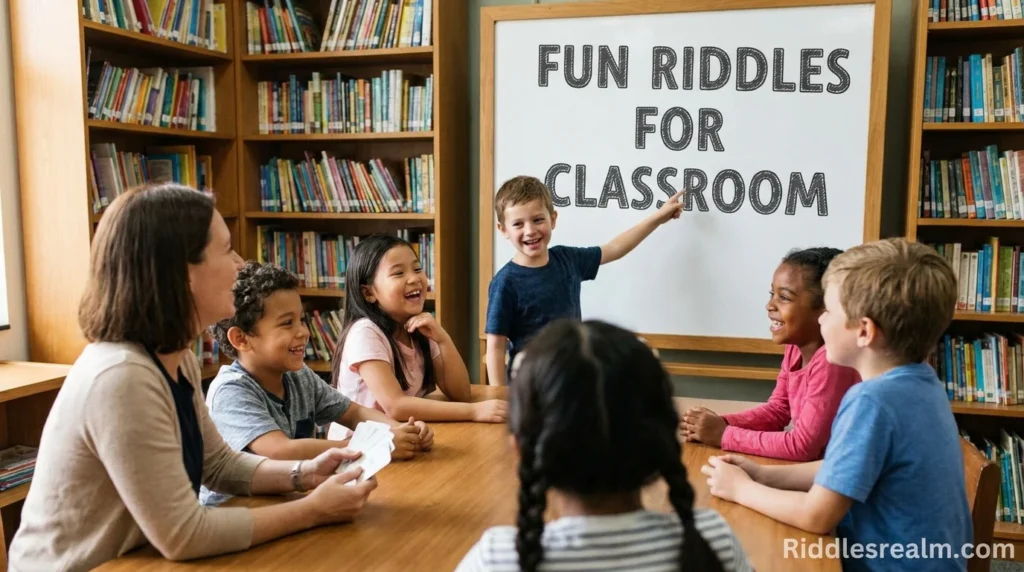
Keeping students engaged can feel challenging on busy school days. Fortunately, riddles offer a simple solution. They spark curiosity, encourage discussion, and help students think in new ways. Teachers often use fun riddles for classroom activities because they require little preparation. Even better, students enjoy the challenge while practicing problem-solving and communication skills.
Quick Answer
Fun classroom riddles are short puzzles that encourage students to think creatively and work through clues. They make excellent bell ringers, brain breaks, warm-ups, and team activities. The best fun riddles for classroom use are age-appropriate, easy to understand, and enjoyable to solve together.
TL;DR
• Riddles increase student participation quickly.
• Brain teasers support logical thinking skills.
• Funny puzzles create a positive classroom atmosphere.
• Short riddles work well as bell ringers.
• Team challenges encourage student collaboration.
• Different riddle types fit every grade level.
Why Riddles Work So Well in Class
Riddles combine learning and fun. As a result, students stay focused longer and participate more actively.
• Encourage creative problem-solving
• Build confidence through success
• Support classroom discussions naturally
• Strengthen listening abilities
• Improve attention during transitions
• Develop flexible thinking habits
• Create low-pressure challenges
• Increase student curiosity daily
• Promote active participation consistently
• Foster positive classroom energy
• Help reluctant learners engage
• Make learning feel playful
How to Introduce Riddles to Students
Start with simple examples. Then gradually increase difficulty as students become more confident.
• Display one puzzle daily
• Read clues aloud clearly
• Allow thinking time first
• Encourage multiple guesses
• Celebrate creative answers
• Pair students occasionally
• Rotate student presenters
• Use visual clue cards
• Keep answers hidden initially
• Connect puzzles to lessons
• Maintain friendly competition
• End with quick explanations
Easy Riddles for Elementary Classrooms
Younger students enjoy straightforward puzzles. Simple clues help build confidence early.
• What has keys but no locks? Piano
• What gets wetter while drying? Towel
• What has hands without arms? Clock
• What has teeth without biting? Comb
• What has one eye? Needle
• What has a neck? Bottle
• What rises without falling? Age
• What runs without walking? River
• What has pages? Book
• What can ring? Telephone
• What has a face? Watch
• What can be cracked? Egg
Funny Riddles That Make Students Laugh
Humor creates memorable learning experiences. Therefore, funny riddles often become student favorites.
• Teacher’s favorite nation? Expla-nation
• Math teacher’s dessert? Pi
• Why eat homework? Piece of cake
• Favorite witch subject? Spelling
• Favorite cat subject? Hiss-tory
• Why wear sunglasses? Bright students
• Favorite pirate class? Arrrrt
• Why bring ladder? High standards
• Favorite snake course? Hiss-tory
• Why sit on clock? On time
• Why magnet in class? Follow rules
• Favorite teacher game? Follow leader
Tricky Riddles for Critical Thinking
Older students enjoy puzzles requiring deeper reasoning. These riddles encourage persistence.
• Dictionary’s wrong word? Wrong
• Month with twenty-eight days? Every month
• Future seen never? Tomorrow
• End of everything? Letter G
• More you take, more remain? Footsteps
• Full of holes yet holds water? Sponge
• Belongs to you, others use? Name
• Once in minute? Letter M
• Always coming never arrives? Tomorrow
• Falls without injury? Paper
• Answers but never asks? Phone
• Changes monthly? Calendar
Wordplay Riddles for Language Skills
Word-focused riddles strengthen vocabulary awareness and language understanding.
• Longest dictionary word? Smiles
• Four letters, ends in k? Book
• Starts with e, ends e? Envelope
• Many letters, not alphabet? Mailbox
• Contains cities, no houses? Map
• Full of words, never speaks? Book
• Broken before eating? Egg
• More spelling practice through clues
• Encourage context understanding
• Reinforce vocabulary retention
• Highlight multiple meanings
• Develop language flexibility
Math Riddles Students Enjoy Solving
Math riddles make numbers feel less intimidating. Students often enjoy the challenge.
• Odd number, remove letter, even? Seven
• Two fathers, two sons, three people
• Half of five? Two and half
• Three apples shared creatively
• Clock hands puzzle challenge
• Number pattern investigations
• Shape recognition riddles
• Counting clue activities
• Logic sequence challenges
• Estimation-based brain teasers
• Mental math warmups
• Numerical reasoning practice
Science-Themed Classroom Riddles
Science riddles connect learning with curiosity. They work especially well before lessons.
• What planet is red? Mars
• What gas helps breathing? Oxygen
• What shines naturally? Sun
• What falls from clouds? Rain
• What freezes into ice? Water
• What animal transforms? Butterfly
• What grows from seeds? Plants
• What orbits Earth? Moon
• What powers photosynthesis? Sunlight
• What attracts metal? Magnet
• What measures temperature? Thermometer
• What causes shadows? Light
Morning Meeting Riddles
Morning riddles create an energetic classroom start. Students arrive ready to think.
• Use one puzzle daily
• Rotate student readers
• Encourage partner discussions
• Reward thoughtful reasoning
• Connect clues to themes
• Build anticipation regularly
• Create prediction opportunities
• Foster respectful debate
• Practice speaking skills
• Support classroom routines
• Increase attendance enthusiasm
• Begin days positively
Bell-Ringer Riddles for Fast Starts
Bell ringers help students settle quickly. Riddles make the transition enjoyable.
• Post puzzle before class
• Require written responses
• Discuss answers briefly
• Track participation growth
• Use weekly challenges
• Encourage independent thinking
• Limit solving time
• Alternate difficulty levels
• Connect with standards
• Promote immediate engagement
• Reduce transition downtime
• Create consistent expectations
Team-Building Riddles for Groups
Group riddles encourage communication. Students learn to listen and collaborate.
• Small group competitions
• Cooperative clue solving
• Relay puzzle challenges
• Mystery answer hunts
• Team discussion circles
• Shared reasoning practice
• Collaborative answer boards
• Rotating leadership opportunities
• Consensus-building exercises
• Peer explanation activities
• Respectful disagreement practice
• Group celebration moments
Middle School Riddles That Challenge Minds
Middle school students often prefer harder puzzles. These encourage deeper reasoning.
• Keyboard without doors? Keyboard
• Barber shaves everyone except himself
• More dry after washing? Towel
• One story house colors irrelevant
• Plane crash survivor puzzle
• Three switches mystery
• Missing dollar challenge
• Logic elimination tasks
• Multi-step clue puzzles
• Deductive reasoning exercises
• Lateral thinking scenarios
• Advanced word tricks
Classroom Riddle Games and Activities
Activities keep riddles fresh throughout the year. Variety helps maintain interest.
• Riddle scavenger hunts
• Mystery clue stations
• Puzzle tournament days
• Student-created challenges
• Escape-room style games
• Whiteboard races
• Partner puzzle swaps
• Secret answer envelopes
• Weekly riddle champions
• Classroom clue chains
• Digital puzzle quizzes
• Interactive challenge walls
Tips for Using Riddles Successfully
A few simple strategies can improve results significantly.
• Match difficulty appropriately
• Keep sessions brief
• Encourage perseverance always
• Avoid embarrassing mistakes
• Praise effort openly
• Use inclusive examples
• Rotate challenge styles
• Provide hints gradually
• Maintain positive energy
• Balance fun and learning
• Track favorite puzzles
• Invite student contributions
FAQs
What age group enjoys classroom riddles most?
Most students enjoy riddles when the difficulty matches their age. Elementary students prefer simple clues, while older learners enjoy complex challenges.
How often should teachers use riddles?
Many teachers use them daily as warm-ups. However, even a few times each week can improve engagement.
Do riddles help academic skills?
Yes. Riddles encourage reasoning, vocabulary growth, communication, and creative problem-solving.
Can riddles work in virtual classrooms?
Absolutely. Teachers can present riddles through slides, chat boxes, polls, and online discussions.
Are riddles good for classroom management?
They can help students focus during transitions. In addition, they create positive routines and encourage participation.
What makes a good classroom riddle?
A good riddle is clear, age-appropriate, and challenging without causing frustration. Students should feel motivated to keep trying.
Conclusion
Riddles remain one of the easiest ways to add excitement to any lesson. They encourage participation, strengthen thinking skills, and create memorable classroom moments. Whether used as warm-ups, brain breaks, or team challenges, riddles help students stay engaged. They also require very little preparation. Most importantly, fun riddles for classroom activities help transform everyday learning into an experience students genuinely enjoy.

A modern riddle-maker who builds clever, pocket-sized puzzles with sharp wordplay and elegant misdirection. Her clues are clean, surprising, and designed to make you think twice—then smile when it clicks.