
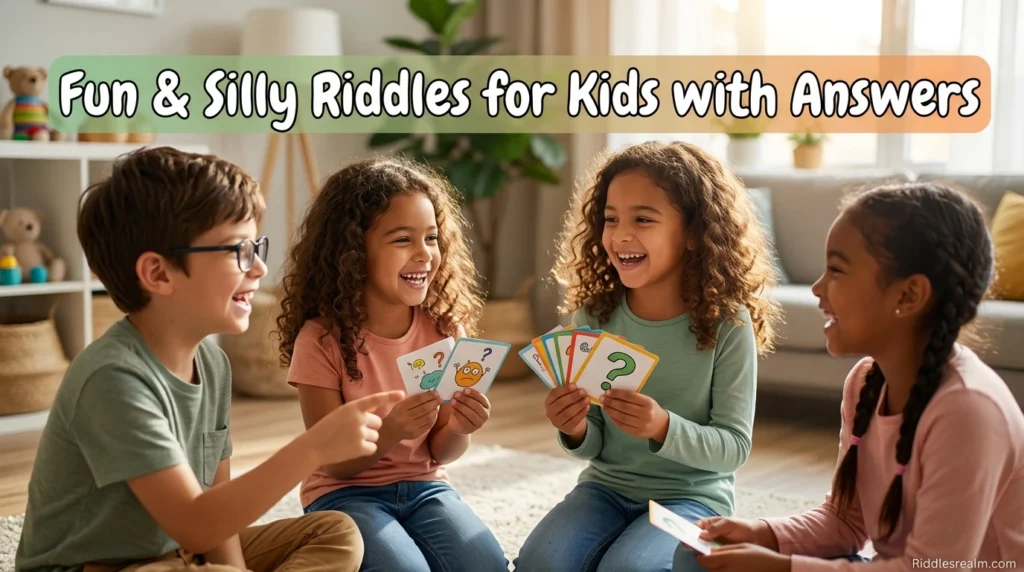
Kids love to laugh, think, and solve puzzles. That is why fun & silly riddles for kids with answers remain one of the best activities for families, classrooms, parties, and road trips. These playful brain teasers encourage children to think creatively while having a great time.
Moreover, riddles help children strengthen important life skills. They improve critical thinking, problem-solving abilities, concentration, memory, and language development. At the same time, they provide endless entertainment without requiring expensive toys or screens.
Whether you are a parent looking for educational activities, a teacher planning classroom games, or someone searching for family-friendly riddles, this collection offers something for everyone. From funny riddles and clever questions to word puzzles and guessing games, these kid-friendly brain teasers will keep young minds engaged for hours.
Why Kids Love Fun and Silly Riddles
Children naturally enjoy challenges that make them think. However, they enjoy them even more when the challenges are funny.
Riddles combine humor with learning. As a result, kids stay engaged while developing valuable cognitive skills.
Some benefits of riddles include:
- Improve critical thinking skills
- Strengthen problem-solving abilities
- Expand vocabulary
- Encourage creative thinking
- Improve memory retention
- Build confidence
- Promote family interaction
- Support classroom learning
- Create fun entertainment activities
- Develop lateral thinking skills
Furthermore, riddles work well for children of different ages because they can range from very simple to moderately challenging.
Easy Fun & Silly Riddles for Kids with Answers
These easy puzzle questions are perfect for younger children.
1. What has hands but cannot clap?
Answer: A clock.
2. What has a face but no eyes?
Answer: A clock.
3. What gets wetter as it dries?
Answer: A towel.
4. What has four wheels and flies?
Answer: A garbage truck.
5. What kind of tree can fit in your hand?
Answer: A palm tree.
6. What has one eye but cannot see?
Answer: A needle.
7. What goes up but never comes down?
Answer: Your age.
8. What has many keys but cannot open a door?
Answer: A piano.
9. What can travel around the world while staying in one corner?
Answer: A stamp.
10. What comes down but never goes up?
Answer: Rain.
11. What has a neck but no head?
Answer: A bottle.
12. What has legs but cannot walk?
Answer: A table.
13. What can you catch but not throw?
Answer: A cold.
14. What gets bigger the more you take away?
Answer: A hole.
15. What belongs to you but other people use it more?
Answer: Your name.
Funny Riddles for Kids That Spark Laughter
Kids especially enjoy funny riddles because the answers often surprise them.
16. Why did the teddy bear skip dessert?
Answer: Because it was stuffed.
17. What kind of room has no doors or windows?
Answer: A mushroom.
18. Why did the math book look sad?
Answer: Because it had too many problems.
19. What do you call cheese that is not yours?
Answer: Nacho cheese.
20. Why did the banana go to the doctor?
Answer: Because it was not peeling well.
21. What do you call a sleeping bull?
Answer: A bulldozer.
22. Why do fish live in salt water?
Answer: Because pepper makes them sneeze.
23. What do you call a bear with no teeth?
Answer: A gummy bear.
24. Why did the cookie go to the hospital?
Answer: Because it felt crummy.
25. What kind of shoes do ninjas wear?
Answer: Sneakers.
26. Why was the broom late?
Answer: Because it swept in.
27. Why did the golfer bring two pairs of pants?
Answer: In case he got a hole in one.
28. What do you call a pig that knows karate?
Answer: A pork chop.
29. Why was the computer cold?
Answer: It left its Windows open.
30. Why did the bicycle fall over?
Answer: Because it was two-tired.
Animal Riddles for Kids
Animal riddles are always a favorite among children.
31. What has a horn but does not honk?
Answer: A rhinoceros.
32. Which bird can lift the most weight?
Answer: A crane.
33. What animal is always at a baseball game?
Answer: A bat.
34. What kind of lion never roars?
Answer: A dandelion.
35. What jumps when it walks and sits when it stands?
Answer: A kangaroo.
36. What animal wears a striped coat?
Answer: A zebra.
37. What animal can sleep standing up?
Answer: A horse.
38. What has eight legs and spins webs?
Answer: A spider.
39. Which animal carries its home on its back?
Answer: A snail.
40. What bird is associated with wisdom?
Answer: An owl.
Food-Themed Riddles for Kids
Food riddles combine fun puzzles with familiar objects.
41. What kind of cup cannot hold water?
Answer: A cupcake.
42. What fruit is always sad?
Answer: A blueberry.
43. What vegetable likes to play tricks?
Answer: A prankster parsnip.
44. What has ears but cannot hear?
Answer: Corn.
45. What is orange and sounds like a parrot?
Answer: A carrot.
46. What food is impossible to trust?
Answer: A sneaky pickle.
47. What kind of bean cannot grow?
Answer: A jellybean.
48. What fruit never tells secrets?
Answer: A pear.
49. What food tells jokes?
Answer: A funny onion.
50. What do cakes and baseball teams have in common?
Answer: They both need a good batter.
School Riddles for Kids
These educational riddles make learning more enjoyable.
51. What is full of words but never speaks?
Answer: A dictionary.
52. What school supply is always tired?
Answer: A pencil because it is always worn out.
53. What can write but never read?
Answer: A pen.
54. What has pages but is not a tree?
Answer: A book.
55. What kind of class can never be dismissed?
Answer: A classic.
56. What gets sharper the more you use it?
Answer: Your brain.
57. What teaches lessons without talking?
Answer: A textbook.
58. What has numbers but cannot count?
Answer: A calculator.
59. What has letters but never delivers mail?
Answer: The alphabet.
60. What is easy to get into but hard to get out of?
Answer: Trouble.
Tricky Riddles for Older Kids
These challenging riddles encourage deeper thinking.
61. What has cities but no houses, rivers but no water, and forests but no trees?
Answer: A map.
62. The more you take, the more you leave behind. What am I?
Answer: Footsteps.
63. What can fill a room but takes up no space?
Answer: Light.
64. What comes once in a minute, twice in a moment, but never in a thousand years?
Answer: The letter M.
65. What can run but never walk?
Answer: Water.
66. What breaks without being touched?
Answer: A promise.
67. What has an end but no beginning?
Answer: A stick.
68. What can be cracked, made, told, and played?
Answer: A joke.
69. What has words but never speaks?
Answer: A book.
70. What flies without wings?
Answer: Time.
Family-Friendly Riddles for Game Night
These guessing games are ideal for families.
71. What has teeth but never bites?
Answer: A comb.
72. What can you hold without touching?
Answer: Your breath.
73. What gets broken every morning?
Answer: Dawn.
74. What starts with T, ends with T, and contains T?
Answer: A teapot.
75. What goes around the world but stays in a corner?
Answer: A stamp.
76. What has a ring but no finger?
Answer: A telephone.
77. What comes at the end of everything?
Answer: The letter G.
78. What is always in front of you but cannot be seen?
Answer: The future.
79. What can you hear but never see?
Answer: Sound.
80. What gets lighter the more it dries?
Answer: Wet clothes.
Word Puzzle Riddles for Kids
Word puzzles challenge language skills and creativity.
81. What word becomes shorter when you add two letters to it?
Answer: Short.
82. What begins with E and contains only one letter?
Answer: An envelope.
83. What word has three consecutive double letters?
Answer: Bookkeeper.
84. What has many letters but is not the alphabet?
Answer: A mailbox.
85. What word is spelled incorrectly in every dictionary?
Answer: Incorrectly.
86. What five-letter word becomes shorter when two letters are added?
Answer: Short.
87. What starts with P, ends with E, and contains thousands of letters?
Answer: Post office.
88. What can speak every language?
Answer: An echo.
89. What has one letter and starts many journeys?
Answer: A stamp.
90. What word describes itself?
Answer: Dictionary.
Quick Riddles for Parties and Road Trips
Need fast entertainment? Try these short riddle answers.
91. What month has 28 days?
Answer: All of them.
92. What has four fingers and a thumb but is not alive?
Answer: A glove.
93. What is easy to lift but hard to throw?
Answer: A feather.
94. What goes through cities and fields but never moves?
Answer: A road.
95. What can you serve but never eat?
Answer: A tennis ball.
96. What has a bottom at the top?
Answer: Your legs.
97. What can never ask questions but gets answered?
Answer: A telephone.
98. What can you keep after giving it away?
Answer: Your word.
99. What is always coming but never arrives?
Answer: Tomorrow.
100. What can be seen once in a year and twice in a week?
Answer: The letter E.
Benefits of Riddles for Child Development
Riddles are more than simple entertainment activities. In fact, they offer educational benefits that support healthy development.
BenefitHow Riddles HelpCritical ThinkingEncourage logical analysisProblem-Solving SkillsTeach children how to find solutionsVocabulary GrowthIntroduce new wordsMemory ImprovementStrengthen recall abilitiesCreativityInspire imaginative thinkingCommunication SkillsEncourage discussion and explanationConfidenceBuild success through achievementFocusImprove attention span
Therefore, teachers and parents often use educational riddles as learning tools.
How to Use Riddles With Kids
You can make riddles even more enjoyable by using them in different settings.
Classroom Activities
- Morning brain teaser sessions
- Group puzzle challenges
- Reading comprehension exercises
- Critical thinking activities
Family Game Nights
- Riddle competitions
- Team guessing games
- Mystery puzzle rounds
- Reward-based challenges
Road Trips
- Quick guessing games
- Travel entertainment
- Family puzzle contests
- Long-distance boredom busters
Birthday Parties
- Treasure hunts
- Puzzle stations
- Team-building games
- Icebreaker activities
Tips for Choosing the Best Riddles for Kids
Selecting age-appropriate riddles helps children stay engaged.
Younger Children
- Use simple vocabulary
- Keep answers familiar
- Focus on funny riddles
- Choose short puzzle questions
Older Children
- Introduce logic puzzles
- Use lateral thinking puzzles
- Include wordplay
- Offer more challenging riddles
For Mixed Age Groups
- Start easy
- Gradually increase difficulty
- Encourage teamwork
- Celebrate participation
Key Takeaways
- Fun and silly riddles help children learn while laughing.
- Brain teasers improve critical thinking and problem-solving skills.
- Family-friendly riddles create meaningful bonding opportunities.
- Educational riddles support vocabulary and memory development.
- Funny riddles keep children engaged and entertained.
- Logic puzzles encourage creative and lateral thinking.
- Riddles work well at home, school, parties, and road trips.
- Age-appropriate challenges keep kids motivated.
Frequently Asked Questions
What are the best fun & silly riddles for kids with answers?
The best riddles are simple, funny, and age-appropriate. Examples include “What gets wetter as it dries?” (A towel) and “What has four wheels and flies?” (A garbage truck).
How do riddles help children learn?
Riddles improve critical thinking, reasoning, vocabulary, memory, and problem-solving skills. Additionally, they encourage creativity and concentration.
What age is best for kids to start solving riddles?
Children can begin solving simple riddles as early as preschool age. However, the difficulty should increase as they grow older.
Are riddles good for classroom learning?
Yes. Teachers often use brain teasers, word puzzles, and logic puzzles to encourage engagement and strengthen thinking skills.
What are some easy riddles for young kids?
Easy examples include:
- What has legs but cannot walk? (A table)
- What gets wetter as it dries? (A towel)
- What has many keys but cannot open doors? (A piano)
Can riddles improve problem-solving skills?
Absolutely. Riddles encourage children to analyze clues, think creatively, and explore different solutions before arriving at the correct answer.
What are good riddles for family game night?
Family-friendly riddles such as “What starts with T, ends with T, and contains T?” (A teapot) work well because people of all ages can enjoy them.
Why do children enjoy funny riddles?
Funny riddles combine humor and surprise. As a result, children stay interested and become more willing to engage in learning activities.
Conclusion
Fun and silly riddles offer far more than a quick laugh. They challenge young minds, strengthen critical thinking, improve problem-solving skills, and create memorable moments with family and friends. Whether you use them in the classroom, during road trips, at birthday parties, or around the dinner table, these fun & silly riddles for kids with answers provide endless opportunities for learning and entertainment.
Most importantly, riddles help children discover that thinking can be exciting. So the next time kids need a fun activity, pull out a few brain teasers, guessing games, word puzzles, or logic challenges and watch their creativity come to life.

Joseph Morgan is an enigmatist known for creating clever and mysterious riddles. Born in Scotland, he spent his life challenging people to think deeply through puzzles and brainteasers. He became famous for his creative mind and love of mystery.