
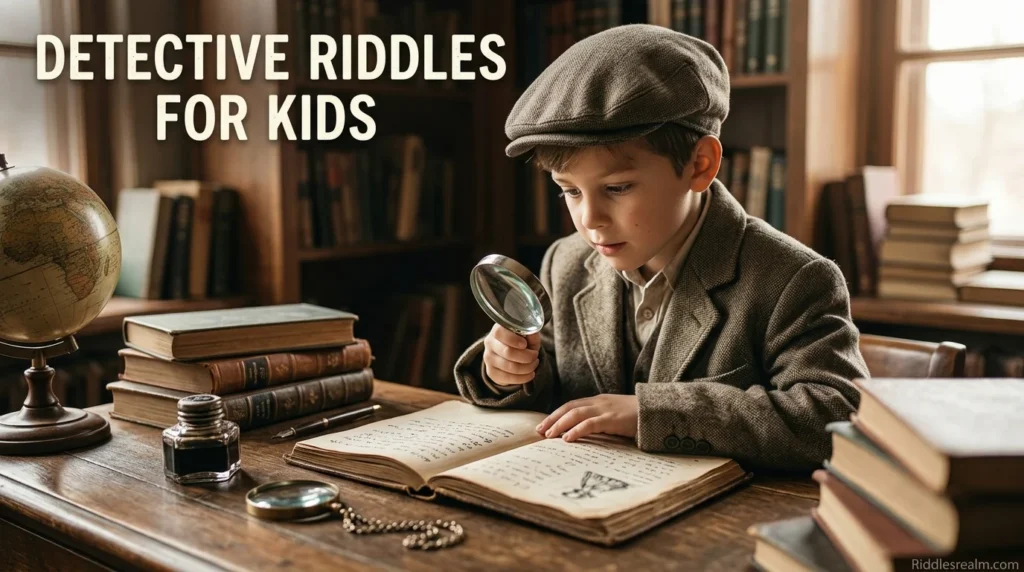
Detective riddles for kids are one of the best ways to combine learning and fun. Children naturally love mysteries, clues, and solving problems. Therefore, detective-themed brain teasers capture their attention while helping them build important thinking skills.
Unlike ordinary riddles, detective riddles encourage kids to analyze evidence, connect clues, and think like real investigators. As a result, they improve critical thinking, logical reasoning, observation skills, and creativity. Whether you’re a parent, teacher, homeschooler, or puzzle enthusiast, these family-friendly riddles can keep children entertained for hours.
In this guide, you’ll discover a huge collection of detective riddles for kids, mystery puzzles, logic challenges, and guessing games. Additionally, you’ll learn how these educational riddles benefit young minds and how to use them in classrooms, parties, and family game nights.
Why Detective Riddles Are Great for Kids
Detective riddles are much more than simple entertainment activities. In fact, they provide several educational benefits.
Benefits of Detective Riddles
- Improve critical thinking skills
- Develop logical reasoning
- Strengthen memory and concentration
- Encourage creative problem-solving
- Build patience and perseverance
- Enhance reading comprehension
- Increase attention to detail
- Promote teamwork during group activities
Furthermore, mystery puzzles teach children how to examine facts before making conclusions. This valuable skill can help them in school and everyday life.
What Makes a Good Detective Riddle?
A detective riddle usually includes:
- A mystery or problem
- Several clues
- Hidden details
- A surprising solution
- Logical reasoning
Instead of guessing randomly, kids must examine the clues carefully. Consequently, they learn to think systematically.
Easy Detective Riddles for Kids
These beginner-friendly detective riddles are perfect for younger children.
1. The Missing Cookie
A mother baked cookies and left them on the kitchen table. Later, one cookie disappeared.
Tom says, “I was outside.”
Sarah says, “I was reading.”
The family dog has crumbs around its mouth.
Who ate the cookie?
Answer: The dog ate the cookie.
2. The Wet Umbrella
A boy enters school carrying a wet umbrella. However, it hasn’t rained all day.
How did the umbrella get wet?
Answer: He washed it.
3. The Muddy Shoes
A girl walks into her house with muddy shoes. Yet there is no mud outside.
How is this possible?
Answer: The mud is inside the house.
4. The Empty Fish Tank
A detective notices a fish tank with no fish.
The owner says, “The fish escaped.”
What really happened?
Answer: Fish cannot escape on their own. The owner removed them.
5. The Broken Vase
A vase is broken in the living room.
The cat is sleeping peacefully nearby.
The dog is hiding under the couch.
Who probably broke the vase?
Answer: The dog, because it is acting guilty.
Funny Detective Riddles for Kids
Mysteries become even better when they include humor.
6. The Invisible Sandwich
A detective searches for a missing sandwich.
The boy says, “I didn’t eat it.”
However, peanut butter is all over his face.
Who ate the sandwich?
Answer: The boy.
7. The Sleeping Detective
Why couldn’t the detective solve the mystery at night?
Answer: Because he was asleep.
8. The Pencil Case Mystery
A student can’t find her pencil case.
Where is the first place she should look?
Answer: Where she last used it.
9. The Missing Homework
A child says the dog ate his homework.
The teacher asks for proof.
What is the mystery?
Answer: Did the dog really eat it?
10. The Ice Cream Clue
A detective finds melted ice cream on a hot day.
Why did it melt?
Answer: Because it was hot outside.
Detective Logic Puzzles for Kids
These logic puzzles require more careful thinking.
11. The Locked Classroom
A teacher finds a locked classroom.
The janitor says he never entered.
The principal says she was in a meeting.
A student says he left his backpack inside.
Who has the strongest reason to enter the classroom?
Answer: The student.
12. The Snowy Footprints
Fresh footprints lead from a house to a shed.
No footprints lead back.
Where is the person?
Answer: Inside the shed.
13. The Library Mystery
Three children borrowed books.
- Emma borrowed a science book.
- Jake borrowed a mystery book.
- Mia borrowed a history book.
Who borrowed the mystery book?
Answer: Jake.
14. The Missing Key
A key disappears from a desk.
The only people in the room were Alex, Ben, and Lily.
Alex says he never touched it.
Ben says he saw Lily near the desk.
Lily says she borrowed it.
Who took the key?
Answer: Lily.
15. The Secret Note
A detective finds a note saying:
“I am hidden where books sleep.”
Where should the detective look?
Answer: On a bookshelf or in a library.
Challenging Detective Riddles for Kids
Older children often enjoy tougher mystery puzzles.
16. The Birthday Cake Mystery
A birthday cake is missing one slice.
Four kids are at the party.
One child has frosting on his shirt.
Who probably ate the slice?
Answer: The child with frosting on his shirt.
17. The School Bell
The school bell rings at noon every day.
Today it rings at 11:45.
Why?
Answer: Someone set it incorrectly.
18. The Missing Pet
A hamster disappears.
The cage door is open.
The window is closed.
Where should you look first?
Answer: Somewhere inside the house.
19. The Chocolate Wrapper
A chocolate wrapper is found under a bed.
The child says he hasn’t eaten any chocolate.
What clue suggests otherwise?
Answer: The wrapper.
20. The Backyard Mystery
A soccer ball breaks a window.
No one admits doing it.
A fresh soccer ball mark is on the wall.
What likely happened?
Answer: Someone kicked the ball into the window.
Mystery Puzzle Stories for Kids
Story-based detective riddles are excellent for building reasoning skills.
The Case of the Missing Lunch
At school, Jacob discovers his lunch is gone.
Three classmates were nearby:
- Olivia was drawing.
- Ethan was reading.
- Noah has a sandwich wrapper matching Jacob’s lunch.
Who is the most likely suspect?
Answer: Noah.
The Mystery of the Empty Bird Feeder
The bird feeder is empty.
A squirrel is sitting underneath it.
Birdseed is scattered everywhere.
What happened?
Answer: The squirrel ate the birdseed.
The Lost Backpack
A backpack disappears from the classroom.
The teacher finds it in the gym.
How was the mystery solved?
Answer: The backpack was misplaced, not stolen.
Detective Riddles That Use Observation Skills
Observation is one of the most important detective skills.
21. Spot the Clue
A detective enters a room and notices:
- A broken lamp
- A soccer ball
- Muddy footprints
What caused the damage?
Answer: The soccer ball likely hit the lamp.
22. The Open Window
A room feels cold.
The heater works.
Why?
Answer: The window is open.
23. The Empty Bowl
A dog’s bowl is empty.
The dog looks happy.
Why?
Answer: The dog already ate.
24. The Wet Floor
The floor is wet.
A mop is nearby.
What happened?
Answer: Someone cleaned the floor.
25. The Missing Crayons
A box of crayons is empty.
Several children are coloring.
Where are the crayons?
Answer: The children are using them.
Detective Riddles for Classroom Activities
Teachers can use these educational riddles to make learning fun.
Classroom Detective Challenge #1
A student forgot their pencil.
Three students have extra pencils.
Who can help?
Answer: Any student with an extra pencil.
Classroom Detective Challenge #2
A book disappears from the shelf.
The librarian discovers it on a reading table.
Was it stolen?
Answer: No, it was simply left there.
Classroom Detective Challenge #3
The classroom plant looks healthier today.
What likely happened?
Answer: Someone watered it.
Detective Riddles for Family Game Night
Family game nights become more exciting with mystery puzzles.
Family Mystery #1
The popcorn bowl is empty.
Dad says he didn’t eat it.
The bowl is beside Dad.
Who probably ate most of the popcorn?
Answer: Dad.
Family Mystery #2
A puzzle is completed overnight.
Everyone claims they were sleeping.
Who solved it?
Answer: Someone wasn’t sleeping.
Family Mystery #3
Cookies vanish from the jar.
Crumbs lead to the couch.
Where should detectives investigate?
Answer: Around the couch.
Detective Riddles With Answers Table
| Detective Riddle | Answer |
|---|---|
| Who ate the cookie? | The dog |
| Why is the umbrella wet? | It was washed |
| Where is the hamster? | Inside the house |
| Why is the floor wet? | Someone mopped it |
| Who borrowed the key? | Lily |
| What broke the lamp? | The soccer ball |
| Who ate the sandwich? | The boy |
| Where is the missing backpack? | The gym |
| Why is the room cold? | The window is open |
| Who likely ate the cake slice? | The child with frosting |
Tips for Solving Detective Riddles
Read Every Clue Carefully
Many mystery puzzles hide important details in plain sight. Therefore, reading carefully can make a huge difference.
Avoid Jumping to Conclusions
Good detectives examine all the evidence first. Likewise, kids should think through every possibility.
Look for Hidden Information
Sometimes the answer is not obvious. Instead, a small clue may reveal the solution.
Practice Logical Thinking
The more logic puzzles children solve, the better they become at recognizing patterns.
Work Together
Group problem-solving often leads to faster solutions because everyone notices different clues.
How Detective Riddles Improve Critical Thinking
Detective riddles train the brain to:
- Analyze information
- Compare evidence
- Evaluate possibilities
- Make logical conclusions
- Think creatively
- Strengthen memory recall
Consequently, these mind games support academic success and lifelong learning.
Best Occasions for Detective Riddles
Birthday Parties
Mystery puzzles create exciting party games that keep kids engaged.
Classrooms
Teachers can use detective riddles as warm-up activities or brain breaks.
Family Gatherings
Family-friendly riddles encourage teamwork and laughter.
Road Trips
Guessing games help children stay entertained during long drives.
Homeschool Lessons
Educational riddles make learning more interactive and enjoyable.
Key Takeaways
- Detective riddles for kids combine fun and learning.
- They strengthen logic, observation, and problem-solving skills.
- Mystery puzzles encourage critical thinking.
- Kids learn to analyze clues before making decisions.
- These riddles work well for classrooms, parties, and family activities.
- Regular puzzle-solving helps improve concentration and reasoning.
Frequently Asked Questions
What are detective riddles for kids?
Detective riddles are mystery-based puzzle questions that require children to use clues, logic, and observation to solve a problem.
At what age can children solve detective riddles?
Many detective riddles are suitable for children ages 6 and older. However, more challenging riddles work best for older kids and teens.
How do detective riddles help children learn?
They improve critical thinking, reasoning, observation skills, memory, and problem-solving abilities.
Are detective riddles educational?
Yes. Educational riddles encourage logical thinking while making learning enjoyable.
Can detective riddles be used in classrooms?
Absolutely. Teachers often use mystery puzzles as engaging learning activities and classroom brain teasers.
What is the difference between a detective riddle and a regular riddle?
A detective riddle focuses on clues, evidence, and reasoning. In contrast, many traditional riddles rely on wordplay or trick answers.
Are detective riddles good for family game night?
Yes. Family-friendly detective riddles encourage teamwork, communication, and fun competition.
How can I create my own detective riddles?
Start with a mystery, add several clues, include a hidden detail, and provide a logical solution that players can discover.
Why do kids enjoy mystery puzzles?
Children enjoy solving mysteries because they feel like detectives. Additionally, they love discovering clues and finding answers.
Do detective riddles improve IQ and reasoning skills?
While riddles alone do not directly increase IQ, they strengthen logical thinking, analytical reasoning, and cognitive skills over time.
Conclusion
Detective riddles for kids offer the perfect mix of fun, education, and mental challenge. Not only do they entertain children, but they also help develop valuable life skills such as observation, reasoning, critical thinking, and problem-solving. Whether you’re organizing a classroom activity, planning a birthday party, hosting family game night, or simply looking for engaging brain teasers, detective riddles provide endless opportunities for learning and laughter.
Moreover, these mystery puzzles encourage children to think beyond the obvious, examine evidence carefully, and approach problems with confidence. As they solve more riddles, their ability to analyze situations and make logical decisions continues to grow. So gather your young detectives, start solving clues, and enjoy the exciting world of mystery puzzles, clever questions, and family-friendly fun.

Christopher McLagan is a celebrated riddle maker known for crafting clever brain teasers and mind-bending puzzles. His work blends classic riddles, logic challenges, and lateral thinking brain teasers designed to spark curiosity and critical thinking. Widely admired in online puzzle communities, McLagan creates engaging riddle questions and answers for both kids and adults. His signature style delivers surprising twists, clean humor, and satisfying “aha” moments that keep readers coming back for more.