
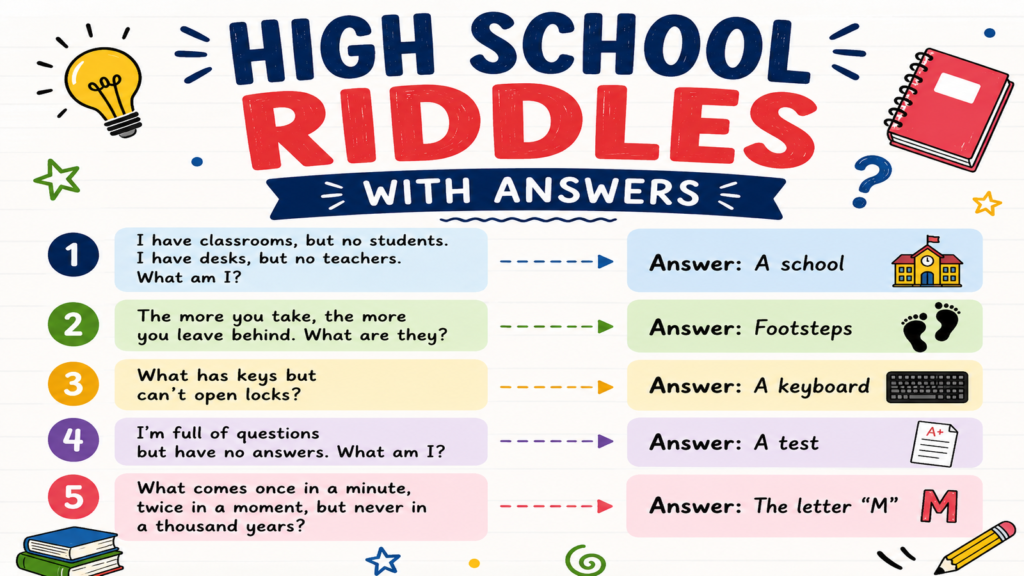
High school can feel busy, but riddles make learning fun again. They spark curiosity and boost thinking skills in a simple way. This guide shares the best high school riddles with answers for students, teachers, and friends. You’ll find funny, tricky, and clever riddles for every situation. Whether you want a quick laugh or a real challenge, there’s something here for you. Let’s jump in and start thinking.
Quick Answer
High school riddles with answers are fun questions that test logic and creativity. They help students think differently while enjoying quick mental challenges.
TL;DR
• Riddles improve critical thinking and problem-solving skills
• High school students enjoy humor mixed with logic puzzles
• Short riddles work best for quick classroom activities
• Hard riddles challenge advanced thinking abilities
• Group riddles boost teamwork and engagement
Funny Riddles for High School Students
Laughter makes learning easier, so funny riddles are always a hit. They keep things light while still making students think.
• What has hands but cannot clap? A clock
• Why did the student eat homework? Teacher said it was easy
• What gets wetter as it dries? A towel
• Why can’t your nose be 12 inches long? It becomes a foot
• What has one eye but cannot see? A needle
• Why did math book look sad? Too many problems
• What has legs but never walks? A table
• Why did computer go to school? Improve its memory
• What runs but never walks? Water
• Why was the broom late? It swept in
• What has a face and two hands? A clock
• Why was the stadium cool? Filled with fans
Tricky Riddles That Make You Think
These riddles seem simple, yet they twist your thinking. So, read carefully before answering.
• What has keys but no locks? A piano
• What can travel around world staying in corner? A stamp
• What has a neck but no head? A bottle
• What gets bigger the more you take away? A hole
• What begins with T ends with T? A teapot
• What has words but never speaks? A book
• What has a ring but no finger? A phone
• What is always in front but unseen? Future
• What can you catch but not throw? A cold
• What has a heart that doesn’t beat? An artichoke
• What goes up but never comes down? Age
• What has many teeth but cannot bite? A comb
Hard Riddles for Teens
Now things get harder, so take your time. These riddles really test your logic skills.
• What disappears when you say its name? Silence
• What has cities but no houses? A map
• What can fill a room but takes no space? Light
• What has one head one foot four legs? A bed
• What is always coming but never arrives? Tomorrow
• What can you hold without touching? Your breath
• What goes through cities and fields? A road
• What has no beginning end or middle? A circle
• What flies without wings? Time
• What can break but never falls? Promise
• What runs but has no legs? A river
• What has a bottom at the top? Legs
Short Riddles with Quick Answers
Sometimes quick riddles work best, especially during breaks. They are fast and fun.
• What has four wheels and flies? Garbage truck
• What can you hear but not see? Sound
• What is full of holes but holds water? Sponge
• What has a thumb and fingers? A glove
• What is always running? A nose
• What has an eye but no body? Needle
• What gets sharper the more used? Brain
• What has keys but can’t open doors? Keyboard
• What can you break without touching? Silence
• What is always hungry? Fire
• What has a tail but no body? Coin
• What gets bigger when more added? Balloon
Brain Teaser Riddles for Students
Brain teasers push thinking further, so they are great for growth. They often need careful logic.
• I speak without mouth what am I? An echo
• I have branches but no fruit? A bank
• I shrink smaller every time? A bar of soap
• I have a bed but never sleep? A river
• I’m tall when young short when old? Candle
• I have keys but no doors? Piano
• I have wings but cannot fly? A fan
• I have pages but not a book? A calendar
• I have a face but no eyes? A clock
• I’m always in front of you? Future
• I go up and down but stay? Stairs
• I have no life but grow? Fire
Classroom Riddles for Group Fun
Group riddles make lessons more exciting. They also build teamwork and discussion.
• What has ears but cannot hear? Corn
• What has a head and tail? A coin
• What can you keep after giving? Promise
• What has one leg? A compass
• What gets broken without falling? A promise
• What can run but never walks? Water
• What has teeth but doesn’t bite? Comb
• What has many rings? A tree
• What has a bark but no bite? Tree
• What has no voice but speaks? Echo
• What has keys but no locks? Piano
• What has a face but no eyes? Clock
Math Riddles for High School
Math riddles mix numbers with logic, making learning more fun.
• I am odd take away letter become even? Seven
• What three numbers equal same sum? 1+1+1=3
• What comes next 2 4 8 16? 32
• What number disappears when divided? Zero
• What is half of two plus two? Three
• What number is always positive? Absolute value
• What comes after million? Million one
• What is double of five? Ten
• What number multiplied stays same? One
• What has value but no number? Variable
• What equals zero always? Zero times anything
• What is square of three? Nine
Logic Riddles with Answers
Logic riddles require careful thinking, so don’t rush.
• If two company three crowd? Four party
• What belongs to you but others use? Your name
• What gets lost every time spoken? Silence
• What has to be broken before use? Egg
• What runs faster hot or cold? Hot you catch cold
• What comes once in minute? Letter M
• What word is spelled wrong? Wrong
• What has no end? A circle
• What can you hold forever? Breath
• What is always moving? Time
• What has no shadow? Darkness
• What cannot be seen? Air
Clever Riddles to Challenge Friends
Challenge your friends with these clever ones. They often surprise people.
• What can fly without wings? Time
• What has many keys but no locks? Piano
• What can travel without moving? Light
• What has no body but grows? Shadow
• What gets shorter as it burns? Candle
• What has no legs but runs? Water
• What can you see but not touch? Light
• What has no start or end? Circle
• What can fill a room? Light
• What has no voice but answers? Echo
• What can you hear without ears? Sound
• What has no weight but heavy? Thoughts
Easy Riddles for Beginners
Beginners need simple riddles to build confidence first.
• What has one eye? Needle
• What has legs but no body? Table
• What can fly? Bird
• What has a tail? Dog
• What has wheels? Car
• What has pages? Book
• What has keys? Piano
• What has water? Ocean
• What has light? Sun
• What has sound? Music
• What has air? Balloon
• What has heat? Fire
Puzzle Riddles for Brain Training
Puzzle riddles improve mental strength over time. So, practice regularly.
• What grows but never shrinks? Age
• What has no teeth but bites? Frost
• What gets larger every day? Age
• What moves without legs? Time
• What has no eyes but sees? Mind
• What has no ears but hears? Mind
• What has no hands but builds? Time
• What has no feet but walks? Time
• What has no brain but thinks? Computer
• What has no heart but beats? Drum
• What has no body but moves? Wind
• What has no form but exists? Energy
School Icebreaker Riddles
Icebreakers help students connect quickly, especially early in the year.
• What has a name but no body? School
• What can you open but not close? Mind
• What has a start but no end? Learning
• What brings people together? Laughter
• What grows in school? Knowledge
• What connects students? Friendship
• What builds confidence? Practice
• What helps memory? Repetition
• What creates ideas? Thinking
• What improves skills? Effort
• What brings success? Hard work
• What drives learning? Curiosity
Best Riddles to Use in 2026
Modern riddles stay simple but clever. They work well in today’s classrooms.
• What has data but no brain? Computer
• What connects world instantly? Internet
• What stores knowledge digitally? Cloud
• What powers devices? Electricity
• What shows time globally? Clock
• What travels faster than light? Thought
• What connects friends online? Social media
• What stores files? Hard drive
• What sends messages instantly? Phone
• What plays music? Speaker
• What captures memories? Camera
• What displays information? Screen
How to Use Riddles in High School
Using riddles is easy, but strategy matters. They work best with clear goals.
• Start class with quick riddle warm-ups
• Use riddles during group discussions
• Assign riddles as homework challenges
• Add riddles to quizzes for fun
• Use riddles to teach critical thinking
• Encourage students to create their own
• Reward correct answers with points
• Use riddles in competitions
• Add riddles to presentations
• Use riddles for brain breaks
• Include riddles in study sessions
• Rotate riddles weekly for variety
FAQs
What are high school riddles?
High school riddles are puzzles designed for teen-level thinking. They mix fun, logic, and creativity in short questions.
Why are riddles useful for students?
Riddles improve problem-solving and critical thinking. They also make learning more engaging and interactive.
Are riddles good for classrooms?
Yes, teachers use riddles to boost participation. They also help students think in new ways.
What are the best tricky riddles?
The best tricky riddles hide simple answers behind confusing wording. They challenge how you think.
How often should students use riddles?
Using riddles a few times weekly works best. It keeps minds sharp without feeling repetitive.
Can riddles improve memory?
Yes, riddles strengthen memory by forcing recall and reasoning. They keep the brain active.
Conclusion
Riddles bring energy, creativity, and fun into everyday learning. They challenge students while keeping things enjoyable. High school riddles with answers are perfect for classrooms, friends, or solo practice. Keep using them, and your thinking skills will grow stronger over time.

Christopher McLagan is a celebrated riddle maker known for crafting clever brain teasers and mind-bending puzzles. His work blends classic riddles, logic challenges, and lateral thinking brain teasers designed to spark curiosity and critical thinking. Widely admired in online puzzle communities, McLagan creates engaging riddle questions and answers for both kids and adults. His signature style delivers surprising twists, clean humor, and satisfying “aha” moments that keep readers coming back for more.