
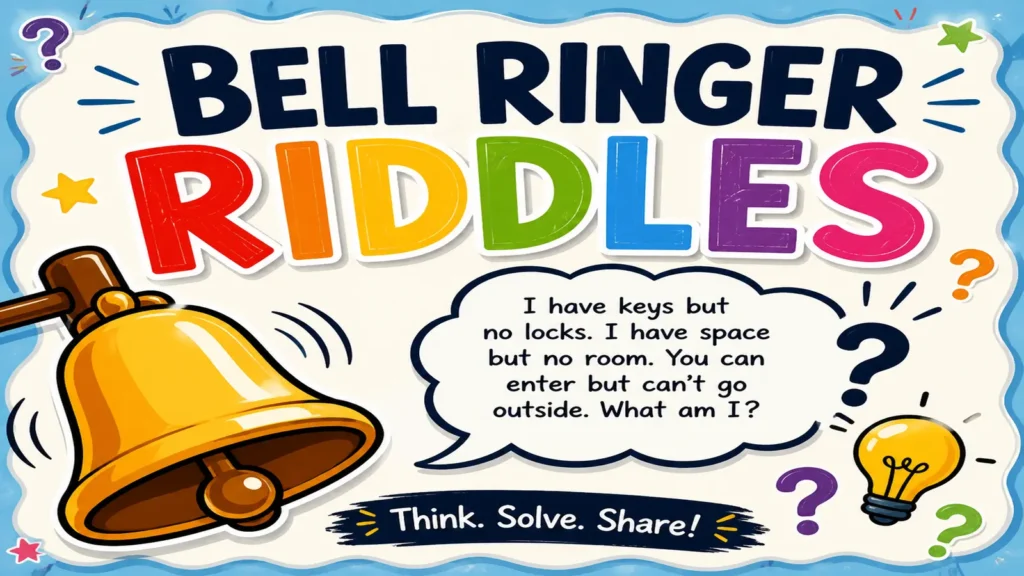
Bell ringer activities set the tone for a productive classroom day. Among them, bell ringer riddles stand out for quick thinking and engagement. Teachers across the USA use these short puzzles to capture attention fast. They also help students shift into learning mode smoothly. This guide explores how they work, why they matter, and how to use them effectively.
Quick Answer
Bell ringer riddles are short brain teasers used at the start of class. They quickly engage students and prepare their minds for learning.
They are popular because bell ringer riddles improve focus, thinking speed, and classroom participation.
TL;DR
• Quick riddles used at class start
• Improve focus and student engagement
• Build thinking and reasoning skills
• Easy to customize for subjects
• Work in all grade levels
What Are Bell Ringer Riddles
Bell ringer riddles are short puzzles given at the start of class. They help students shift into learning mode quickly.
Teachers use them as warm-up tasks before lessons begin. They are simple but mentally stimulating.
• Short puzzles for class openings
• Designed to grab student attention
• Help transition into learning mindset
• Often used in middle and high school
• Encourage early class participation
• Can be verbal or written prompts
• Usually solved in minutes
• Improve focus at start of lesson
• Reduce classroom transition delays
• Work across multiple subjects
• Adaptable to difficulty levels
• Build daily learning routine consistency
Why Teachers Use Them Daily
Teachers rely on these riddles because they settle students quickly. They also reduce downtime at the start of class.
Consistency makes classrooms smoother and more predictable.
• Quickly captures student attention
• Reduces morning classroom chatter
• Creates structured daily routine
• Encourages punctual thinking habits
• Helps manage classroom energy
• Provides smooth lesson transitions
• Builds anticipation for learning
• Works without heavy preparation
• Keeps students mentally active
• Encourages early participation
• Supports classroom discipline naturally
• Fits short time windows
Classroom Benefits Overview
Bell ringer riddles support both academic and behavioral growth. They help students ease into deeper learning tasks.
They also encourage teamwork and participation.
• Improves overall classroom engagement
• Boosts attention at lesson start
• Encourages student curiosity
• Strengthens participation rates
• Builds positive classroom energy
• Supports collaborative learning habits
• Helps quieter students contribute
• Enhances lesson readiness
• Reduces off-task behavior
• Encourages discussion naturally
• Increases motivation early
• Supports consistent learning flow
Cognitive Skills They Build
These riddles do more than entertain. They train important thinking skills in students.
They strengthen mental flexibility and reasoning.
• Enhances logical thinking ability
• Improves problem-solving speed
• Builds pattern recognition skills
• Strengthens short-term memory
• Encourages analytical reasoning
• Supports creative thinking
• Improves attention to detail
• Develops decision-making skills
• Strengthens language interpretation
• Builds mental agility
• Encourages structured thinking
• Supports critical analysis
Easy Bell Ringer Riddles Examples
Easy riddles help students build confidence. They are perfect for early grades or warmups.
These are quick and fun starters.
• What has keys but no locks
• What gets wetter while drying
• What has hands but cannot clap
• What has a face but no eyes
• What runs but never walks
• What has a ring but no finger
• What goes up but never down
• What has legs but cannot walk
• What can fill a room but takes no space
• What has a bed but never sleeps
• What has teeth but cannot bite
• What has cities but no houses
Hard Bell Ringer Riddles Examples
Hard riddles challenge deeper thinking. They require more steps to solve.
They are best for advanced learners.
• I speak without a mouth
• I move without walking feet
• The more you take away the bigger
• I have branches but no fruit
• I travel around the world staying corner
• I disappear when you say my name
• I can be cracked made told played
• I am always coming but never arrive
• I have cities but no people living
• I am not alive but I grow
• I have a neck but no head
• I have one eye but cannot see
Funny Bell Ringer Riddles Collection
Humor helps students relax while thinking. Funny riddles improve classroom mood.
They are great for morning energy boosts.
• Why did pencil go to school
• What has ears but cannot hear jokes
• Why did book look sad today
• What kind of tree fits in hand
• Why did clock get detention
• What do you call sleeping dinosaur
• Why did student bring ladder
• What has feet but always sits
• Why did math book cry
• What runs but never gets tired
• Why did chair fail test
• What has voice but no mouth
Math-Based Bell Ringer Riddles
Math riddles strengthen numerical thinking. They make calculations more engaging.
They are ideal for quick practice.
3x+5=20
• Solve quick linear equation challenges
• Identify missing numbers in sequences
• Compare simple fractions mentally
• Estimate answers before calculating
• Solve real-world word problems
• Find patterns in numbers
• Use mental math strategies
• Break problems into steps
• Apply basic algebra reasoning
• Spot arithmetic tricks quickly
• Practice multiplication speed drills
• Improve numerical confidence daily
Wordplay Bell Ringer Riddles
Word riddles build language skills. They improve vocabulary and understanding.
They are fun and educational.
• Words that sound alike meanings differ
• Hidden meanings inside common phrases
• Letters rearranged form new words
• Puns that change sentence meaning
• Words inside words hidden carefully
• Double meaning vocabulary tricks
• Spelling changes alter meanings
• Homophones used in clever ways
• Prefix and suffix transformations
• Word reversal logic puzzles
• Sentence context changes meaning
• Language twist challenges daily
Logic Puzzle Riddles Format
Logic riddles follow structured reasoning paths. Students must eliminate possibilities.
They train step-by-step thinking.
• Start with given clues
• Remove impossible options first
• Compare relationships carefully
• Track multiple conditions
• Use deduction strategies
• Test each hypothesis
• Identify contradictions quickly
• Organize information clearly
• Break problem into parts
• Recheck final answer
• Avoid assumption errors
• Focus on evidence only
How To Introduce In Class
Introducing riddles requires consistency. Teachers should set expectations early.
This builds a smooth routine.
• Explain purpose of daily riddles
• Set clear time limits
• Model solving process first
• Keep instructions simple
• Start with easy examples
• Build routine from day one
• Encourage student participation
• Allow group discussions
• Review answers briefly
• Keep tone supportive
• Rotate difficulty levels
• Connect riddles to lessons
Mistakes To Avoid Using Them
Avoiding common issues improves effectiveness. Poor planning reduces engagement.
Simple fixes make a big difference.
• Using overly complex riddles early
• Skipping explanation of rules
• Repeating same puzzle type
• Allowing too much time
• Ignoring student feedback
• Choosing unrelated riddles
• Not adjusting difficulty levels
• Overloading with daily volume
• Lack of clear timing
• Poor classroom pacing
• Not reviewing answers
• Making riddles too long
Student Engagement Strategies
Engagement increases when students feel involved. Interactive formats work best.
Competition can also help.
• Use small group solving teams
• Add friendly classroom competitions
• Offer participation recognition
• Rotate student leaders
• Encourage board explanations
• Use peer discussion rounds
• Track class improvement progress
• Allow creative answer sharing
• Mix individual and group work
• Add timed challenges
• Reward consistent participation
• Encourage student-made riddles
Digital Tools For Riddles
Technology makes riddles more interactive. Digital tools increase excitement.
They also save preparation time.
• Use classroom presentation apps
• Interactive whiteboard activities
• Online quiz platforms
• Mobile learning tools
• Timer apps for challenges
• Virtual classroom polls
• Game-based learning platforms
• Shared digital worksheets
• Student response systems
• Learning management systems
• Riddle generator tools
• Online collaboration boards
Creating Your Own Riddles
Custom riddles make learning personal. Teachers can match topics easily.
This increases relevance.
• Start with simple concepts first
• Add surprising twist endings
• Keep wording clear and short
• Match student grade level
• Test difficulty before use
• Avoid confusing language
• Base riddles on lessons
• Include real-world examples
• Mix humor with logic
• Keep answers unique
• Revise based on feedback
• Encourage student creation
Seasonal Bell Ringer Ideas
Seasonal themes keep students interested. They add freshness to daily routines.
They also connect to real-world events.
• Holiday-themed winter riddles
• Spring nature-based puzzles
• Summer vacation word challenges
• Fall harvest-related riddles
• Halloween spooky brain teasers
• Thanksgiving gratitude puzzles
• New Year reflection riddles
• Weather-based thinking prompts
• School event-themed riddles
• Sports season challenges
• Cultural celebration puzzles
• End-of-year review riddles
FAQs
What grade levels use bell ringer riddles?
They work across elementary through high school. Teachers adjust difficulty based on student age.
How long should a bell ringer riddle take?
Most should take three to five minutes. This keeps class pacing efficient.
Do bell ringer riddles improve learning?
Yes, they help students focus and think faster. They also support engagement at lesson start.
Can bell ringer riddles be used in math class?
They are widely used in math classes. They help reinforce quick problem-solving skills.
Are bell ringer riddles good for group work?
Yes, group solving encourages collaboration. It also improves communication among students.
How often should teachers use them?
Daily use works best for routine building. Consistency improves student response.
Conclusion
Bell ringer riddles make classroom starts more engaging and structured. They help students shift into learning mode quickly. They also support thinking skills and participation across subjects. With consistent use, bell ringer riddles can improve classroom flow and energy naturally.

A modern riddle-maker who builds clever, pocket-sized puzzles with sharp wordplay and elegant misdirection. Her clues are clean, surprising, and designed to make you think twice—then smile when it clicks.