
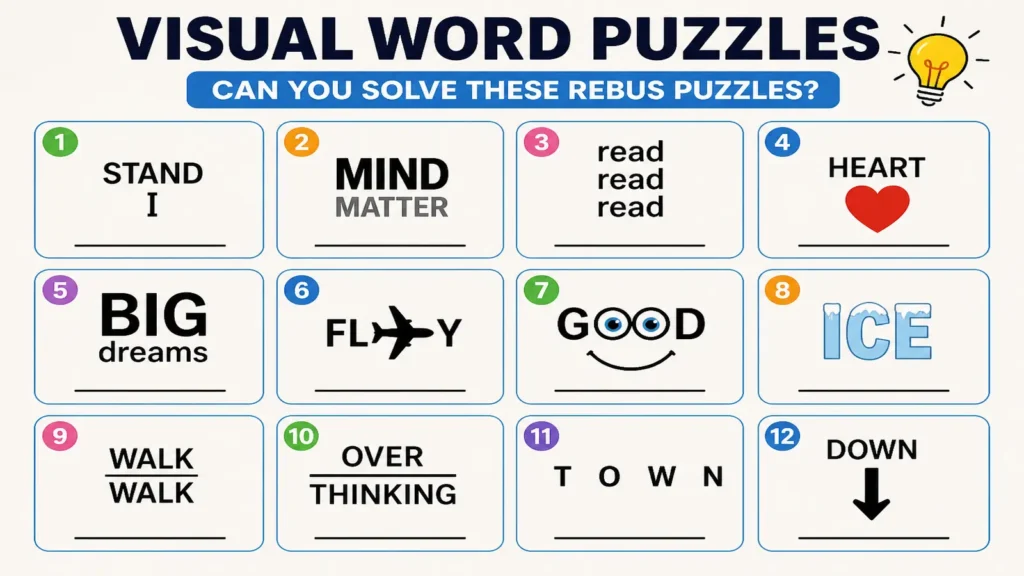
Visual word puzzles are perfect for people who enjoy clever clues. They mix pictures, letters, symbols, and spacing to hide a word or phrase. They work well for kids, adults, classrooms, parties, and family nights. Also, they are easy to start because most puzzles need no special supplies. In this guide, you will learn how they work. You will also find tips, uses, and ideas for making your own.
Quick Answer
Visual word puzzles are picture-based word games that hide a phrase, saying, or idea. Most use letters, symbols, images, spacing, or sound clues. Rebus puzzles are the most common example.
TL;DR
• Visual clues often hide common phrases.
• Rebus puzzles are the main style.
• Kids need simple, familiar answers.
• Adults enjoy layered wordplay.
• Printables work well offline.
• Daily games build steady practice.
What Are Visual Word Puzzles?
Visual word puzzles are clues you solve with your eyes and ears. Instead of reading a normal question, you study how words look.
They may show a word upside down, repeated, split apart, or paired with a picture. As a result, the answer often feels surprising.
• Combine images with short text
• Hide common words or sayings
• Use spacing as a clue
• Turn letters into pictures
• Make symbols carry meaning
• Reward careful looking
• Encourage playful guessing
• Often use familiar phrases
• Include rebus-style designs
• Work across many ages
• Need little setup time
• Fit quick group activities
How Visual Word Puzzles Work
These puzzles work by changing how a clue appears. Therefore, the layout matters as much as the words.
A puzzle might place one word inside another. Or, it may use size, color, direction, or sound to suggest the answer.
• Look at word position
• Notice repeated letters
• Check for missing parts
• Say the clue aloud
• Watch for hidden directions
• Study unusual spacing
• Compare big and small text
• Count objects when needed
• Read symbols as sounds
• Think about common sayings
• Try literal meanings first
• Then test figurative meanings
Common Types You Will See
Many people call these puzzles by different names. However, most names point to the same playful idea.
Rebus puzzles are the best-known type. Meanwhile, dingbats and “say what you see” puzzles often use similar clue tricks.
• Rebus puzzles mix images and words
• Dingbats rely on visual arrangement
• Emoji puzzles use modern icons
• Picture phrases show image clues
• Word stacks suggest hidden meanings
• Letter puzzles use shapes creatively
• Number clues may replace sounds
• Color clues can signal phrases
• Size changes create extra hints
• Direction clues show movement
• Sound clues create word matches
• Mixed clues combine several tricks
Easy Visual Word Puzzles for Kids
Kids do best with clear clues and familiar answers. So, start with short phrases they already know.
Simple puzzles help children feel smart quickly. In addition, they build confidence before harder clues appear.
• Choose answers kids recognize
• Use bright, simple pictures
• Avoid rare old sayings
• Start with one clue type
• Keep answer sheets nearby
• Offer hints before solutions
• Let kids explain guesses
• Pair beginners with helpers
• Use puzzles as warmups
• Celebrate creative attempts
• Limit timed rounds early
• End with an easy win
Challenging Visual Word Puzzles for Adults
Adult puzzles often use layered clues. However, hard does not need to mean unfair.
A strong challenge uses familiar answers in unexpected ways. Because of this, the best puzzles feel obvious after solving.
• Use idioms with twists
• Hide clues in plain sight
• Add misleading first impressions
• Mix sound with placement
• Include two clue steps
• Use negative space carefully
• Try abstract phrase answers
• Add light time pressure
• Avoid overly obscure references
• Share hints in stages
• Reward teamwork and debate
• Reveal answers with explanations
How to Solve Visual Word Puzzles Faster
The fastest solvers follow a simple routine. First, they describe exactly what they see.
Next, they test common phrases that match the layout. If stuck, they read the clue aloud and change direction.
• Name every visible element
• Describe the layout simply
• Check above and below
• Look inside each word
• Notice what is absent
• Read from different angles
• Listen for sound-alikes
• Replace pictures with words
• Guess common expressions early
• Ask what changed visually
• Take short breaks when stuck
• Compare ideas with others
Classroom Uses for Teachers
Visual word puzzles fit short classroom moments. They can start a lesson, close a unit, or fill transition time.
They also support vocabulary, reading, and creative thinking. Meanwhile, students can work alone or in groups.
• Begin class with one puzzle
• Use teams for discussion
• Connect answers to vocabulary
• Build puzzles from spelling words
• Create themed puzzle stations
• Add clues to bulletin boards
• Let students design examples
• Use answer keys for checking
• Pair puzzles with journal prompts
• Try five-minute challenge rounds
• Support English learners gently
• Review idioms through pictures
Family Game Night Ideas
Visual word puzzles are great for mixed ages. Everyone can stare at the same clue and shout ideas.
For smoother play, use simple rules. Also, rotate who reads hints so one person does not control the game.
• Split players into teams
• Mix kids with adults
• Use a shared timer
• Award points for explanations
• Give bonus points for speed
• Let teams buy hints
• Rotate puzzle readers often
• Include easy starter rounds
• Save hard puzzles for later
• Use themed snack breaks
• Keep answers hidden until needed
• End with a team-made puzzle
Printable Visual Word Puzzles
Printables are useful when screens are not ideal. They work well during travel, class time, parties, and quiet afternoons.
Choose printables with answers included. Also, sort pages by difficulty before handing them out.
• Print one level per page
• Keep answer keys separate
• Laminate cards for reuse
• Cut puzzles into strips
• Pack sets for road trips
• Use clipboards for parties
• Add pencils and scratch space
• Mark puzzles by difficulty
• Create a hint envelope
• Store solved sets apart
• Reuse cards in stations
• Save favorites for repeats
Online and Daily Puzzle Games
Online puzzle games make practice easy. Many offer hints, streaks, and fresh clues each day.
Still, daily play works best in small doses. Therefore, stop while the game still feels fun.
• Try one puzzle each morning
• Use hints after real effort
• Track streaks without pressure
• Compare answers with friends
• Pick difficulty levels wisely
• Avoid rushing every puzzle
• Screenshot favorite clue styles
• Play on larger screens sometimes
• Pause before checking answers
• Notice patterns across games
• Share fair puzzles only
• Balance screens with printables
How to Make Your Own Visual Word Puzzles
Making your own puzzle is easier than it seems. Start with a phrase people already know.
Then choose one visual trick that points toward the answer. Finally, test it on someone before sharing widely.
• Pick a familiar answer
• Choose one main clue
• Sketch several rough ideas
• Keep artwork simple
• Use clear letter spacing
• Avoid too many symbols
• Test with one friend
• Ask what confused them
• Add a gentle hint
• Write a clear answer
• Explain the clue logic
• Save strong puzzle templates
Common Mistakes to Avoid
Most puzzle problems come from unclear clues. However, solvers can also make things harder than needed.
Good puzzle play needs patience and fair design. So, aim for clever, not impossible.
• Do not peek too quickly
• Avoid changing answers randomly
• Do not ignore picture size
• Avoid vague homemade clues
• Skip private inside jokes
• Do not stack many tricks
• Avoid tiny unreadable text
• Do not shame wrong guesses
• Avoid sudden difficulty jumps
• Do not overuse timers
• Skip answers nobody knows
• Avoid cluttered puzzle layouts
FAQs
What are visual word puzzles?
Visual word puzzles are games where images, letters, symbols, and layout hide an answer. They often reveal a phrase, saying, or simple idea.
Are rebus puzzles the same as visual word puzzles?
Rebus puzzles are one popular kind of visual word puzzle. However, visual word puzzles can also include dingbats, emoji clues, and picture phrases.
How do I get better at solving them?
Start by saying what you see in plain words. Then look for position, size, sound, number, and missing pieces.
Are visual word puzzles good for kids?
Yes, when the clues match their age and reading level. They can support vocabulary, flexible thinking, and group discussion.
Can adults enjoy visual word puzzles too?
Absolutely. Adults often enjoy harder clues with idioms, sound tricks, and hidden meanings.
Where should I use printable visual word puzzles?
Use them during class, travel, parties, family nights, or quiet time. They are helpful when you want screen-free fun.
Conclusion
Visual puzzles turn ordinary words into playful surprises. They are simple to start, yet they can stay challenging for years. They also work almost anywhere. You can use them in classrooms, at home, online, or during a party. Most of all, visual word puzzles reward curiosity. Keep looking, keep guessing, and enjoy the “aha” moment.

Christopher McLagan is a celebrated riddle maker known for crafting clever brain teasers and mind-bending puzzles. His work blends classic riddles, logic challenges, and lateral thinking brain teasers designed to spark curiosity and critical thinking. Widely admired in online puzzle communities, McLagan creates engaging riddle questions and answers for both kids and adults. His signature style delivers surprising twists, clean humor, and satisfying “aha” moments that keep readers coming back for more.