
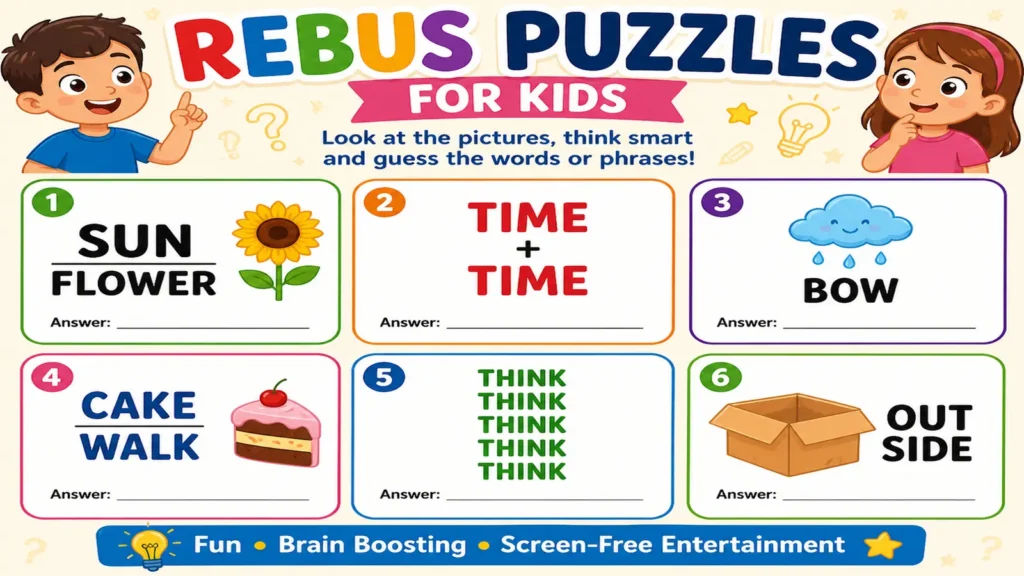
Rebus puzzles for kids are clever picture-word challenges. They turn letters, symbols, numbers, and drawings into hidden words or phrases. Parents, teachers, and kids can use them almost anywhere. They work well for quiet time, class warm-ups, road trips, and family games. Best of all, they feel like play. However, they also build focus, reading skills, and creative thinking.
Quick Answer
Rebus puzzles for kids are visual riddles that use pictures, words, letters, numbers, or placement clues. Kids solve them by spotting patterns and turning clues into a phrase.
TL;DR
• Rebus puzzles mix pictures, words, and symbols.
• Kids solve them by noticing hidden clues.
• Easy puzzles build confidence before harder ones.
• Printable cards work well at home.
• Answers help adults guide without guessing.
What Are Rebus Puzzles for Kids?
A rebus puzzle shows a word or phrase in a visual way. Instead of reading a normal sentence, kids decode the clue.
For example, a word above another word can mean “over.” Also, a picture plus a letter can create a new word.
• Pictures can stand for whole words.
• Letters may replace sounds in phrases.
• Numbers often sound like common words.
• Word size can show meaning.
• Word color may become a clue.
• Repeated words can signal quantity.
• Missing letters may change answers.
• Arrows can guide reading direction.
• Spacing often matters a lot.
• Symbols can connect clue parts.
• Simple drawings work better first.
• Answers usually feel obvious afterward.
How Kids Can Solve Rebus Puzzles Step by Step
Kids solve rebus puzzles best with a calm routine. A clear method keeps guessing from feeling random.
Start with what is visible. Then, ask what the clue might sound like or mean.
• Name every picture out loud.
• Read all words slowly first.
• Notice where each word sits.
• Count repeated letters or objects.
• Check for missing parts carefully.
• Say numbers as words aloud.
• Try simple phrases before tricky ones.
• Look for common sayings nearby.
• Ask what changed visually.
• Use hints before revealing answers.
• Skip hard puzzles briefly.
• Return with fresh eyes later.
Easy Rebus Puzzles for Beginners
Beginner puzzles should feel friendly, not confusing. Simple clues help kids learn the game quickly.
Choose puzzles with clear pictures and short phrases. Also, give gentle hints before showing answers.
• SUN plus flower means sunflower.
• STAR inside box means boxed star.
• CAT plus fish means catfish.
• RAIN over bow means rainbow.
• BEE plus hive means beehive.
• BOOK inside case means bookcase.
• CUP under cake means cupcake.
• SNOW plus man means snowman.
• FOOT before ball means football.
• TOOTH plus brush means toothbrush.
• PAN plus cake means pancake.
• AIR beside plane means airplane.
Picture Rebus Puzzles Kids Love
Picture rebus puzzles are great for younger solvers. The drawings give kids something concrete to notice.
Meanwhile, older kids can use pictures in trickier ways. They may add, remove, or combine sounds.
• Animal pictures support early readers.
• Food clues feel familiar fast.
• Sports images make phrases lively.
• Weather drawings create simple answers.
• School objects fit classroom lessons.
• Holiday images add seasonal fun.
• Faces can show feelings clearly.
• Road signs create direction clues.
• Simple icons beat busy drawings.
• Large pictures help group play.
• Black outlines print cleanly.
• Color clues need clear labels.
Word-Position Rebus Puzzles Explained
Some rebus puzzles use placement as the main clue. Kids must read where words appear.
For example, one word inside another can mean “in.” However, a word under another may mean “under.”
• WORD over HEAD suggests overhead.
• LINE under sand suggests underline.
• ME inside YOU suggests in between.
• STAR around moon suggests surrounding moon.
• DAY after night suggests daybreak.
• STEP above step suggests upstairs.
• HAND beside hand suggests close at hand.
• TIME after time suggests again and again.
• DOWN written upward suggests upside down.
• BACK written backward suggests looking back.
• SIDE beside side suggests side by side.
• OUT outside box suggests outside the box.
Printable Rebus Puzzle Ideas for Home
Printable rebus puzzles make home play simple. You only need paper, pencils, and answer cards.
For a smoother game, print puzzles by level. Then, keep answers on a separate page.
• Print four puzzles per sheet.
• Cut cards for quick rounds.
• Laminate favorites for reuse.
• Add answers on the back.
• Use envelopes for difficulty levels.
• Keep pencils beside each stack.
• Save hard cards for weekends.
• Mix themes for longer play.
• Use timers for silly races.
• Let siblings trade puzzle sets.
• Store solved cards separately.
• Bring cards on road trips.
Classroom Rebus Puzzle Activities
Rebus puzzles fit many classroom moments. They work well as warm-ups, early finisher tasks, or team challenges.
Because they are short, teachers can use them without long setup. Also, students can discuss answers together.
• Start class with one puzzle.
• Pair students for quiet solving.
• Use puzzle cards at stations.
• Let groups explain clue logic.
• Connect puzzles to vocabulary words.
• Place easier cards near entry.
• Give hints after two minutes.
• Invite students to draw answers.
• Use puzzles before reading lessons.
• Add themed cards near holidays.
• Celebrate clever wrong guesses kindly.
• End lessons with puzzle exits.
Family Game Night Rebus Challenges
Rebus puzzles can turn family night into a laughter-filled challenge. They are short, simple, and easy to share.
Also, mixed ages can play together. Younger kids can solve picture clues while adults tackle harder phrases.
• Divide players into small teams.
• Give each team puzzle cards.
• Award points for clear explanations.
• Add bonus points for speed.
• Let youngest players choose rounds.
• Use hints as team lifelines.
• Trade cards after each turn.
• Create a silly champion title.
• Mix easy and tricky puzzles.
• Pause for snack-break challenges.
• Let teams design final puzzles.
• Finish with everyone solving together.
How Kids Can Make Their Own Rebus Puzzles
Creating rebus puzzles helps kids think like puzzle makers. They must choose a phrase, then hide it visually.
Start with easy compound words. Next, move toward sayings, idioms, and short jokes.
• Pick a short answer first.
• Choose one clear clue style.
• Draw simple pictures boldly.
• Use big letters for words.
• Add arrows only when needed.
• Test the puzzle on someone.
• Rewrite confusing clues quickly.
• Keep the answer page hidden.
• Try compound words first.
• Use favorite animals or foods.
• Make holiday cards for friends.
• Share finished puzzles aloud.
Rebus Puzzles by Age and Skill Level
Different ages need different puzzle styles. A puzzle that delights one child may frustrate another.
So, begin slightly below a child’s level. Then, raise the challenge after several wins.
• Ages five to six need pictures.
• Ages seven to eight handle compounds.
• Ages nine to ten enjoy phrases.
• Older kids can solve idioms.
• Beginners need fewer clue parts.
• Strong readers can handle wordplay.
• Visual learners may solve quickly.
• Mixed groups need varied cards.
• Hard puzzles should include hints.
• Timed rounds suit confident players.
• Quiet solving helps careful thinkers.
• Team play supports younger children.
Answer Key Tips for Parents and Teachers
Answer keys are helpful when used wisely. They should guide kids, not end the challenge too soon.
Instead of giving the answer immediately, offer one small hint. Then, let kids make another guess.
• Keep answer sheets face down.
• Give hints before final answers.
• Ask kids to explain thinking.
• Praise effort, not just speed.
• Mark solved puzzles with stickers.
• Review missed puzzles calmly afterward.
• Accept close answers when reasonable.
• Discuss why the clue works.
• Avoid laughing at wrong guesses.
• Let kids request one clue.
• Save answers for adult helpers.
• Use answer keys for sorting.
Common Rebus Puzzle Mistakes to Avoid
Rebus puzzles are fun, but they can become frustrating. Adults can help by choosing clear puzzles and fair rules.
Also, kids need permission to guess. A wrong answer can still show smart thinking.
• Avoid starting with hard idioms.
• Do not crowd the page.
• Skip unclear clip art.
• Avoid tiny printed words.
• Do not reveal answers instantly.
• Limit puzzle time for beginners.
• Avoid too many clue types.
• Do not force silent solving.
• Skip phrases kids never hear.
• Avoid messy handwritten clues.
• Do not overuse tricky spelling.
• Stop before kids feel stuck.
FAQs About Rebus Puzzles for Kids
What is a rebus puzzle for kids?
A rebus puzzle is a visual riddle. It uses pictures, letters, symbols, or placement to show a word or phrase.
What age is best for rebus puzzles?
Many kids can start around age five with picture-based puzzles. Older kids can handle phrases, sayings, and word-position clues.
Are rebus puzzles good for learning?
Yes, they can support reading, vocabulary, focus, and flexible thinking. They also help kids explain ideas clearly.
How do I teach a child to solve rebus puzzles?
Start by naming every clue out loud. Next, ask what the pictures, words, numbers, and positions might suggest.
Where can I use printable rebus puzzles?
Use them at home, in classrooms, during travel, or at parties. They also work well for quiet breaks.
Should rebus puzzles always include answers?
Answers are useful for adults and beginners. However, keep them hidden until kids have tried hints first.
Can kids make their own rebus puzzles?
Yes, and it is a great creative activity. Start with compound words, then try short phrases.
Conclusion
Rebus puzzles make kids slow down, look closely, and think creatively. They turn simple pictures and words into small moments of discovery. They also work in many places. Use them during class, at home, on trips, or during family game night. With the right hints and answer keys, rebus puzzles for kids can stay fun and frustration-free. Start easy, celebrate guesses, and keep playing.

Joseph Morgan is an enigmatist known for creating clever and mysterious riddles. Born in Scotland, he spent his life challenging people to think deeply through puzzles and brainteasers. He became famous for his creative mind and love of mystery.