
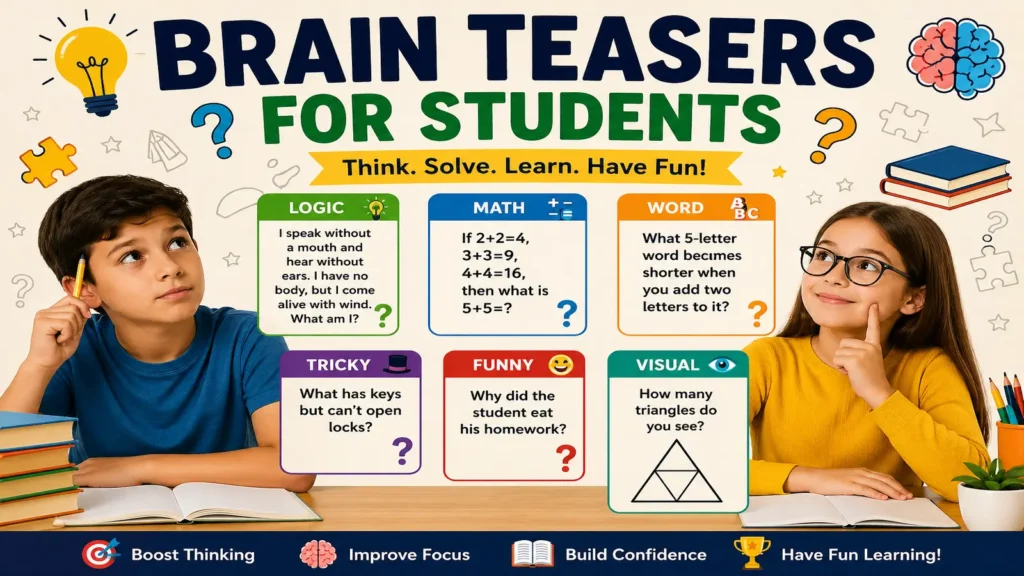
Brain teasers make learning feel active, playful, and fresh. They help students slow down, notice clues, and explain their thinking.
This guide is for teachers, parents, tutors, and students. You will find brain teasers for students across ages, subjects, and classroom moments.
Use them for warm-ups, breaks, group work, or quiet challenges. Also, each idea includes a quick answer when needed.
Quick Answer
Brain teasers for students are short puzzles that build thinking, focus, and problem-solving. They can fit into lessons, morning work, homework, or group games.
TL;DR
• Brain teasers make thinking practice fun.
• Use easy puzzles before harder ones.
• Answers help students learn from mistakes.
• Mix math, word, logic, and visual puzzles.
• Team puzzles build speaking and listening skills.
• Short daily practice works better than cramming.
Easy Brain Teasers for Elementary Students
Easy puzzles help younger students feel brave. Also, they teach kids to listen closely before answering.
Start with playful questions and clear answers. Then, let students explain how they solved each one.
• What has hands but cannot clap? A clock.
• What gets wetter while drying? A towel.
• What has legs but never walks? A table.
• What has keys but opens nothing? A piano.
• What has a face but no eyes? A clock.
• What runs but never gets tired? Water.
• What has teeth but cannot bite? A comb.
• What has words but never speaks? A book.
• What has ears but cannot hear? Corn.
• What has a neck but no head? A bottle.
• What has a bed but never sleeps? A river.
• What can fly without wings? Time.
Math Brain Teasers for Problem Solvers
Math brain teasers should feel like puzzles, not tests. Because of this, students can enjoy numbers without pressure.
These examples use patterns, place value, and simple logic. Encourage students to show more than one method.
• I am even and less than four. Answer: two.
• Ten minus ten is ten in what case? Tennis.
• What number comes after 2, 4, 8, 16? Thirty-two.
• Three cats catch three mice in three minutes. Same rate.
• A dozen minus two equals ten. Simple subtraction.
• Half of eight can be four or zero.
• What is 9 plus 5 on a clock? Two.
• Double six, then add one. Answer: thirteen.
• Five pairs of socks make ten socks.
• Seven days after Monday is Monday again.
• Add two sides to a triangle. You get five.
• Twenty has two tens and zero ones.
Word Brain Teasers for Reading Practice
Word puzzles help students notice meaning, spelling, and sound. In addition, they make reading practice feel lighter.
These brain teasers work well before vocabulary lessons. However, students should explain the clue, not just answer.
• What word starts and ends with E? Envelope.
• Which word becomes shorter when letters are added? Short.
• What word has many letters? Mailbox.
• What five-letter word sounds like one letter? Queue.
• What begins with T and ends with T? Teapot.
• What has one eye but cannot see? Needle.
• What word is spelled wrong in dictionaries? Wrong.
• What month has 28 days? Every month.
• What can you catch but not throw? A cold.
• Which letter drinks the most water? C.
• What word has three consecutive double letters? Bookkeeper.
• What comes once in minute, twice in moment? M.
Logic Brain Teasers for Careful Thinkers
Logic puzzles reward careful reading. Still, students often rush and miss the hidden clue.
Ask students to underline important words first. Next, let them compare answers with a partner.
• A farmer has 17 sheep; all but nine leave. Nine remain.
• Two mothers and two daughters share three apples. Three people.
• A plane crashes on a border. Survivors are not buried.
• You enter a dark room with one match. Light the match.
• A rooster lays an egg on a roof. Roosters do not lay eggs.
• Two coins equal thirty cents; one is not a nickel. Quarter and nickel.
• A bus driver goes wrong way; no one stops him. He walks.
• One-story house has red walls. No stairs exist.
• Before Mount Everest was discovered, highest mountain was Everest.
• You see ten birds; three fly away. Seven stay.
• A cowboy rides Friday and returns Friday. Horse named Friday.
• The more you take, the more you leave. Footsteps.
Visual Brain Teasers for Sharp Eyes
Visual brain teasers train students to notice patterns. Also, they help quiet learners shine without speaking first.
You can draw many of these on a board. Meanwhile, students can solve them on paper.
• Spot the odd number: 2, 4, 6, 9.
• Find the repeated word: cat, dog, cat, fish.
• Continue the pattern: circle, square, circle, square.
• Which is different: red apple, green apple, blue car.
• Count triangles in a square split diagonally. Two.
• Find the missing letter: A, C, E, G, I.
• Which shape has no corners? Circle.
• Reverse the word STAR. Answer: RATS.
• Read this backward: LEVEL stays level.
• Which line is longer? Measure before guessing.
• Find the mirror word: MOM.
• Spot the pattern: up, down, up, down.
Funny Brain Teasers for Class Laughs
Funny brain teasers loosen the room. As a result, students feel safer trying tricky answers.
Keep the tone kind and school-friendly. Also, remind students that silly mistakes are part of thinking.
• Why did the student eat homework? Teacher said digest it.
• What school supply is king? The ruler.
• Why was math book sad? Too many problems.
• What room has no walls? A mushroom.
• Why did pencil win? It drew attention.
• What animal cheats at exams? A cheetah.
• Why did computer visit nurse? It had a virus.
• What do libraries take fishing? Bookworms.
• Why was broom late? It swept in.
• What did zero say to eight? Nice belt.
• Why did calendar panic? Its days were numbered.
• What pencil tells jokes? A sharp one.
Hard Brain Teasers for Older Students
Older students enjoy puzzles that feel clever, not childish. However, the answer still needs to feel fair.
Use these for warm-ups or challenge stations. Then, ask students to defend their reasoning in one sentence.
• What disappears when you say its name? Silence.
• I speak without mouth and hear without ears. Echo.
• What belongs to you but others use more? Name.
• What has cities but no houses? A map.
• What breaks without being touched? A promise.
• What goes up but never comes down? Age.
• What can fill a room without space? Light.
• What is always in front but unseen? Future.
• What can travel worldwide while staying cornered? Stamp.
• What has branches but no leaves? Bank.
• What is bought by yard and worn by foot? Carpet.
• What has roots nobody sees? Mountain.
Team Brain Teasers for Group Work
Team puzzles help students practice listening. In addition, they show that smart thinking has many styles.
Give each group a role. For example, choose a reader, recorder, checker, and speaker.
• Build tallest paper tower using one sheet.
• List ten round objects in two minutes.
• Solve a riddle, then write another.
• Sort mystery words into secret categories.
• Create a pattern classmates must finish.
• Find three answers to one question.
• Explain one puzzle without saying answer.
• Trade clues with another group.
• Vote on strongest reasoning, not loudest voice.
• Draw a solution using only symbols.
• Make a number using exactly four fours.
• Design a clue path around classroom.
Brain Teasers for Bell Ringers
Bell ringers should start fast and end cleanly. So, choose puzzles students can attempt within minutes.
Post one puzzle as students enter. Then, reveal the answer after brief discussion.
• What has four wheels and flies? Garbage truck.
• Which weighs more, feathers or bricks? Same pound.
• What comes next: 1, 1, 2, 3, 5? Eight.
• What has many rings but no fingers? Tree.
• Which word is pronounced same after four letters removed? Queue.
• What starts with P and ends with E? Post office.
• What can be cracked, made, told, and played? Joke.
• What has a thumb and four fingers? Glove.
• What has a spine but no bones? Book.
• What is full of holes yet holds water? Sponge.
• What question can never be answered yes? Are you asleep?
• What can you keep after giving away? Your word.
Printable Brain Teasers and Answer Keys
Printable puzzles are useful for centers, packets, and early finishers. Also, they help students work at their own pace.
Keep answer keys simple and separate. However, include space for students to explain one solution.
• One-page riddle sheet with blank answer lines.
• Pattern worksheet with three missing spots.
• Number puzzle grid with answer box.
• Word ladder from cat to dog.
• Logic chart with three friendly clues.
• Rebus cards for partner practice.
• Mystery object clues with drawing space.
• Clock puzzles using school-day times.
• Shape-count page with reflection question.
• Match riddles to answer choices.
• Exit ticket asking favorite puzzle strategy.
• Answer key page with short explanations.
How to Use Brain Teasers in Class
Brain teasers work best with routines. Because of this, students know when to think, talk, and share.
Do not grade every answer. Instead, praise effort, strategy, and clear explanation.
• Start with one puzzle twice weekly.
• Set a short timer for focus.
• Read directions aloud once.
• Let students think before talking.
• Ask partners to compare strategies.
• Celebrate unusual but logical ideas.
• Reveal answers after discussion.
• Invite students to explain mistakes kindly.
• Rotate math, word, logic, and visual types.
• Save hard puzzles for challenge days.
• Use easier puzzles after testing.
• Let students submit original teasers.
Brain Teasers for Students by Grade Level
Different ages need different challenge levels. Still, every group benefits from clear clues and fair answers.
You can adjust any puzzle by adding hints. In addition, older students can create their own versions.
• Kindergarten: use pictures, objects, and simple rhymes.
• Grade one: choose short riddles with concrete answers.
• Grade two: add patterns and easy wordplay.
• Grade three: introduce number clues and categories.
• Grade four: use multi-step riddles with hints.
• Grade five: mix logic, math, and vocabulary.
• Grade six: ask students to explain reasoning.
• Grade seven: include debate over possible answers.
• Grade eight: use harder patterns and hidden assumptions.
• High school: choose clever puzzles with deeper logic.
• Mixed groups: offer easy, medium, and hard choices.
• Advanced learners: ask for original puzzle design.
FAQs About Brain Teasers for Students
What are brain teasers for students?
They are short puzzles that make students think carefully. They often use logic, words, numbers, patterns, or visual clues.
How do brain teasers help students learn?
They build focus, reasoning, and flexible thinking. Also, they help students explain ideas in a low-pressure way.
Are brain teasers good for every grade level?
Yes, but the difficulty should match the student. Younger students need simple clues, while older students can handle trickier logic.
How often should teachers use brain teasers?
Two or three short sessions each week can work well. Daily use is fine when puzzles stay quick and varied.
Should brain teasers be graded?
Usually, they should not be graded for right answers. Instead, teachers can praise effort, reasoning, and clear explanations.
What types of brain teasers work best in class?
A mix works best because students think in different ways. Try math, word, logic, funny, team, and visual puzzles.
Conclusion
Brain teasers can turn a few quiet minutes into active thinking. They also help students practice patience, focus, and explanation. The best brain teasers for students are clear, fair, and fun. Use a mix of easy and hard puzzles, so everyone can join. Finally, keep the goal simple. Students should leave feeling curious, confident, and ready to think again.

Christopher McLagan is a celebrated riddle maker known for crafting clever brain teasers and mind-bending puzzles. His work blends classic riddles, logic challenges, and lateral thinking brain teasers designed to spark curiosity and critical thinking. Widely admired in online puzzle communities, McLagan creates engaging riddle questions and answers for both kids and adults. His signature style delivers surprising twists, clean humor, and satisfying “aha” moments that keep readers coming back for more.