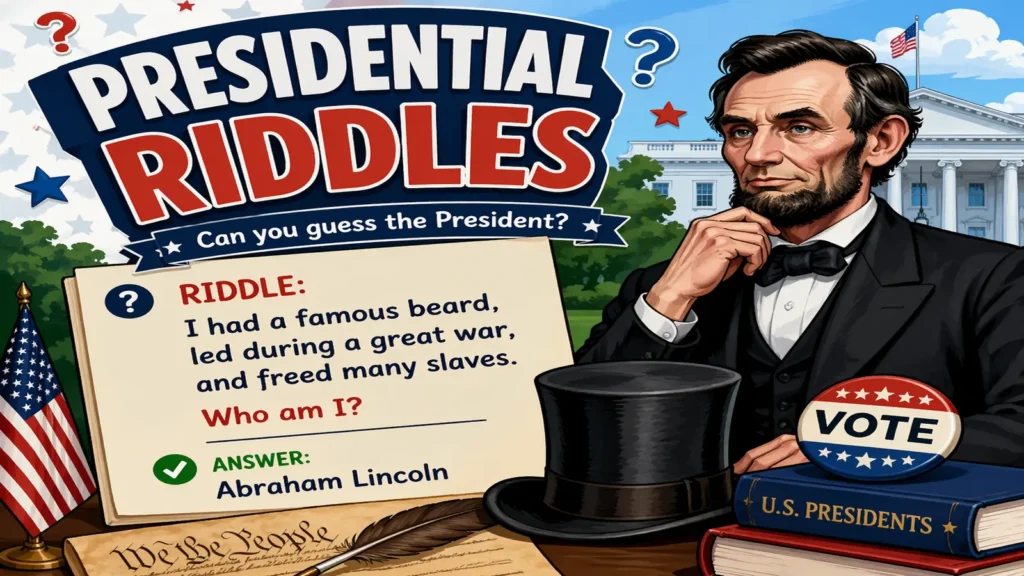
Presidential history can feel big and serious. However, a clever riddle makes it feel fun, friendly, and easy to remember. This guide is for parents, teachers, students, and trivia fans who want presidential riddles that are simple to use, easy to enjoy, and fresh enough to share at home, in class, or at a party.
Quick Answer
Presidential riddles are short clue games about U.S. presidents, the White House, elections, and famous moments. They mix history with humor, so people learn while they guess. Good presidential riddles feel fair, playful, and easy to remember.
TL;DR
• Great clues mix facts, surprise, and simple wording.
• Kids enjoy visual hints and famous names.
• Adults like deeper history and sharper twists.
• Presidents’ Day works well for classroom riddles.
• Strong answers feel obvious after the reveal.
What Makes a Great Presidential Riddle
A great riddle gives just enough help. It should feel tricky at first, yet fair by the end. Also, the best ones use facts people can picture fast.
• One clear answer, not three
• Strong clue, not random detail
• Familiar fact with fresh twist
• Short setup, sharp payoff
• Easy wording for broad readers
• Visual hints beat vague hints
• Funny tone keeps readers going
• Real history adds more punch
• Surprising clue order builds suspense
• Famous symbols make guessing faster
• Answer should click instantly
• Clean humor fits every age
Presidential Riddles for Kids
Kids do best with bold, simple clues. So, these work best when they use hats, houses, birthdays, coins, and easy firsts. Each line below gives a riddle idea and answer.
• First president, white horse vibe — George Washington
• Tall hat, famous beard — Abraham Lincoln
• Smiling on the quarter — George Washington
• On the penny, split logs — Abraham Lincoln
• Teddy bear name helper — Theodore Roosevelt
• Lived in the White House — many presidents
• Biggest office in America — the presidency
• Needs at least thirty-five — a president
• Wins votes across the states — a candidate
• Oval room for big choices — Oval Office
• Big house at 1600 Pennsylvania — White House
• Leads the executive branch — the president
Presidential Riddles for Adults
Adults usually enjoy layered clues. Meanwhile, stronger wordplay helps when readers already know the basics. These ideas lean a little deeper without getting heavy.
• Served two nonconsecutive terms — Grover Cleveland
• Fireside voice during hard times — Franklin Roosevelt
• Trust buster with a big stick — Theodore Roosevelt
• Louisiana Purchase dealmaker — Thomas Jefferson
• Moon mission challenge speaker — John Kennedy
• Resigned before term ended — Richard Nixon
• Former actor in the Oval Office — Ronald Reagan
• Only unelected vice president turned president — Gerald Ford
• Chief during Civil War strain — Abraham Lincoln
• Father of the Constitution partner — George Washington
• Expanded west with bold purchase — Jefferson again
• Youngest elected president — John Kennedy
Funny Presidential Riddles
Funny riddles should stay light. Instead of mocking people, aim for clean puns and silly images. That keeps the joke usable in homes and classrooms.
• Why did Lincoln skip shaving? Beard business
• Why loved Washington the quarter? Change mattered
• Why sit in the Oval Office? Corners confuse
• Why run for president? Better office chair
• Why carry a flag pin? Easy clue
• Why study presidents? History drops hints
• Why like campaign trails? So many signs
• Why love the White House? Prime address
• Why tell riddles on Presidents’ Day? Instant laughs
• Why did Teddy grin? Bearly contained joy
• Why did a candidate whisper? Secret platform
• Why bring pencils to debate? Point making
Hard Presidential Riddles
Hard clues need balance. If they get too obscure, readers quit. Still, a smart challenge can be the most fun part of the page.
• Only president with a patent — Abraham Lincoln
• First president born in Hawaii — Barack Obama
• Only president to serve four terms — Franklin Roosevelt
• First to live in White House — John Adams
• Supreme Court chief after presidency — William Howard Taft
• Youngest to become president — Theodore Roosevelt
• Last wig-era president style — James Monroe
• Annexed Texas during his term — James Polk
• Truman upset headline winner — Harry Truman
• Returned to office years later — Donald Trump
• First president on television regularly — Franklin Roosevelt
• Born a British subject, then president — Andrew Jackson
Presidents’ Day Classroom Riddles
Classroom clues should teach while they entertain. Because of that, they work best when they are short, repeatable, and easy to discuss in groups.
• February holiday honoring presidents — Presidents’ Day
• School bell, history game starter — riddle time
• Coin clue for first leader — quarter
• Penny points toward Lincoln — one cent
• Mount Rushmore face to guess — president
• Honest nickname in a clue — Lincoln
• Cherry tree story warning — myth
• Big speech at Gettysburg — Lincoln
• White House mail target — president
• Red, white, and clue cards — classroom set
• Team answer wins applause — correct guess
• History lesson with laughter — ideal activity
George Washington Riddles
Washington clues work because readers know his place fast. However, the best riddles avoid using the exact answer word too early. Try these crisp clue paths.
• First in office, not alphabet — George Washington
• Quarter face, wooden-teeth myth — Washington
• Crossed icy Delaware at war — Washington
• Led before presidents were many — Washington
• Never lived in White House — Washington
• Farewell Address without third term — Washington
• Mount Vernon points homeward — Washington
• Father of his Country clue — Washington
• General first, president next — Washington
• One-dollar portrait to notice — Washington
• Revolution hero, republic starter — Washington
• Set the two-term example — Washington
Abraham Lincoln Riddles
Lincoln is one of the easiest presidents to clue well. For example, a hat, a beard, a speech, or a log cabin can all point readers the right way.
• Top hat and tall frame — Abraham Lincoln
• Gettysburg words, brief and lasting — Lincoln
• Penny face with calm stare — Lincoln
• Honest nickname, courtroom roots — Lincoln
• Split rails before national office — Lincoln
• Beard made famous in portraits — Lincoln
• Civil War burden on shoulders — Lincoln
• Emancipation clue, freedom theme — Lincoln
• Illinois lawyer turned president — Lincoln
• Theater night ended his story — Lincoln
• Memorial statue in Washington — Lincoln
• Five-dollar bill familiar face — Lincoln
Theodore Roosevelt and FDR Riddles
The two Roosevelts give writers great contrast. One feels rugged and restless. The other feels steady, strategic, and radio-friendly.
• Big stick line fits him — Theodore Roosevelt
• Teddy bear name link — Theodore Roosevelt
• National parks champion clue — Theodore Roosevelt
• Rough Rider in many riddles — Theodore Roosevelt
• New Deal architect answer — Franklin Roosevelt
• Fireside chats reached families — Franklin Roosevelt
• Four election wins in history — Franklin Roosevelt
• Led through Depression and war — Franklin Roosevelt
• Roosevelt with trust-busting fame — Theodore Roosevelt
• Roosevelt on the dime? Neither
• Cousins through powerful history — both Roosevelts
• Two famous Roosevelts, different eras — shared clue
White House and Oval Office Riddles
Not every clue needs a person. In fact, place-based riddles add variety and help readers who like symbols more than names. These also work well in school games.
• Famous home on Pennsylvania Avenue — White House
• Round-edged room for decisions — Oval Office
• Press briefings happen nearby — West Wing
• South Lawn event setting — White House grounds
• House painted after fire damage — White House
• Executive mansion common nickname — White House
• Address starts with sixteen hundred — White House
• Window view for many presidents — residence
• Desk with historic stories — Resolute Desk
• Room for cabinet meetings — Cabinet Room
• Holiday tours and photo dreams — White House
• Power symbol without campaign signs — Oval Office
Election and Constitution Riddles
Civics riddles can make rules stick better. So, these clues focus on age, votes, terms, and office basics. They are short enough for class or trivia cards.
• Minimum age to serve — thirty-five
• Must be natural-born citizen — president rule
• Years of U.S. residency needed — fourteen
• Win enough state votes — Electoral College
• Maximum elected terms now — two
• January oath day tradition — inauguration
• Backup leader after president — vice president
• Written rules guide eligibility — Constitution
• Counted state-by-state victory path — electoral votes
• Promise spoken before office — oath
• Article setting executive branch — Article II
• Office limited after FDR era — Twenty-Second Amendment
How to Write Your Own Presidential Riddles
Writing a strong clue is easier than it looks. First, pick one fact readers can picture. Then add one twist that hides the answer without breaking logic.
• Start with one famous fact
• Add one less-known detail
• Remove the president’s name
• Keep clues under one breath
• Use images readers know
• Avoid five facts at once
• Build toward one clean reveal
• Test it on one friend
• Cut any confusing filler
• Pick classroom-safe humor every time
• Match difficulty to audience
• End with a satisfying answer
FAQs
What are presidential riddles?
Presidential riddles are clue-based questions about U.S. presidents, the White House, elections, and famous history moments. They work like mini puzzles, so readers guess the answer from a few smart hints.
Are presidential riddles good for kids?
Yes, they can be great for kids. The best ones use simple facts, strong visuals, and easy answers like George Washington, Abraham Lincoln, or the White House.
What is the difference between a presidential riddle and presidential trivia?
A riddle hides the answer inside playful clues. Trivia usually asks directly for a fact, date, name, or event without the same puzzle feel.
How do I make a presidential riddle harder?
Use layered clues instead of obvious ones. You can also mix a famous fact with a lesser-known detail, as long as the answer still feels fair.
Can teachers use presidential riddles on Presidents’ Day?
Absolutely. They fit warm-ups, exit tickets, team games, bulletin boards, and quick review rounds. They also help history facts feel more lively.
Which presidents work best in riddles?
George Washington, Abraham Lincoln, Theodore Roosevelt, and Franklin Roosevelt are strong choices. Their symbols, stories, and famous moments are easy to turn into clues.
Conclusion
Presidential riddles work because they make history easier to hold onto. A good clue invites people in, while a good answer gives them that quick, happy click. You can use them in class, at family dinners, during trivia night, or on Presidents’ Day. They fit kids, adults, and mixed groups when the clue style matches the audience. Best of all, presidential riddles turn facts into fun. That simple shift makes people want to keep learning.
A modern riddle-maker who builds clever, pocket-sized puzzles with sharp wordplay and elegant misdirection. Her clues are clean, surprising, and designed to make you think twice—then smile when it clicks.