
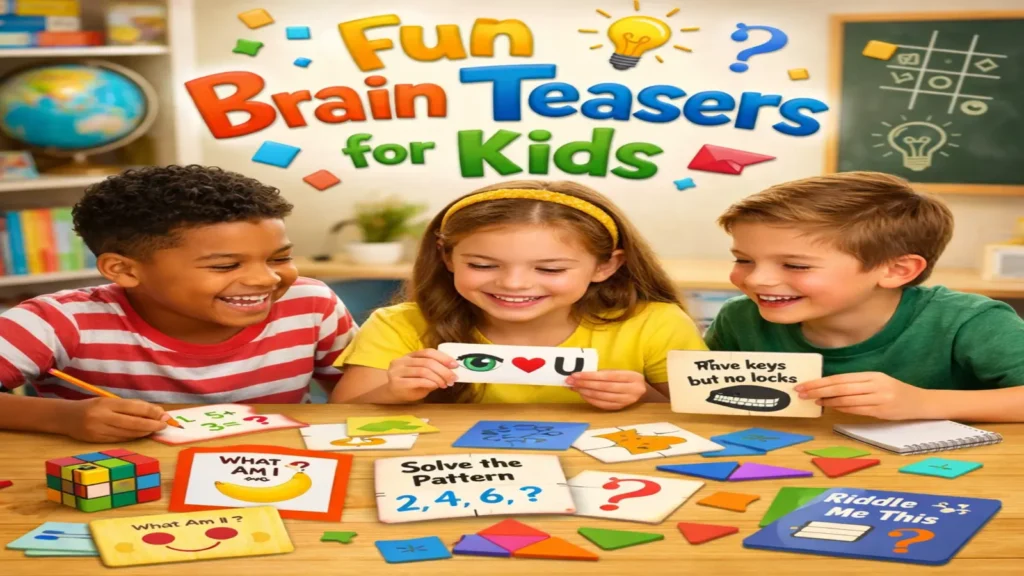
Brain teasers can turn a slow afternoon into a lively challenge. They help kids think, guess, laugh, and try again. Better yet, they work at home, in class, or on the go. This guide is for parents, teachers, and caregivers who want fun brain teasers for kids that feel fresh. You will get easy picks, trickier options, and simple ways to keep the fun going.
Quick Answer
Fun brain teasers for kids are short puzzles that make children think in playful ways. The best ones mix humor, logic, and simple surprise. They work best when the challenge feels exciting, not overwhelming.
TL;DR
• Start with easy wins for quick confidence
• Mix funny, tricky, and number-based puzzles
• Use short clues during car rides or class transitions
• Give hints before sharing the answer
• Let kids invent teasers too
Why Brain Teasers Are Great for Kids
Brain teasers feel like play, yet they also build useful habits. Kids slow down, listen closely, and test ideas. As a result, even a tiny puzzle can spark real excitement.
A good teaser also invites conversation. One child may guess fast, while another spots a hidden clue later. That shared moment makes the activity feel rewarding.
• They make thinking feel playful
• Kids practice listening for clues
• Wrong guesses still build confidence
• Short puzzles fit busy days
• Laughter keeps attention strong
• Surprises make answers memorable
• Quick wins encourage another try
• Kids learn patience through puzzling
• Family members can join together
• Classrooms gain calm, focused energy
• Waiting time feels less boring
• Screen-free fun becomes easier
Easy Brain Teasers to Warm Up Young Minds
Easy teasers help kids feel smart right away. That matters, especially for beginners. Start simple, then raise the challenge bit by bit.
Younger kids usually enjoy everyday answers. Familiar objects, animals, and actions make guessing feel fair. Because of that, they stay engaged longer.
• I have keys, no locks — piano
• I go up, never down — age
• I am full of holes — sponge
• I shine at night — moon
• I have hands, no arms — clock
• I get wetter while drying — towel
• I run, but never walk — water
• I bark, yet have no mouth — tree
• I have a ring, no finger — phone
• I can fly without wings — time
• I have one eye — needle
• I am read, never eaten — book
Funny Brain Teasers That Get Instant Laughs
Funny brain teasers work because the answer sneaks up on you. Kids enjoy the surprise, and adults usually laugh too. Meanwhile, the silly mood lowers the pressure.
These are great for group settings. Nobody feels stuck for long, and each answer lands with a grin. That keeps the pace lively.
• Why fish fail tests — sea-crets
• Why ghosts lie badly — seen through
• What has four wheels — shopping cart
• Why bees get sticky — honeycombs
• What kind of room — mushroom
• Why teddy skips dessert — stuffed already
• What rises without rain — dough
• Why math books worry — many problems
• What kind of coat — paint
• Why cows wear bells — horns fail
• What bow cannot tie — rainbow
• What kind of band — rubber band
Tricky Brain Teasers for Bigger Thinkers
Older kids often want a stronger challenge. They like clues with a twist and answers that feel clever. Still, the best tricky teasers stay fair.
Give these a little breathing room. A short pause can help kids rethink the wording. Often, the clue hides in plain sight.
• Add two letters, shorter gets longer
• One-story house lacks stairs entirely
• Greenhouse is made of glass
• Seven days without sleep — nights
• Forward I weigh much — ton
• More you take, more left — footsteps
• Belongs to you, others use it — name
• Starts with T, ends with T — teapot
• Has a neck, no head — bottle
• Cuts hair, never uses scissors — time
• Month with twenty-eight days — all
• Once in minute, never hour — M
Math Brain Teasers That Feel Like Games
Math brain teasers work best when they feel playful. Kids should sense a puzzle, not a worksheet. So keep the wording light and the numbers friendly.
You can also read them aloud. That helps children hear patterns and picture the problem. In many cases, the setup matters more than the math.
• Two parents plus six kids — eight
• Double thirty, then halve — thirty
• Three cats catch three mice
• Odd number, remove letter — even
• Add five to nine — two
• Half of eight, then eight more
• A dozen eggs minus seven
• Count corners on two squares
• Next pattern: 2, 4, 8, 16
• Ten birds, one flies — nine
• Three quarters of twelve — nine
• Two coins make thirty — quarter nickel
What Am I Brain Teasers Kids Love
“What am I” teasers are easy to use and easy to remember. They paint a tiny picture, then invite a guess. Because of that, kids often repeat them later.
This format also helps shy children join in. They can picture the clue quietly before answering. That makes the activity feel less rushed.
• I open wide each morning — backpack
• I glow when rooms get dark — lamp
• I carry food to lunch — plate
• I pop when soap meets air — bubble
• I bounce, then roll away — ball
• I sharpen thoughts on paper — pencil
• I keep rain off heads — umbrella
• I beep before school starts — alarm
• I hide feet in winter — sock
• I cool drinks in summer — ice
• I hold stories on shelves — library
• I zip shut with teeth — jacket
Animal Brain Teasers for Curious Kids
Animals are a favorite teaser theme for many children. The clues feel lively, and the answers often bring a quick smile. In addition, kids usually know the creatures already.
Use these when the group feels restless. Animal themes often pull attention back fast. That makes them handy for both home and school.
• Black and white, loves bamboo — panda
• Long neck reaches tall leaves — giraffe
• Sleeps upside down at dawn — bat
• Slow shell traveler on land — turtle
• Laughing bird with a pouch — pelican
• Has stripes, not pajamas — zebra
• Desert ship without sails — camel
• Hops fast, carries a pouch — kangaroo
• Night hunter with silent wings — owl
• Pink bird on one leg — flamingo
• Builds dams from fallen wood — beaver
• Tiny jumper with green songs — frog
Classroom Brain Teasers for Teachers
Classroom brain teasers shine during transitions. They can open the day, reset attention, or fill a spare minute. Best of all, they need almost no setup.
Teachers can read one aloud or post one on the board. Then let students whisper guesses to a partner. That keeps the room active without getting too loud.
• Use one as morning work
• Start read-alouds with a teaser
• Pair clues with partner talk
• Let students defend their guesses
• Add one to exit tickets
• Rotate a weekly puzzle wall
• Invite kids to write hints
• Use silent think time first
• Offer one clue at a time
• Match challenge level to grade
• Celebrate smart reasoning, not speed
• Keep answers visible afterward
Road Trip Brain Teasers for On-the-Go Fun
Brain teasers are perfect when you want quiet fun without supplies. They travel well and start fast. So they fit cars, doctor visits, and restaurant waits.
Choose short clues in noisy places. Long setups are harder to hear when kids feel wiggly. A fast win usually works better.
• Read clues during traffic stops
• Keep a small teaser notebook handy
• Let siblings alternate puzzle turns
• Save harder ones for older kids
• Repeat favorites during long drives
• Use clues before snack breaks
• Turn wrong guesses into jokes
• Pick themes kids already love
• Pause before revealing each answer
• Ask kids to explain reasoning
• Use teaser rounds at restaurants
• End with everyone’s favorite puzzle
How to Make Your Own Brain Teasers
Making brain teasers can be just as fun as solving them. Kids notice clues, pick details, and build surprise. As a result, they start thinking like puzzle makers.
The easiest method uses one object and three clues. Start broad, then narrow the hint. Finally, hide the answer until the end.
• Pick one familiar answer first
• List three obvious traits
• Replace one trait with wordplay
• Remove clues that feel too easy
• Keep answers short and clear
• Use objects kids know well
• Test the teaser aloud
• Add humor when it fits
• Avoid clues needing special facts
• Let kids swap homemade riddles
• Write answers on folded cards
• Revise weak clues after guessing
Best Brain Teasers by Age Group
Not every teaser fits every child. A kindergartener may love object clues, while a preteen wants misdirection. Because of this, age fit matters.
Interest matters too. Some kids love animals. Others want numbers or silly twists. So it helps to keep a mix ready.
• Ages 5–6 like simple object clues
• Ages 6–8 enjoy silly word twists
• Ages 7–9 handle easy logic jumps
• Ages 8–10 like number patterns
• Ages 9–12 enjoy hidden meanings
• Older kids want less obvious answers
• Beginners need fast early success
• Confident solvers enjoy delayed reveals
• Visual thinkers like image-rich clues
• Talkative kids enjoy group guessing
• Quiet kids may prefer solo thinking
• Mixed ages need layered difficulty
Tips to Keep Brain Teasers Fun, Not Frustrating
A teaser should feel challenging, not discouraging. If kids shut down, the fun disappears fast. So watch the mood as much as the puzzle.
Hints can help without spoiling the moment. Try a tiny nudge first. Then let kids take another shot.
• Start below the child’s level
• Give one hint before answers
• Praise effort, not only correctness
• Keep rounds short and upbeat
• Switch styles when energy drops
• Let laughter reset hard moments
• Avoid teasing kids for misses
• Choose familiar topics at first
• Stop before frustration takes over
• Invite kids to pass sometimes
• Revisit missed teasers later
• End sessions with an easy win
FAQ
What age is best for brain teasers?
Brain teasers can work for almost any age. The trick is choosing the right level. Younger kids usually do best with short, concrete clues.
Are brain teasers good for classrooms?
Yes, they fit small openings in the day. Teachers can use them for warm-ups, transitions, or partner talk. They also help students explain how they think.
How long should a brain teaser session last?
Short sessions usually work best. Five to ten minutes is plenty for most kids. That keeps attention fresh and prevents fatigue.
What if my child gets upset by hard puzzles?
Drop the difficulty right away. Then give a gentle hint or switch to a funny teaser. The goal is steady confidence, not pressure.
Should I tell the answer quickly or wait?
Wait a little, but not too long. A small pause helps kids think harder. Still, if energy drops, reveal the answer and move on.
Can kids make their own brain teasers?
Absolutely. Homemade teasers build creativity and clue-writing skills. Kids also love trying to stump friends and family.
Conclusion
Brain teasers give kids a fun reason to think carefully. They also create easy moments for laughter, teamwork, and surprise. That makes them useful far beyond rainy days. You do not need fancy supplies or long prep. A few good prompts can wake up a classroom, brighten a car ride, or reset a slow afternoon. Most of all, fun brain teasers for kids work because they feel like a game. Start easy, mix up the styles, and let curiosity do the rest.

A playful wordsmith with a knack for misdirection, I craft riddles that tease the brain. My puzzles blend clever clues, clean logic, and a dash of humor—built to challenge beginners and stump seasoned solvers alike. From short, punchy brainteasers to layered mysteries with hidden meanings, I love turning everyday ideas into mind-bending questions that invite curiosity and conversation. When I’m not twisting words into puzzles, I’m collecting strange facts, testing new clue styles, and fine-tuning the art of fair—but fiendish—fun.