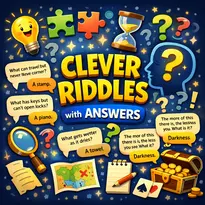
Welcome to a big, reader-friendly guide for anyone who loves a smart little challenge. Some people want quick laughs. Others want a riddle that makes the room go quiet for ten seconds. This collection does both. You will find clever riddles with answers for adults, kids, classrooms, parties, and slow afternoons when your brain wants a stretch. The sections stay organized, easy to scan, and fun to use right away. So whether you want one great opener or a full game-night stash, you are in the right place.
Quick Answer
Clever riddles with answers are short puzzles that use wordplay, logic, or misdirection. The best ones feel surprising, yet fair. A strong collection mixes quick wins, harder twists, and a few laugh-out-loud lines.
TL;DR
• Clever riddles work best when the answer feels obvious later.
• Short riddles are easiest to share in groups.
• Funny riddles keep the mood light and easy.
• Hard riddles use sharper misdirection and patience.
• Kid-friendly riddles need simple clues and familiar objects.
What Makes a Riddle Feel Clever
A clever riddle does more than hide an answer. It nudges your mind in one direction, then flips the path. Because of that, the reveal feels both surprising and earned.
The strongest riddles are usually short. However, they still leave enough detail to spark an image, a wrong guess, or a tiny mental trap.
• It hides truth behind plain words.
• It sounds simple at first glance.
• It rewards listening, not random guessing.
• It uses misdirection without cheating.
• It plants a false picture gently.
• It turns common objects into surprises.
• It often pivots on one word.
• It feels fair after the reveal.
• It invites discussion before the answer.
• It works well aloud in groups.
• It creates a quick mental pause.
• It sticks in memory after solving.
Short Clever Riddles With Answers
Short riddles are great when you want fast fun. They fit lunch breaks, text threads, and family drives. Also, they are easy to remember and repeat.
These quick picks prove a riddle does not need many words. It just needs the right twist.
• What has keys, no locks? A piano.
• What gets wetter while drying? A towel.
• What has hands, cannot clap? A clock.
• What can travel, yet stays cornered? A stamp.
• What has one eye, cannot see? A needle.
• What has a neck, no head? A bottle.
• What has teeth, never bites? A comb.
• What goes up, never down? Your age.
• What has words, never speaks? A book.
• What runs, never walks? Water.
• What breaks when spoken? Silence.
• What fills rooms, takes no space? Light.
Funny Clever Riddles With Answers
Funny riddles work because the answer lands with a smile. They still need a twist, though. Otherwise, they feel more like plain jokes.
A good funny riddle keeps the brain moving. Meanwhile, it keeps the room relaxed.
• What kind of band never plays? A rubber band.
• What has four wheels and flies? A garbage truck.
• Which room has no doors? A mushroom.
• What coat goes on wet? Paint.
• What tastes better than smells? Your tongue.
• Which tree fits your hand? A palm.
• What month has twenty-eight days? Every month.
• What building has the most stories? A library.
• What can you catch, not throw? A cold.
• What has a ring, no finger? A phone.
• Which animal jumps higher than houses? Any animal.
• What kind of key opens nothing? A turkey key.
Hard Clever Riddles With Answers
Hard riddles should challenge you, not annoy you. The best ones bend your thinking, then snap it back. So the answer feels sharp instead of random.
Take your time with these. In many cases, the trick sits inside one small detail.
• A man rode Friday, left Friday. Horse named Friday.
• Two in the corner, one in the room? Letter R.
• Forward I’m heavy, backward not. Ton.
• The poor have it, the rich need it? Nothing.
• The more you take, the larger it grows? A hole.
• Six sisters each have one brother. Seven children.
• Lives without body, hears without ears? An echo.
• Before Mount Everest, highest mountain? Everest.
• If you drop me, I crack. Fame.
• The more there is, the less seen? Darkness.
• You see me once in June. Letter E.
• What belongs to you, used more by others? Name.
Easy Clever Riddles With Answers
Easy riddles are perfect for warm-ups. They build confidence fast. As a result, they help younger solvers join the fun right away.
These are simple, clear, and satisfying. Even so, they still have a neat little twist.
• What has a face, no mouth? A clock.
• What has legs, cannot walk? A table.
• What has a tail, no body? A coin.
• What has a bed, never sleeps? A river.
• What has a mouth, never talks? A river.
• What has many keys, no locks? A keyboard.
• What has a head and tail? A coin.
• What has ears, cannot hear? Corn.
• What gets sharper with use? Your brain.
• What has branches, no leaves? A bank.
• What can you hold hands-free? Your breath.
• What is full of holes, holds water? Sponge.
Wordplay Riddles That Reward Careful Reading
Wordplay riddles are sneaky in a fun way. They lean on spelling, sounds, and double meaning. Because of that, careful readers often solve them faster.
This style feels especially clever. One tiny word can change everything.
• What starts with T, ends T? Teapot.
• What has an end, no beginning? A stick.
• What comes once in a minute? Letter M.
• What has cities, no houses? A map.
• What begins with P, ends E? Post office.
• What word is always wrong? Wrong.
• What word loses head, still the same? Empty.
• What has letters, never writes? Mailbox.
• What begins and ends with E? Envelope.
• What can you read, never hear? Closed captioning.
• What word shortens as added? Short.
• What has a bark, no bite? Tree.
Logic Riddles With Clean, Smart Answers
Logic riddles ask you to slow down. They often look bigger than they are. However, the answer usually rests on plain reasoning.
These work well for group play. Different guesses make the final reveal even better.
• Three ducks arrangement totals how many? Three ducks.
• Surviving crash victims buried where? Nowhere.
• Ten fish, two drown, left? Ten fish.
• How many birthdays does one person have? One.
• You pass second place, become? Second place.
• Seven-year sleep lasts how long? Seven years.
• A farmer has seventeen sheep left? Seventeen.
• Which weighs more, feathers or bricks? Same weight.
• One match, lamp, stove first? Match.
• Can February have twenty-nine days? Yes, leap years.
• Which is correct, yolk? Neither.
• How far into the woods can you walk? Halfway.
“What Am I?” Riddles With Answers
“What am I?” riddles are popular for a reason. They build a clear picture through clues. Then they ask you to name the thing.
This format is easy to use with kids. Still, adults enjoy the clever ones too.
• I have hands, never hold. Clock.
• I have pages, no voice. Book.
• I have teeth, love hair. Comb.
• I have a neck, no face. Bottle.
• I have keys, no rooms. Piano.
• I have wings, never fly. Stage.
• I have a spine, no bones. Book.
• I have a lid, no box. Trash can.
• I have a shell, no feet. Nut.
• I have a ring, never marry. Bell.
• I have a screen, no cinema. Phone.
• I have roots upward in winter. Icicle.
Math-Style Riddles Without Heavy Math
Math-style riddles sound serious, yet many use common sense first. Numbers matter, but so does reading carefully. That makes them great for mixed groups.
These are light and playful. So you can enjoy the twist without needing a calculator.
• If two’s company, three’s what? A crowd.
• How many months have twenty-eight days? Twelve.
• Roman numerals for half eleven? VI.
• Add five to nine, get two? Clock math.
• If one rooster lays eggs? Roosters lay none.
• Take away one, leave ten? Remove I from IX.
• Twice eleven equals what shape? Twenty-two.
• What goes up, not back? Age.
• Buy a dozen eggs, use all. Zero left.
• Two fathers and two sons fish? Three people.
• Divide thirty by half? Sixty.
• Which number has letters in order? Forty.
Clever Riddles for Adults
Adult riddles can carry a little more misdirection. They also work well at dinners, road trips, and office icebreakers. The key is keeping them smart, not muddy.
These have a slightly sharper edge. Still, they stay clean and easy to share.
• What can be stolen, never touched? Time.
• The more honest I am, the harder? My apologies.
• What question gets different answers daily? What time is it?
• What has no beginning, end, middle? Doughnut.
• What grows shorter while working? Candle.
• What can open but not close? An egg.
• What can be kept after giving? Your word.
• What can snap without hands? A promise.
• What is yours, but spoken by others? Name.
• What comes before success? Dictionary order.
• What room do ghosts avoid? Living room.
• What rises when rain falls? Umbrella.
Clever Riddles for Kids
Kids’ riddles work best when the picture is familiar. A child should be able to imagine the object quickly. Then the answer feels fun instead of frustrating.
These are bright, simple, and easy to say aloud. Because of that, they fit classrooms and family nights well.
• What has a thumb, not alive? Glove.
• What has wheels and wings? Garbage truck.
• What has stripes and says meow? Tiger.
• What is black, white, red? Newspaper.
• What has a horn, no honk? Rhino.
• What falls, never gets hurt? Snow.
• What has a shell, not a beach? Peanut.
• What can hop, yet stays still? Frog toy.
• What has a zipper, no mouth? Backpack.
• What rings, never answers? School bell.
• What has a cap, no head? Pen.
• What rides rails, needs no road? Train.
How to Use Clever Riddles at Home, School, or Parties
A great riddle becomes even better in the right setting. Short ones fit quick moments. Harder ones shine when people have time to guess together.
You do not need special tools. Instead, you just need the right match between mood and riddle style.
• Start with easy ones to build confidence.
• Save harder picks for later rounds.
• Read clues slowly, once or twice.
• Let kids guess before adults speak.
• Use short riddles during car rides.
• Add funny ones to party games.
• Put logic riddles on lunch notes.
• Try teams for larger gatherings.
• Pause before giving the answer.
• Reward creative wrong guesses too.
• Mix ages with simple object clues.
• Keep a favorite list on your phone.
FAQs
What is a clever riddle?
A clever riddle uses a fair trick, not random confusion. Usually, it plays with language, logic, or the picture in your head. That is why the answer feels satisfying once you hear it.
Are clever riddles good for kids?
Yes, as long as the clues match the child’s age. Short object-based riddles work especially well. Also, easy wins help kids stay excited.
What makes a riddle hard?
Hard riddles often use stronger misdirection or more than one possible guess. However, a good hard riddle still feels fair after the answer. If it feels random, it is usually not well built.
What is the difference between a riddle and a brain teaser?
A riddle often hides its answer in wording or imagery. A brain teaser may lean more on patterns, logic, or problem-solving steps. Still, the two often overlap.
How do I remember riddles better?
Start with short ones that use everyday objects. Then repeat them aloud a few times. Because the answer links to a strong image, memory gets easier.
When should I use funny riddles instead of hard ones?
Funny riddles work best when you want energy and quick smiles. Hard riddles fit quieter moments or competitive groups. So the better choice depends on the room.
Conclusion
Clever riddles with answers do more than fill time. They wake up a room, spark a laugh, and give your brain a playful push. Some are quick and silly. Others make you stare at the ceiling for a minute.
The best part is their range. You can use them with kids, adults, classmates, coworkers, or friends on a long drive. Keep a few favorites nearby, and you will always have a smart way to start a conversation.

Christopher McLagan is a celebrated riddle maker known for crafting clever brain teasers and mind-bending puzzles. His work blends classic riddles, logic challenges, and lateral thinking brain teasers designed to spark curiosity and critical thinking. Widely admired in online puzzle communities, McLagan creates engaging riddle questions and answers for both kids and adults. His signature style delivers surprising twists, clean humor, and satisfying “aha” moments that keep readers coming back for more.