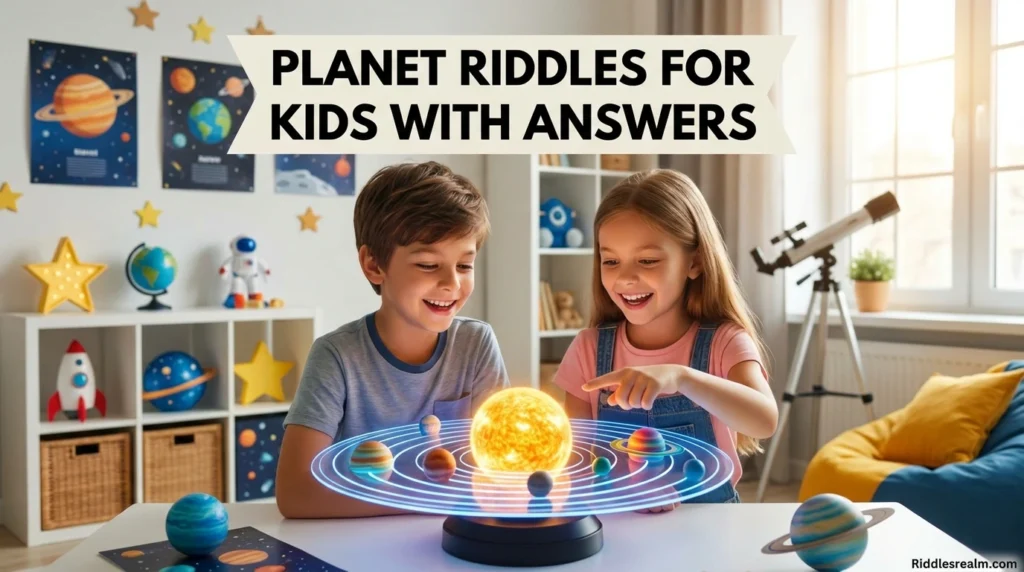
Space is full of mystery, adventure, and endless opportunities for learning. That’s why Planet Riddles for Kids with Answers are a fantastic way to combine education and entertainment. Whether you’re a parent, teacher, homeschooler, or simply a young space enthusiast, these fun riddles can make learning about the solar system exciting and memorable.
Moreover, riddles help children develop critical thinking, problem-solving skills, and creativity. Instead of simply memorizing facts about planets, kids actively engage their minds to uncover answers. As a result, they learn faster while having fun.
In this collection, you’ll discover easy riddles, funny riddles, challenging brain teasers, educational puzzle questions, and clever guessing games all focused on planets and space. Additionally, you’ll find tips for using riddles in classrooms, family game nights, and educational activities.
So, buckle up and prepare for an exciting journey through our solar system!
Why Planet Riddles Are Great for Kids
Planet riddles are more than just entertainment. They offer valuable educational benefits while keeping children engaged.
Benefits of Planet Riddles
- Improve critical thinking skills
- Encourage problem-solving abilities
- Boost memory retention
- Make science learning fun
- Introduce astronomy concepts
- Strengthen reading comprehension
- Support STEM education
- Enhance creativity and imagination
Furthermore, these educational riddles help children become curious about the universe around them.
Quick Facts About the Planets
Before diving into the riddles, let’s review some basic planet facts.
PlanetInteresting FactMercuryClosest planet to the SunVenusHottest planet in the solar systemEarthOur home planetMarsKnown as the Red PlanetJupiterLargest planetSaturnFamous for its ringsUranusRotates on its sideNeptuneFarthest major planet from the Sun
Knowing these facts will make solving the riddles even easier.
Easy Planet Riddles for Kids with Answers
These beginner-friendly puzzle questions are perfect for younger children.
1. The Red Planet
Riddle: I am red and dusty too. Rovers explore me. Who am I?
Answer: Mars
2. Our Home
Riddle: People, animals, and plants live on me every day. What planet am I?
Answer: Earth
3. Ring Leader
Riddle: My beautiful rings make me easy to spot. Which planet am I?
Answer: Saturn
4. Giant of the Solar System
Riddle: I am bigger than every other planet. What am I?
Answer: Jupiter
5. Closest to the Sun
Riddle: I race around the Sun faster than all the others. Who am I?
Answer: Mercury
6. Hottest Planet
Riddle: Even though I’m not the closest to the Sun, I’m the hottest. Who am I?
Answer: Venus
7. Blue and Beautiful
Riddle: Most of my surface is covered with water. What planet am I?
Answer: Earth
8. Sideways Spinner
Riddle: I spin on my side like a rolling ball. Which planet am I?
Answer: Uranus
9. Deep Blue World
Riddle: Strong winds blow across me far from the Sun. What planet am I?
Answer: Neptune
10. Solar System Neighbor
Riddle: I am the third planet from the Sun. Which planet am I?
Answer: Earth
Funny Planet Riddles for Kids
Kids love humor, and these funny riddles add laughter to learning.
11. Space School
Riddle: Why did Saturn get good grades?
Answer: Because it always stayed within its rings of knowledge!
12. Planet Music
Riddle: Which planet loves singing the most?
Answer: Neptune because it’s always making waves!
13. Planet Athlete
Riddle: Which planet wins every race?
Answer: Mercury because it’s the fastest around the Sun!
14. Ring Fashion
Riddle: Which planet spends the most money on jewelry?
Answer: Saturn
15. Planet Chef
Riddle: Which planet makes the hottest soup?
Answer: Venus
16. Space Joke
Riddle: Why didn’t Jupiter fit through the door?
Answer: Because it was too giant!
17. Cosmic Friend
Riddle: Which planet is always ready for a hug?
Answer: Earth because it supports everyone!
18. Planet Dance
Riddle: Which planet has the strangest dance moves?
Answer: Uranus because it spins sideways!
19. Windy World
Riddle: Which planet blows out birthday candles the fastest?
Answer: Neptune
20. Planet Party
Riddle: Which planet throws the biggest parties?
Answer: Jupiter because it has the most space!
Educational Planet Brain Teasers
These brain teasers encourage deeper thinking and learning.
21. Morning Star
Riddle: People often call me the Morning Star, but I am actually a planet. What am I?
Answer: Venus
22. Giant Storm
Riddle: I have a giant storm bigger than Earth. Which planet am I?
Answer: Jupiter
23. Rover Destination
Riddle: Scientists send rovers to study my surface. Who am I?
Answer: Mars
24. Ring Collection
Riddle: I have thousands of ring pieces made of ice and rock. What planet am I?
Answer: Saturn
25. Tiny Traveler
Riddle: I am the smallest planet in the solar system. Which planet am I?
Answer: Mercury
26. Wind Champion
Riddle: My winds can travel faster than a jet airplane. What planet am I?
Answer: Neptune
27. Tilted Planet
Riddle: I lean so much that I almost roll around the Sun. Who am I?
Answer: Uranus
28. Life Planet
Riddle: As far as we know, I am the only planet with life. Which planet am I?
Answer: Earth
29. Thick Atmosphere
Riddle: My atmosphere traps heat better than any other planet. What am I?
Answer: Venus
30. Gas Giant
Riddle: I am mostly made of gas and am the largest planet. Who am I?
Answer: Jupiter
Challenging Planet Riddles for Older Kids
These challenging riddles require a little more thought.
31. Planet Order Puzzle
Riddle: I am between Saturn and Neptune. Which planet am I?
Answer: Uranus
32. Neighbor Puzzle
Riddle: Earth sits between Venus and me. What planet am I?
Answer: Mars
33. Heat Mystery
Riddle: I am hotter than Mercury even though Mercury is closer to the Sun. Who am I?
Answer: Venus
34. Great Red Spot
Riddle: My famous storm has lasted for centuries. What planet am I?
Answer: Jupiter
35. Frozen Rings
Riddle: My rings are made mostly of ice and rock. Which planet am I?
Answer: Saturn
36. Planet Tilt
Riddle: I have the most unusual rotation in the solar system. Who am I?
Answer: Uranus
37. Distant Blue Giant
Riddle: I am the farthest major planet from the Sun. Which planet am I?
Answer: Neptune
38. Quick Orbit
Riddle: My year is only 88 Earth days long. What planet am I?
Answer: Mercury
39. Dust Storm Planet
Riddle: Massive dust storms often cover my surface. Which planet am I?
Answer: Mars
40. Water World
Riddle: I am called the Blue Planet. Who am I?
Answer: Earth
Planet Guessing Games
Guessing games help kids think creatively while learning space facts.
41. Planet Mystery
Riddle: I am known for my rings, but I am not the largest planet. Who am I?
Answer: Saturn
42. Red Clue
Riddle: My nickname comes from the rusty color of my soil. What planet am I?
Answer: Mars
43. Blue Giant
Riddle: I am an icy giant with powerful winds. Which planet am I?
Answer: Neptune
44. Fast Planet
Riddle: I travel around the Sun faster than anyone else. Who am I?
Answer: Mercury
45. Hottest Neighbor
Riddle: Thick clouds keep me extremely hot. Which planet am I?
Answer: Venus
Planet Logic Puzzles
These logic puzzles challenge children to connect clues and think critically.
46. Three Clues
Riddle: I am red. Robots visit me. Scientists hope humans will visit me too.
Answer: Mars
47. Four Clues
Riddle: I am giant. I have a red storm. I am made mostly of gas.
Answer: Jupiter
48. Ring Puzzle
Riddle: I wear rings, but I’m not a king. What am I?
Answer: Saturn
49. Sideways Planet
Riddle: I rotate differently from most planets. Which planet am I?
Answer: Uranus
50. Ocean Planet
Riddle: Life exists on me and water covers much of my surface.
Answer: Earth
Planet Riddles for Classroom Activities
Teachers can use these riddles in many creative ways.
Space-Themed Learning Games
- Morning brain teaser challenges
- Science class warm-ups
- Astronomy units
- STEM activities
- Quiz competitions
- Team-building exercises
Group Riddle Challenge
Divide students into teams. Then, read a riddle aloud and award points for correct answers. Consequently, learning becomes interactive and exciting.
Planet Treasure Hunt
Hide planet clues around the classroom. Students solve riddles to find the next clue. As a result, they stay active while learning.
How Planet Riddles Improve Critical Thinking
Planet riddles are powerful educational tools because they require children to analyze clues rather than memorize information.
Skills Developed Through Riddles
Observation
Kids learn to notice important details.
Reasoning
Children connect clues logically.
Memory
Students recall facts about planets.
Creativity
They imagine possibilities before choosing answers.
Problem-Solving
Kids practice finding solutions independently.
Therefore, regular exposure to riddles can strengthen academic performance across multiple subjects.
Best Ways to Use Planet Riddles at Home
Parents can easily turn these family-friendly riddles into educational entertainment activities.
During Family Game Night
Ask planet riddles between board game rounds.
Before Bedtime
Share a few space riddles each evening.
On Road Trips
Use riddles to keep kids entertained.
During Homeschool Lessons
Introduce astronomy concepts through guessing games.
At Birthday Parties
Create a space-themed riddle contest.
Consequently, children stay engaged while learning valuable science facts.
Key Takeaways
- Planet riddles combine learning and fun.
- They improve critical thinking and problem-solving skills.
- Kids learn astronomy concepts naturally.
- Brain teasers encourage curiosity about space.
- Educational riddles support STEM learning.
- Family-friendly puzzle questions work for classrooms and homes.
- Space-themed guessing games make science memorable.
- Challenging riddles help older kids expand their knowledge.
Frequently Asked Questions
What are planet riddles for kids?
Planet riddles are fun puzzle questions that use clues about planets in the solar system. Children solve them by identifying the correct planet.
Why are planet riddles educational?
They teach astronomy facts while improving memory, reasoning, critical thinking, and problem-solving skills.
What age group enjoys planet riddles?
Most children between ages 5 and 14 enjoy planet riddles. However, many adults find them entertaining too.
Can teachers use planet riddles in science lessons?
Yes. Teachers often use riddles as classroom warm-ups, review activities, STEM exercises, and educational games.
Are planet riddles good for homeschooling?
Absolutely. They make astronomy lessons interactive and help children retain information more effectively.
How do riddles improve critical thinking?
Riddles require children to analyze clues, eliminate wrong answers, and apply logical reasoning before solving the puzzle.
Can planet riddles be used at parties?
Yes. Space-themed birthday parties often include riddle contests, treasure hunts, and guessing games.
What makes a good planet riddle?
A good planet riddle includes clear clues, encourages thinking, and teaches interesting facts while remaining fun and age-appropriate.
Are planet riddles useful for STEM education?
Yes. They support science learning, curiosity, observation, reasoning, and problem-solving—all essential STEM skills.
How many planets are in our solar system?
There are eight recognized planets: Mercury, Venus, Earth, Mars, Jupiter, Saturn, Uranus, and Neptune.
Conclusion
Planet riddles offer an exciting way to explore the wonders of the solar system while developing valuable thinking skills. Whether you’re solving easy puzzle questions, tackling challenging brain teasers, or enjoying funny space jokes, these riddles transform learning into an adventure.
Moreover, they help children build critical thinking, creativity, memory, and problem-solving abilities in a fun and engaging format. Parents, teachers, and homeschool educators can use these educational riddles to spark curiosity about astronomy and inspire a lifelong love of science.

A playful wordsmith with a knack for misdirection, I craft riddles that tease the brain. My puzzles blend clever clues, clean logic, and a dash of humor—built to challenge beginners and stump seasoned solvers alike. From short, punchy brainteasers to layered mysteries with hidden meanings, I love turning everyday ideas into mind-bending questions that invite curiosity and conversation. When I’m not twisting words into puzzles, I’m collecting strange facts, testing new clue styles, and fine-tuning the art of fair—but fiendish—fun.